
Single-use plastic bottles usually have a very short lifespan. Once the beverage they contain has been consumed, they quickly become waste that must be collected and managed appropriately. An Australian school decided to demonstrate that, before reaching that point, some packaging can still have a second use.
Students, teachers and families from Richardson Primary School, located in Canberra, gathered more than 2,000 bottles to build a peculiar greenhouse named “Plastic Palace”. Although the project was inaugurated in 2015, its proposal continues to be an interesting example of reuse and environmental education.
From waste to greenhouse: this is how they reused more than 2,000 bottles
The idea came from teacher Kate Davis when her students were still in their third year. During the following years, the educational community stored bottles until they gathered those necessary to build the structure.
According to information originally published by ABC Australiainitially estimated that about 2,000 units would be necessary. The design, however, ended up growing to allow a full class to fit in, so they eventually used more than that amount.
The procedure to build this type of greenhouse is quite simple. The bottles are cleaned, the bottoms are removed and then they are placed inside each other to create long columns. These rows are later fixed on a framework, forming the walls.
Organizations such as Scouts UK include this type of construction among their environmental activities and explain a method based precisely on clean bottles, poles or reeds and a wooden structure.
In the case of the Australian school, the project was also completed thanks to a grant of 2,000 Australian dollars from the Teachers Mutual Bank Environment Fund to purchase additional materials.
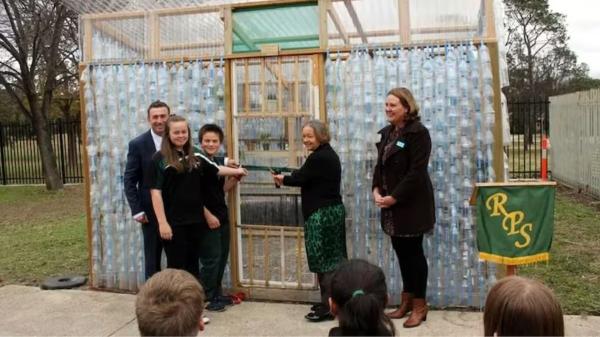
The greenhouse became a classroom to grow and experiment throughout the year
The objective went far beyond finding an original outlet for thousands of containers. The “Plastic Palace” was conceived as a space where students could germinate seeds and obtain seedlings that would later be used in the school garden.
The transparent bottles allow light to pass through and the walls offer some protection from the outside. This allows creating a favorable environment for different crops and expanding the possibilities of the school garden during different times of the year, although it should not be confused with the thermal performance of a professional greenhouse.
In fact, later experiences show that the idea can work in practice. Greenside Up documented another greenhouse built with around 2,000 bottles in which, after several seasons, tomatoes, cucumbers and different seedlings had been grown. Those responsible also designed the construction to be able to replace bottles damaged by sun exposure.
The Australian project also had an educational purpose. The students participated in caring for the garden, planting and growing food, and using the greenhouse to conduct scientific experiments. In this way they could practically follow the process that a plant takes from germination to becoming food.
The school’s director, Jason Borton, highlighted precisely the involvement of the students as one of the main achievements of the initiative. It was not just about observing a finished structure, but about participating in its planning, construction and subsequent use.
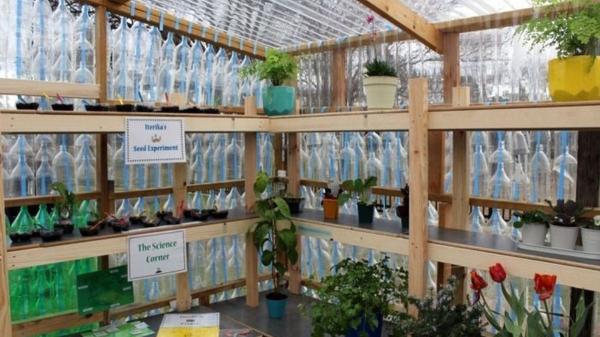
Reuse before recycling: the environmental lesson of the project
The environmental interest of the project is mainly in reuse. The bottles were not industrially transformed to produce a new material: they retained much of their shape and began to perform a completely different function.
The difference is important. European regulations establish a hierarchy to manage waste. The European Union’s Waste Framework Directive places prevention first and, subsequently, preparation for reuse, recycling, other forms of recovery and, finally, disposal.
Spain maintains this same principle in Law 7/2022 on waste and contaminated soils for a circular economy, which also establishes prevention, preparation for reuse and then recycling as priorities. The regulations can be consulted on the legal platform of the United Nations Environment Programme.
This does not mean that building greenhouses with bottles is a global solution to the problem of plastic waste. The environmental priority continues to be reducing the generation of waste and the unnecessary consumption of single-use products.
Furthermore, bottles installed outdoors end up degrading due to, among other factors, continued exposure to solar radiation and must be managed correctly when they are no longer useful.
The value of the “Plastic Palace” lies, therefore, both in the reused bottles and in their educational capacity: turning everyday waste into a visible tool to explain what it means to extend the life of materials.
Other projects have turned thousands of bottles into greenhouses
The Australian experience is not an isolated case either. In Vietnam there is a particularly striking project that demonstrates the architectural possibilities of these containers.
The Vegetable Nursery House, developed in 2013 in the Soc Son district, was built with bamboo and around 2,000 plastic bottles contributed by students and neighbors. According to ArchDailythe small structure occupies about six square meters and reaches 3.6 meters in height.
In this design, the bottle walls help regulate the entry of light and the interior conditions for the vegetables, while a system installed on the roof allows the water to be used for irrigation. The structure was also designed to be light enough to be moved according to agricultural needs.
Other educational centers have followed similar paths. In Wales, for example, students at Colcot Primary School collected more than 600 two-litre bottles to build another greenhouse for learning and growing tomatoes, cucumbers and peppers. The project was documented by Bouygues UK.
The lesson from these experiences is not to consume more bottles to obtain construction material, but exactly the opposite: to demonstrate that what already exists can be used before being thrown away.
The more than 2,000 bottles gathered in Canberra thus ended up becoming something more than the walls of a greenhouse. They also helped students understand, in a tangible way, that reducing, reusing and recycling are not abstract concepts, but decisions that can be applied to everyday objects.
If you want to read more articles similar to An Australian school collected more than 2,000 plastic bottles and turned them into a greenhouse to grow crops throughout the year, we recommend that you enter our Recycling and waste management category.
