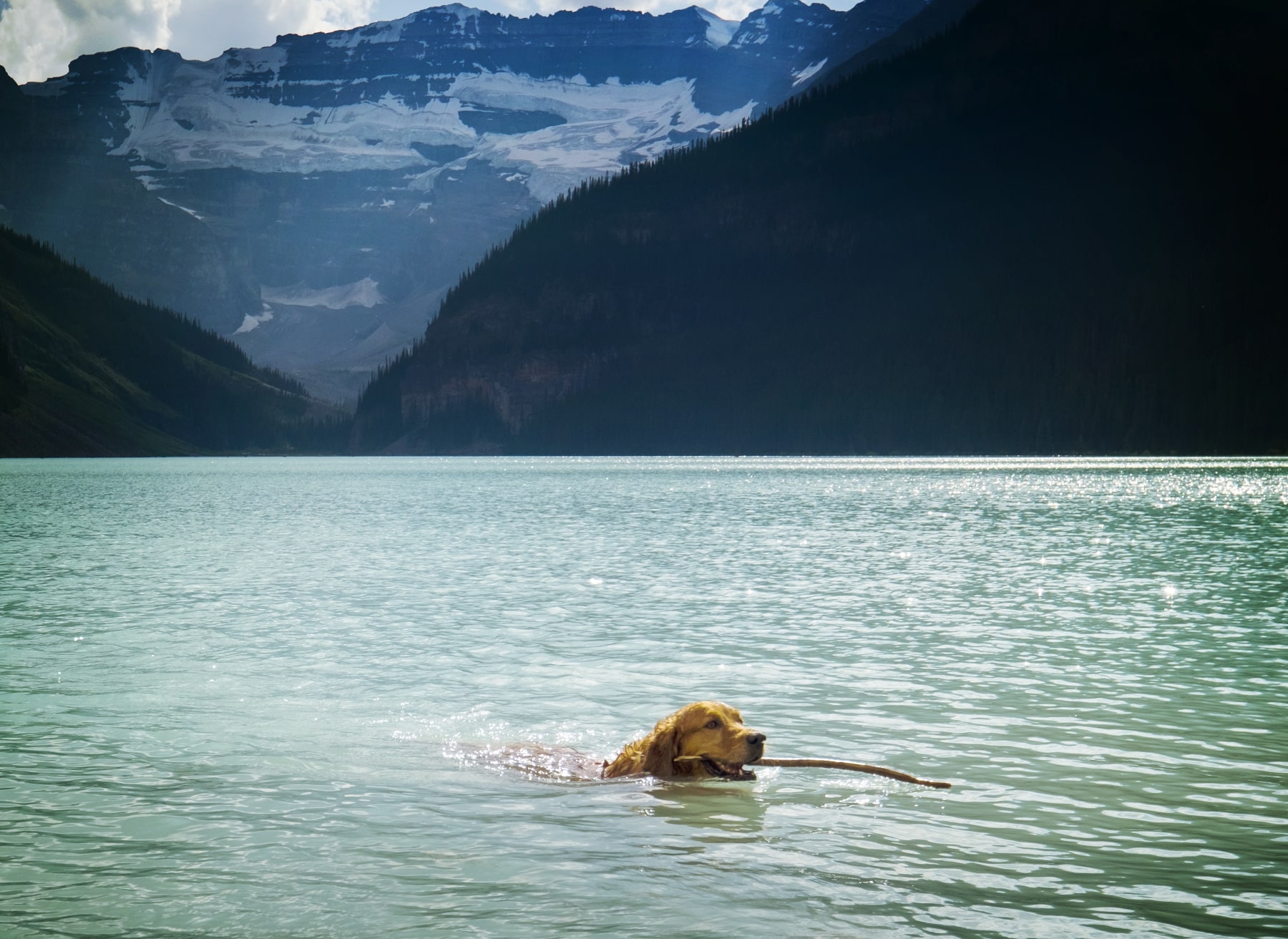
For this year it seems that it’s over, and we can finally put the hottest summer ever in the attic. But the constant increase in global temperatures will increasingly lead us to face problems that we have so far calmly ignored. For example: are you in the habit of letting your dog take a dip in rivers, lakes and canals, to cool him off on a too hot day?
A study published in Current Opinion in Food Science proposes an excellent reason not to do it, or at least do it wisely: the possibility that, especially in the heat, these apparently clean waters are “infested” with potentially toxic algae.
Algae and global warming
It should be said right away that the study is not focused on dogs but rather on algae, and their link to global warming. And it must also be said that we are not talking about real algae but about the so-called blue algae, cyanobacteria, organisms capable of reproducing at very high speeds.
These explosions are called blooms, and are facilitated by high temperatures: cyanobacteria love the heat, and warmer water also favors the phenomenon of eutrophication, that is, an uncontrolled increase in nutrients that become fuel for blooms.
The result is that many fresh waters (rivers, lakes, irrigation canals…) risk experiencing an increase in blooms in the coming years. Which are not a problem in themselves, but become one when cyanobacteria produce potentially lethal neurotoxins: an example is dihydroanatoxin, which is often found in algal mats and whose ingestion can even lead to death. And here we come to the problem of dogs: their way of “experiencing” water is different from ours, leading them to ingest large quantities of it when they swim and filling their fur with organic material.
When in doubt…
This in turn means that it is much easier for a dog to swallow neurotoxic material, as already demonstrated by studies conducted by the same team in 2020 and 2023. It’s not just bath time: dogs spend a lot of time licking and cleaning themselves after a dip, with easily imaginable consequences. Does this mean you should never let your dog swim in the creek behind your house again? Not really: the advice is to be careful.
There are indicators of water quality that cannot be missed: if algae or other organic material is floating in it, and if the smell is not the best, it is better to keep the dog (and ourselves) away.
However, it would be better to keep under control what the institutions write, which should keep the data on the quality of the local waters updated. The best advice, however, is also the simplest, and we report it as it is expressed in the study: “When in doubt, it is better not to enter the water”.
