
Researchers managed to isolate the signal coming from the exoplanet Beta Pictoris b: however, it was not an extraterrestrial civilization that generated the impulses, but its spectacular auroras and a record magnetic field.
There is still no evidence of life beyond Earth, but astronomers continue to scan the sky for signs that we are not alone in the Universe. And now a group from the Center for Astrophysics Harvard & Smithsonian and the University of Oregon has achieved a historic record: the first direct detection of radio waves coming from an exoplanet, that is, a planet outside the Solar System.
Until now, every radio signal detected in extrasolar planetary systems could not be attributed with certainty to the planet itself, but only, more generally, to the star around which it orbits. This time, however, the researchers managed to isolate the exact origin of the emission.
Non-alien Auroras
No aliens looking for contact, it must be said immediately: the signal arises from the planet’s auroras, produced by the interaction between charged particles, atmosphere and magnetic field, a phenomenon that releases energy in the form of radio waves. The Earth also has its auroras, northern and southern, generated by the same type of mechanism.
“Although auroral radio bursts have already been observed in Solar System planets and in some ultracool dwarfs, so far no radio detection has been unambiguously attributed to an exoplanet rather than its host star,” the researchers write in their paper published on arXiv.
Beta Pictoris b, the gas giant under observation
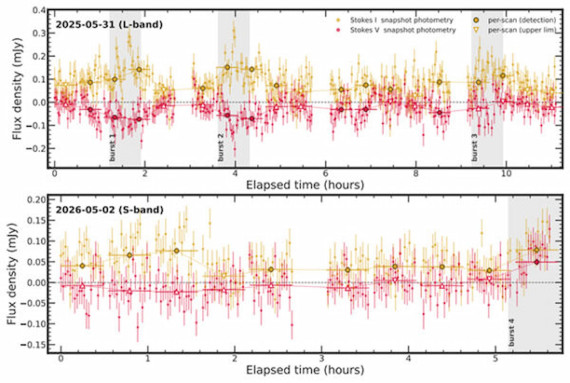
The frequencies were monitored with the MeerKAT radio telescope in South Africa in four observation sessions conducted between 2025 and 2026. Target of the observations: the star Beta Pictoris, about 63.4 light years away from Earth, around which three known planets orbit — Beta Pictoris b, c and d.
From the observations, short repeated radio pulses emerged, characterized by a strong circular polarization: a typical signature of auroral emissions. Using quasars, extremely bright galactic nuclei, as references in the celestial map, scientists were able to establish with a high degree of certainty that it was the planet and not the star that emitted the signal. A detail that is not obvious, because Beta Pictoris is a young star – hotter, larger and structurally different from our Sun – and “no known physical mechanism for radio emission in stars of this type can explain what is observed”, specify the authors of the study.
A clue to the planet’s magnetic field
The characteristics of the signal point to a phenomenon called “electron cyclotron maser instability” (ECMI), the same mechanism that generates auroras on Earth and Jupiter.
And ECMIs are not just the signature of an aurora: they also provide valuable information about the magnetic field intensity of the planet that produces them.
According to the team’s calculations, Beta Pictoris b has a particularly intense magnetic field — thousands of times stronger than Earth’s — a fact consistent with theoretical models previously developed on the planet’s “dynamo”, i.e. the internal processes that generate planetary magnetism.
“This represents the first direct measurement of an exoplanet’s magnetic field strength, and is consistent with dynamo-based predictions for a young massive giant planet,” the researchers write. The auroral emission would be fueled by the extremely rapid rotation of the planet, which completes a complete rotation on itself in just 8-9 hours.

A record-breaking giant
Beta Pictoris b was discovered in 2008 and has a mass equal to about 10 times that of Jupiter, so much so that it is close in size to brown dwarfs, celestial objects halfway between a very massive planet and a failed star. Precisely for this reason such a powerful magnetic field does not surprise scientists: similar phenomena have already been observed on brown dwarfs. Now the planet also holds the distinction of being the first exoplanet from which an unambiguous radio signal has ever been detected.
Not all experts, it must be said, consider the question definitively closed: according to some astronomers who commented on the study, the most convincing proof will come when the signal is observed pulsating with the same periodicity as the planet’s rotation, given that the aurora should enter and exit the field of view as the planet rotates.
Next goals
Strengthened by this result, the researchers have already set their sights on seven other known giant exoplanets, distributed in five nearby star systems, which could soon be analyzed with the same method used for Beta Pictoris b.
“An improvement in the sensitivity of the instruments of about 5-7 times, expected for new generation radio observatories, will make them detectable,” conclude the authors of the study.
