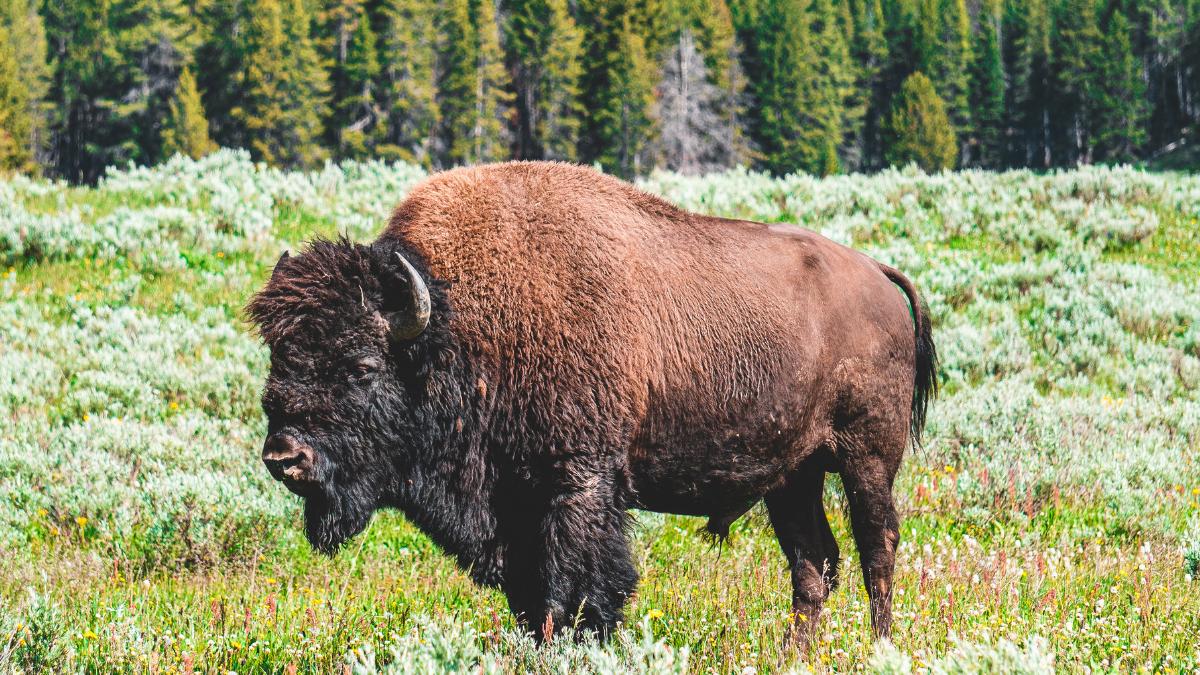
For decades, scientists have studied what happens when large herbivores reoccupy the ecosystems in which they evolved. On a Kansas prairie, an experiment started in 1987 has left a particularly striking result: the reintroduction of bison was accompanied by a significant increase in the diversity of native plants.
It all started when 30 bison were taken to the Konza Prairie, a large tall grass prairie located in the Flint Hills of eastern Kansas. Almost three decades later, the areas subjected to their grazing had 103% more native plant species at the local scale and 86% more at the basin scale than the areas where there were no herbivores.
The finding shows to what extent the presence of a large herbivore can modify an ecosystem and generate effects that go far beyond the animal itself.
A prairie where bison once again became part of the ecosystem
The Konza Prairie Biological Station is a protected area of native tall grass prairie and one of the reference sites for studying the functioning of these ecosystems. Its long-term research program has been analyzing for decades how factors such as fire, grazing and climate interact.
In 1987, bison were reintroduced to a part of the prairie to study precisely what consequences their presence had. The objective was not only to observe the animals, but also to recover one of the ecological processes that had historically characterized these grasslands.
American bison had been large herbivores of the North American grasslands for thousands of years. The disappearance of a good part of these ecosystems modified the relationships between animals, vegetation and the landscape.
In Konza, researchers were able to compare areas grazed by bison for years with areas without grazing and with areas where domestic livestock grazed. The long-term design made it possible to observe changes that could hardly be detected in an experiment lasting a few years.
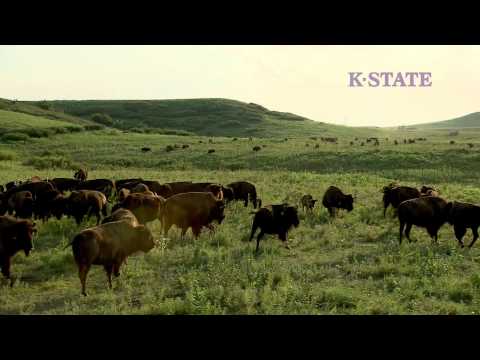
Bison grazing changed plant diversity
The most striking result appeared after almost three decades of monitoring.
Compared to ungrazed areas, the richness of native plant species increased by 103% in small-scale plots of about 10 square meters. When the researchers analyzed larger surfaces, corresponding to the basins studied, the increase reached 86%.
The explanation has to do with the way in which grazing modifies competition between plants.
Bison consume large amounts of vegetation and reduce the dominance of some of the most abundant grass species. By decreasing that dominance, other plants find opportunities to grow and establish themselves.
In this way, grazing does not simply cause a reduction in vegetation. Under certain conditions, it can generate a mosaic of areas with different consumption intensity that favors the coexistence of more species.
The researchers precisely observed a lower joint coverage of the four dominant grass species in the areas grazed by bison and an increase in the presence of broad-leaved herbaceous plants.
Bison had a greater effect than cattle
One of the most interesting aspects of the study was that the researchers did not only compare areas with and without herbivores. They also analyzed what happened when grazing was done by domestic livestock.
Livestock also increased the richness of native plant species compared to ungrazed areas, but the effect was considerably smaller.
At the plot scale, the increase associated with cattle was 41%, compared to 103% seen with bison. At the basin scale, the increase was 30%, compared to the 86% recorded in areas grazed by bison.
This suggests that it is not enough for a herbivore to exist to exactly reproduce the functioning of an ecosystem. The type of animal, its behavior and the way it uses the landscape can also influence the result.
In this case, the presence of bison was associated with a more profound transformation of the plant community than that observed with domestic livestock.
Plant diversity withstood even extreme drought
The result becomes even more interesting when the response of the ecosystem to extreme climate events is taken into account.
During the study period, one of the most severe droughts recorded in four decades occurred in the region. Despite the adverse conditions, the benefits associated with the presence of the bison did not disappear: plant diversity showed the ability to recover after the episode.
For researchers, this resistance is one of the keys to the discovery. The reintroduction of large native herbivores was not only related to greater plant richness, but also to a plant community capable of maintaining this gain in diversity in the face of an extreme climate episode.
This is especially relevant in a context where droughts and other extreme climate events can become an increasing pressure on grassland ecosystems.
An example of the role of large herbivores in nature
The case of Konza Prairie helps to understand why the conservation of an ecosystem is not only about protecting plants or animals in isolation.
Bison are part of an ecological network in which the behavior of a large herbivore can modify the vegetation and, with it, the opportunities available to other species.
The study concludes that some grasslands retain the potential to recover plant diversity when the large native herbivores that were historically part of them are once again present. The results also suggest that these effects may be more intense than those produced by domestic herbivores.
In Konza Prairie, what began in 1987 with the arrival of 30 bison ended up providing almost three decades of data on a fundamental relationship: the return of a large herbivore can change the vegetation and promote a more diverse and resilient grassland.
If you want to read more articles similar to In 1987, 30 bison were taken to a Kansas prairie: 29 years later, the richness of native plants had increased by 103%, we recommend that you enter our Ecosystems category.
