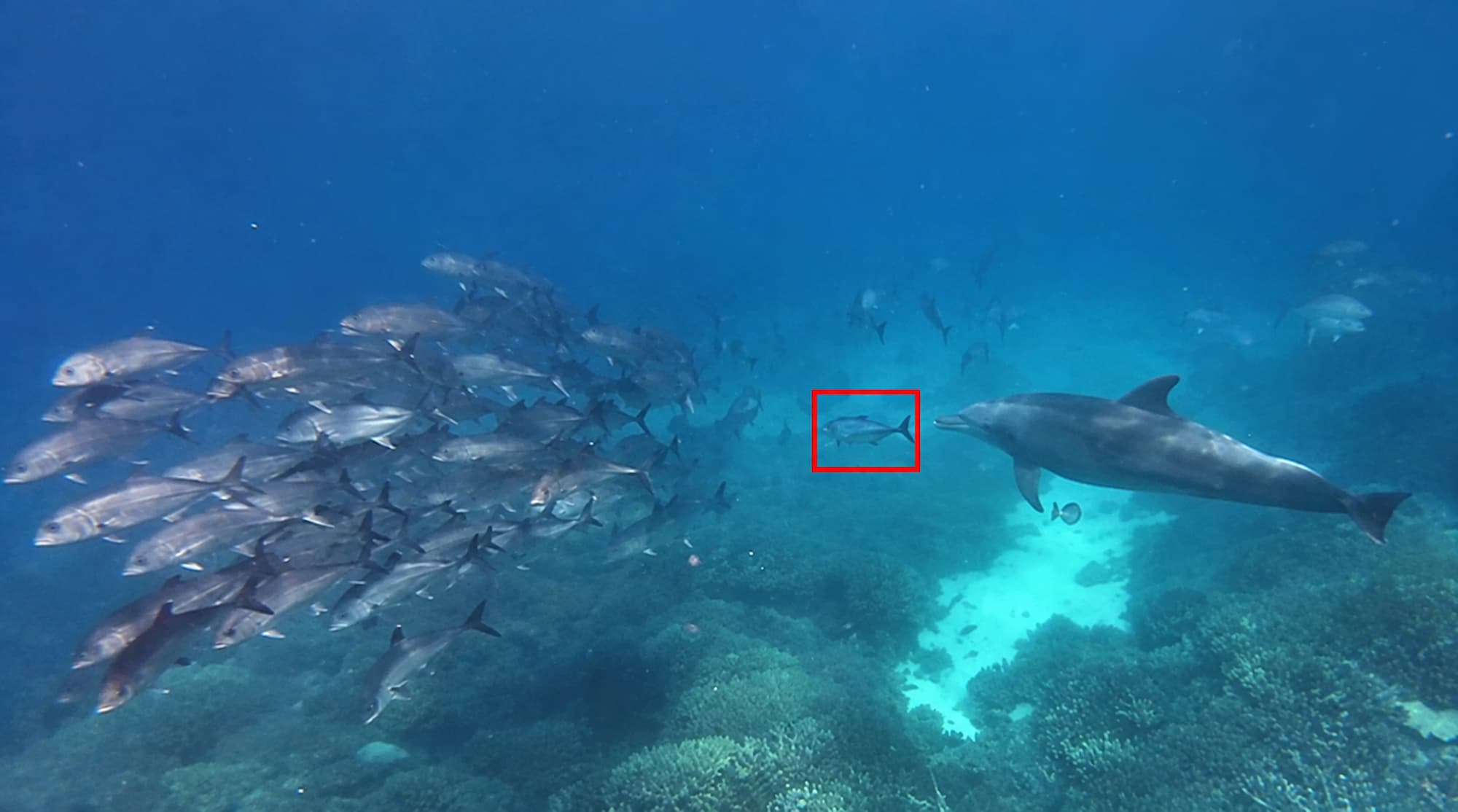
Bubbles is a bottlenose dolphin who lives free off the coast of Lady Elliot Island, an island located in the Australian Great Barrier Reef. There’s a reason he’s well-known to scientists and has even earned a nickname: he’s an incredible opportunist, inventing a method of obtaining food that’s as disgusting as it is effective.
It has been doing so for at least six years, as reported by a study published in Ecology and Evolutionand always against the fish themselves, who are “tortured” to the point of… vomiting what they have just eaten.
Underwater bullying
Observations of Bubbles’ behavior began in 2021, and since then the bottlenose dolphin has been seen doing so several times, and has been filmed on 11 different occasions, including the one in the video above. The method is very simple: Bubbles always targets a school of trevally of the species Caranx sexfasciatusa large fish that feeds on other fish, crustaceans and various cephalopods.
The bottlenose dolphin seems to have learned to select the specimen it has just eaten, and which has filled its stomach most of all. Once located, Bubbles begins to “torture” him, chasing him, prodding him and perhaps even making high-intensity vocalizations to stress him further. After a while the fish can’t take it anymore and vomits what it has just swallowed: at that point, the bottlenose dolphin can consume its meal (already partially chewed) in complete tranquility, and without the need to waste energy hunting.
Little effort, excellent results
Technically, Bubbles’ behavior is called kleptoparasitism: an animal that steals food already captured from another animal, even of another species. This is not uncommon behavior on land, but it is in water, and particularly among marine mammals. According to the authors of the study, there could be a link between the tendency of this specific bottlenose dolphin to hunt alone and the invention of this tactic: without the support of companions, letting a fish do the bulk of the work, and then taking advantage of it, is the best way to save energy.
According to the researchers who documented Bubbles’s antics, it’s possible that he’s not the only bottlenose dolphin engaging in kleptoparasitism: “We suspect that (tactics of this type) are under-reported,” and that there are many more marine mammals stealing other people’s food than reported in the studies.
The problem is that it is not easy to catch them red-handed: the use of new technologies could, in the coming years, reveal many more thieves than we suspected.
