
The time window in which the Earth stopped being a meteorite hell has been identified, creating the first stable zones for the chemistry of life.
Imagine the newly born Earth: 4.5 billion years ago it was a scorching world, still shocked by the chaos that had accompanied the formation of the Solar System. Scientists call this phase Hadean, after Hades, the Greek god of the underworld, and the name is apt.
Asteroids, comets and fragments left over from the birth of planets (planetesimals) continually rained down on the planet. Each impact heated the Earth’s crust. Larger ones could melt rocks and evaporate oceans: according to the study, bodies much larger than the asteroid that marked the end of the dinosaurs continued to hit Earth until about 4.4 billion years ago. In such an environment no delicate molecule could survive for long. The question is: when did this hell end, long enough for the chemistry of life to begin?

The “RNA world”
To answer, researchers from the Institute of Planetary Sciences in Tucson (Ariz.), led by Oleg Abramov and with Stephen Mojzsis among the authors, focused on the so-called RNA world. The study is out Nature Communications.
What is it about? In today’s cells, DNA stores the genetic instructions, proteins do the practical work, and RNA acts as the middleman. But this system poses a “chicken and egg” problem: to build proteins you need genetic instructions and to copy the instructions you need proteins. RNA, however, can do both: it stores information And can accelerate chemical reactions. Hence the hypothesis, put forward at the beginning of the 1960s, that before DNA there was a phase in which RNA molecules capable of self-replicating constituted the basis of early biology. There’s one obstacle: RNA is fragile. To form, remain intact and interact with other molecules it needs time and temperatures that do not rise too much. The team used a threshold of around 110°C: above that value, key molecules degrade.
How to reconstruct a past of 4 billion years
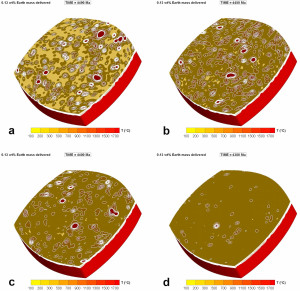
No rock from that era has preserved a complete “diary,” so Abramov and colleagues built a three-dimensional computer model that simulates how impacts heated the crust between 4.5 and 3.5 billion years ago. The model is not invented: it is constrained by two real elements.
The first is the craters of the Moon. The Moon has no erosion or tectonic plates, so it retains the scars of the bombardment suffered by the Earth in the same period.
By counting them, it is estimated how many bodies arrived and when.
The second is the siderophile elements. They are metals such as platinum, gold and iridium, “iron lovers”: in the newly formed Earth they sank into the core together with the iron. Those we find today in the upper mantle arrived largely later, brought by impacts. Their quantity is therefore a kind of counter of the material fallen from space. The team considered multiple estimates of the amount of incoming material, and for each scenario evaluated negative effects (heat destroying biomolecules) and positive effects (the formation of hydrothermal systems).
The turning point: the “never sterilized” regions
Before about 4.4 billion years ago, the crust lived in an endless cycle: an area would cool enough to host prebiotic reactions, then a new impact would heat it again, obliterating everything. As Abramov points out, prebiotic chemistry does not need a short pause between shots, but long-lasting stability.
After 4.4 billion years ago, however, portions of the crust appear in the model which, once cooled, never again exceed the critical threshold: the “never sterilized regions”. As the bombardment subsides, these areas grow, and by 4.25 billion years ago they constitute more than half the volume of crust modeled.
When impact helps life
The impacts were not just an enemy. A large impact leaves fractured, hot rocks underground; the water that circulates there heats up and becomes enriched with chemicals, giving rise to a hydrothermal system similar to today’s hot springs and underwater chimneys. These environments have long been considered among the possible “laboratories” where life was prepared, because they combine water, heat and chemical energy.
Here lies the central point. Around 4.4 billion years ago impacts sterilized the planet less and less, but still produced many hydrothermal systems. Around 4.3 billion years ago, in the simulations, clusters of connected hydrothermal systems become particularly numerous. The best time is 4.33 billion years ago: late enough for stable environments to endure, early enough for hydrothermal activity to still be widespread. The overall window is 4.4 to 4.3 billion years ago.
What changes compared to the past
Previous estimates, based on geochemical models, biomolecule analyzes and simulations of the early atmosphere, ranged between 4.46 and 3.9 billion years ago – a range of half a billion years.
The new approach narrows it considerably.
The result also communicates with other clues such as zircon crystals. According to Abramov, the prediction is consistent with zircons, minerals that indicate the presence of liquid water on Earth already about 4.4 billion years ago. There is also the molecular clock. By comparing the DNA of current organisms, we estimate the age of LUCA, the last universal common ancestor (not the first form of life, but the population from which all living things descend). Estimates place LUCA around 4.2 billion years ago, with a margin of uncertainty of 4.09 to 4.33 billion. Conditions suitable for RNA therefore appear just before LUCA, as one would expect.
Necessary precautions
The study does not say that life arose exactly 4.33 billion years ago. It narrows the time window, but does not establish when the first RNA life forms appeared. Furthermore, even in a thermally favorable crust, the lack of a single requirement could have prevented the birth of RNA. To verify the model, new evidence will be sought, for example in samples of the Earth’s mantle or in other zircons that retain traces of water and chemical reactions at low temperatures. A fascinating fact remains: the Earth seems to have “turned off” its most violent phase at just the right time to give chemistry time to become biology.
