
In 1972, off the coast of Fort Lauderdale, Florida (United States), a project was launched that seemed to solve two problems at the same time: getting rid of a huge amount of used tires and creating a new habitat for fish and corals. Between one and two million wheels were deposited in the ocean to build what was presented as one of the largest artificial reefs in the world.
More than half a century later, the so-called Osborne Reef has become an example of the risks involved in intervening in marine ecosystems without sufficiently knowing its possible consequences. The tires did not form the expected reef. Many broke loose, were displaced by storms and hurricanes, and ended up hitting and damaging nearby natural reefs.
The problem currently persists. The Florida Department of Environmental Protection (DEP) maintains a specific project to remove this waste and recognizes that the magnitude and complexity of the operation have prevented it from being resolved for decades.
The plan seemed perfect: turn millions of used tires into a reef
The initiative arose at a time when artificial reefs were seen as a possible tool to generate marine habitats and attract fish. At the same time, the United States accumulated enormous quantities of used tires, the disposal of which was a problem.
The Broward Artificial Reef organization then promoted the construction of Osborne Reef. The tires were grouped and tied together using elements such as steel bands and nylon ropes before being deposited approximately one mile from the coast.
The idea was that these structures would remain immobile and be progressively colonized by marine organisms. Time showed that the approach had a fundamental problem: the tires did not remain where they had been placed.
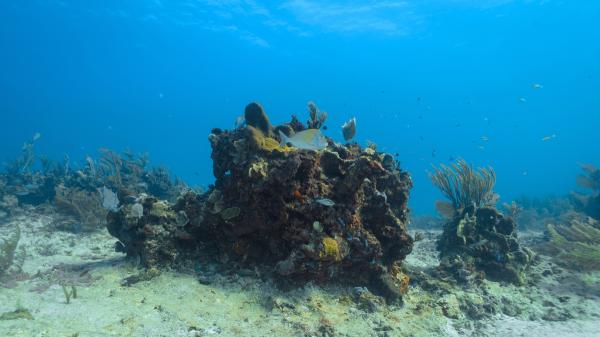
The tires did not stay still: the storms turned them into a threat to the corals
The Florida Department of Environmental Protection itself points out that many were mobilized by these weather phenomena and caused damage to nearby coral reefs.
Research by Stephanie C. Crawford of the University of Miami also described how the failure of the steel clips and ropes allowed the wheels to become free and ultimately affect the surrounding natural reefs. The study can be consulted in the University of Miami repository.
The problem lies especially in its mobility. Unlike heavy structures specifically designed to function as artificial reefs, a tire can move with waves and currents. In doing so, it can repeatedly collide with corals and other organisms attached to the substrate.
The result was paradoxical: a project designed to favor marine life ended up becoming a threat to ecosystems that already existed.
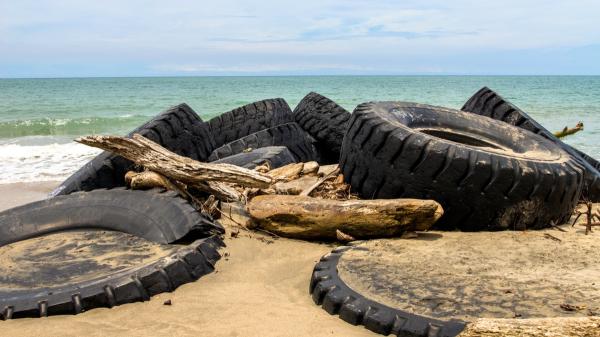
Removing tires from the sea became a decades-long operation
Major recovery work did not begin until many years later. In 2006, the US National Oceanic and Atmospheric Administration’s (NOAA) marine debris program funded a survey of the area to study how to properly remove and manage the tires.
Subsequently, pilot programs were developed and US Navy divers participated. Since 2015, the Florida Department of Environmental Protection has maintained removal operations through contractors.
The procedure is laborious. A diver gathers tires on the bottom, they are lifted by crane or winch to a boat, and when the boat completes approximately a 300-unit load, it returns to Port Everglades. From there they are transported to authorized facilities for treatment. Authorities consider this system one of the least destructive to nearby habitats.
Cleaning also presents an unexpected difficulty: some tires have been colonized by corals. Before removing these wheels it is necessary to rescue the organisms. In one of the recent programs, 700 corals were extracted, most of which were transferred to natural reefs, while others were destined for scientific research.
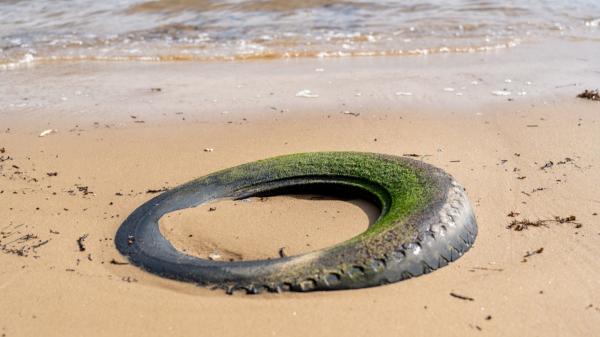
More than 500,000 tires have already been recalled, but the problem continues
Osborne Reef continues to be the subject of action. In September 2025, Florida formalized a $5 million contract to continue removing tires located on sand, reef areas and hard bottoms. The contract takes as reference sonar studies carried out in 2019 and 2024.
By the end of 2025, 538,176 tires had been removed since the start of the contractor-managed cleanup phase in 2015, while hundreds of thousands would still remain at the bottom.
The Florida case thus constitutes a warning about environmental restoration projects based solely on reusing waste. An artificial reef needs stable materials, an adequate design and a prior evaluation of its physical and ecological effects.
At Osborne Reef, a solution that more than 50 years ago promised to turn trash into habitat ended up generating an environmental problem whose repair continues in the 21st century.
If you want to read more articles similar to In 1972, Florida threw up to two million tires into the sea to create a reef and it went wrong: 50 years later they are still being removed, we recommend that you enter our Pollution category.
