
For more than a century, the large deer that once roamed Kentucky were virtually absent from this US state. The situation began to change in December 1997, when seven animals left a trailer in the east of the territory. It was the beginning of one of the most successful large mammal reintroduction projects in the eastern United States.
Between 1997 and 2002, the Kentucky Department of Fish and Wildlife (KDFWR) transported 1,541 individuals from six states: Arizona, Kansas, North Dakota, New Mexico, Oregon and Utah. Currently, different estimates place the population at around 13,000 animals, making it the largest of its kind east of the Rocky Mountains.
Old coal mines ended up offering something the elk needed
It is worth clarifying the name of the species. Although some information in Spanish refers to these animals as “elks”, they are elk or Canadian deer (Cervus canadensis), known in North American English as elk. The true elk belongs to another species, the so-called elk moose., and the confusion arises because in British English, the same word elkis used to refer to elk.
The choice of Eastern Kentucky was no coincidence. Before starting the releases, the authorities carried out a feasibility study and public consultations in 1997. The area offered a favorable combination: a large available area, low human population density and relatively little commercial agriculture.
There was, furthermore, a seemingly contradictory feature: decades of open-pit coal mining had profoundly transformed part of the Appalachian landscape.
Elk need open spaces to feed, something less abundant in the dense forests of the eastern United States. The old mining operations, once recovered and covered by vegetation, had generated extensions of grasslands and bushes that provided food.
The current restoration zone encompasses 16 counties and more than 4.1 million acres, about 1.66 million hectares. According to the KDFWR, approximately 80% is deciduous forest and about 10% is active or reclaimed surface mines.
This does not mean that mining has become a conservation tool. A study of land cover changes in eastern Kentucky warns of their impacts on terrestrial ecosystems, aquatic habitats and water quality. Furthermore, the vegetation that colonizes restored mining lands does not always reproduce the ecosystem that existed before exploitation.
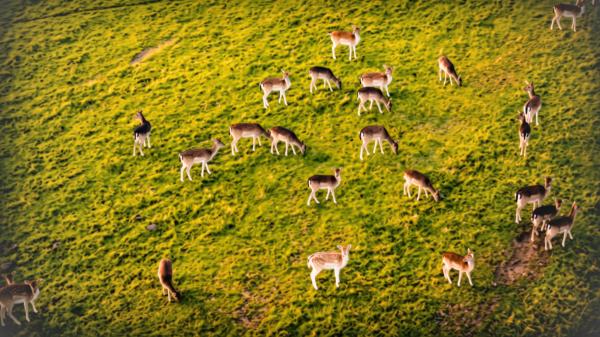
From seven animals to a population of thousands: this is how the herd grew in Kentucky
The magnitude of the project was decisive. Although they started with seven specimens, instead of introducing only a few dozen in total, Kentucky moved more than 1,500 for five consecutive years and distributed them at different points.
The Rocky Mountain Elk Foundation estimates that that founding population gave rise to a herd of around 13,000 individuals, while official sources and estimates made in different years offer somewhat different figures due to the methods used to calculate the population.
Success also made it possible to reverse the process. Kentucky, which initially needed animals from other states, has ended up becoming a source population for restoration projects in other regions.
In 2022, in addition, authorities moved animals within the state itself to occupy areas where density remained low. One of those projects brought elk to McCreary County and the surrounding area of the Daniel Boone National Forest.
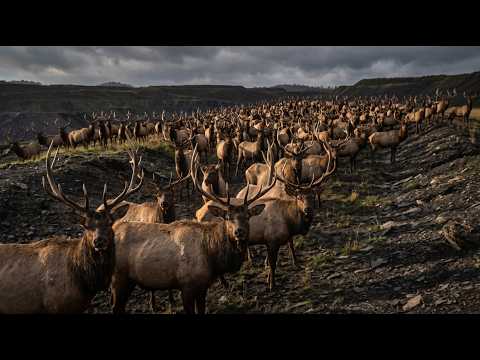
Not all elk came from the same place: genetics was another key
There is another particularly interesting aspect. The released animals did not come from a single population.
A research published in The Journal of Wildlife Management analyzed the genetic diversity of restored elk and found levels comparable to those of the original populations used for reintroductions. The researchers especially detected the genetic fingerprint of the animals from Utah and North Dakota.
The study suggests that Kentucky’s success may have been due, in part, to three decisions: releasing a large number of individuals, repeating introductions for several years, and using populations of different origins. In this way, the risk of suffering from genetic problems that can appear when a population is reconstructed from very few specimens was reduced.
Kentucky’s history doesn’t mean the restoration is over, either. The population requires monitoring, health control and habitat management. In fact, research launched in 2026 studies how techniques such as hunting and certain vegetation treatments can improve the availability of food for these large herbivores.
The result, almost three decades after those first releases, offers a relevant lesson for other conservation projects: recovering a disappeared species is not only about returning animals to the territory. The quantity and genetic diversity of the founder specimens, the quality of the habitat and subsequent monitoring can decide whether a reintroduction fails or manages to establish a viable population.
If you want to read more articles similar to Between 1997 and 2002, 1,541 Canadian deer were released in old open-pit coal mines: 25 years later there are about 13,000, we recommend that you enter our Ecosystems category.
