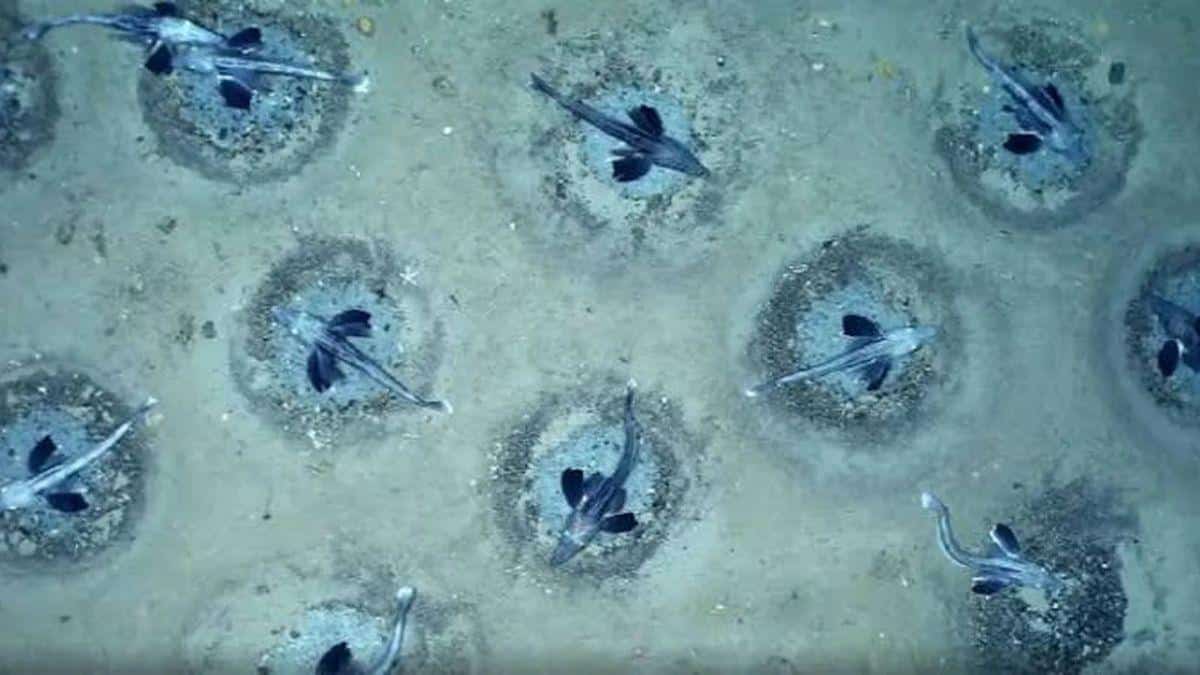
535 meters under the ice of Antarctica hides a world that few could imagine. Scientists have discovered an authentic “underwater city” made up of millions of fish nests, reaching an astonishing number: about 60 million.
A discovery that turns this remote corner of the ocean into one of the largest known fish nurseries on the planet. But how is it possible for a colony of such size to survive in such an extreme place and what did the researchers really find under the ice?
Scientists used a camera system to explore the seabed
Under hundreds of meters of ice and in one of the most extreme environments on the planet lies a concentration of life that is difficult to imagine. During a scientific expedition in the Weddell Sea, researchers found a gigantic breeding area occupied by millions of Antarctic icefish nests.
The discovery occurred in February 2021, when the research icebreaker Polarstern was exploring the waters near the Filchner Ice Shelf. To study the seabed, scientists used the OFOBS towed camera and sensor system, which allowed direct observation of the ocean floor at depths between 420 and 535 meters.
The images showed that the bottom was covered by an almost endless succession of nests. The researchers directly counted 16,160 nests in an area of about 45,600 square meters, which allowed them to estimate that the entire colony could extend over approximately 240 square kilometers and house around 60 million active nests.
The figure makes this area of the Weddell Sea one of the largest fish breeding sites known so far and explains why the comparison with a real “underwater city” is so striking.
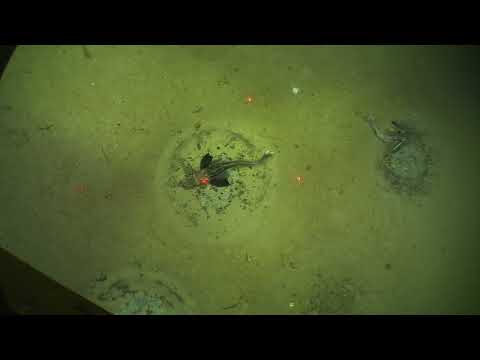
These are the nests that form this extraordinary colony of fish
What the researchers found was not a city in the literal sense, but a gigantic colony of Antarctic ice fish that had turned the seabed into a huge breeding ground. The concentration was so extraordinary that, seen from the cameras of the underwater vehicle, it seemed to extend endlessly beneath the waters of the Weddell Sea.
Each nest consists of a circular depression excavated in the mud, reinforced with small stones. These structures are approximately 75 centimeters in diameter and 15 centimeters deep. In the center is the laying of eggs and, in about 75% of the nests observed, an adult fish remained on them to protect them.
The number of eggs each one can contain is also surprising: between 1,500 and 2,500 eggs. If we take into account that the colony could have around 60 million nests, we are facing a reproductive concentration of exceptional dimensions.
The researchers also calculated that this enormous colony occupies an area of approximately 240 square kilometers, with a density of approximately one nest every three or four square meters. Altogether, the biomass associated with the colony was estimated at about 60,000 tons.
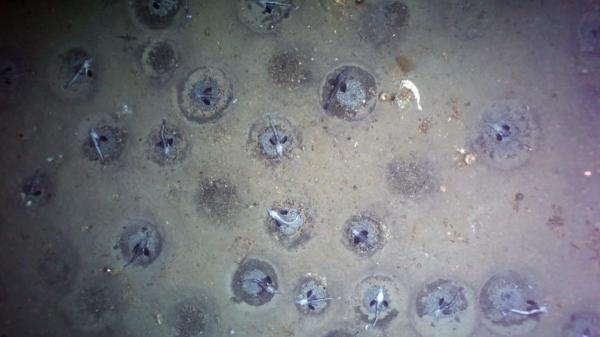
The ice fish that has created this gigantic colony under Antarctica
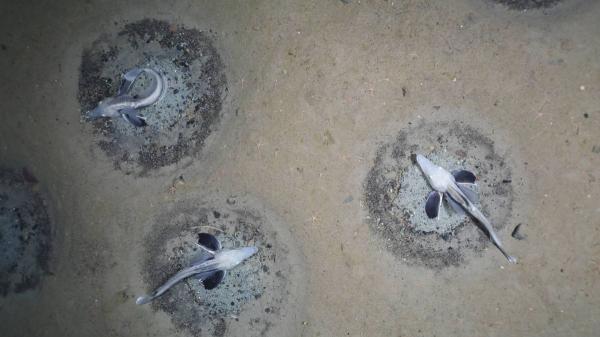
The protagonists of this extraordinary concentration of nests are the ice fish of the species Neopagetopsis ionahanimals especially adapted to the extreme conditions of Antarctic waters. Their peculiarity is not only in surviving in an environment covered by hundreds of meters of ice, but also in the way in which they reproduce.
The specimens build their nests directly on the seabed and remain close to them to protect the nest. The researchers observed that many of the nests were occupied by an adult fish, which shows that the area is not simply a place where remains or abandoned structures accumulate, but rather an authentic active nursery.
The location of this colony does not seem to be coincidental either. The area is located near an area where relatively warm deep water rises to the surface. These conditions could provide fish with the right environment to reproduce and maintain their eggs in an ecosystem that, at first glance, seems completely incompatible with a concentration of life of such magnitude.
The discovery shows that under the Antarctic ice there are still large ecosystems to be discovered
The discovery of this gigantic colony of ice fish has a scientific importance that goes far beyond the spectacular figure of 60 million nests. Until now, researchers had very limited knowledge about the life that exists under the Antarctic ice shelves, so finding a breeding area of such size demonstrates that these seemingly inhospitable environments can host much more complex ecosystems than previously thought.
The colony also raises new questions about the relationship between ocean currents, ice and the distribution of Antarctic species. The presence of millions of nests concentrated in the same area suggests that there are very specific environmental conditions that make this place an especially favorable enclave for reproduction.
Furthermore, the discovery highlights the need to protect these ecosystems. Being in a remote, ice-covered region, these communities are difficult to study and could be especially vulnerable to the changes the Southern Ocean is experiencing.
Therefore, that first exploration not only allowed us to discover one of the largest concentrations of reproductive fish known on the planet. It also opened a window onto a virtually unknown underwater world and reminded the scientific community that there are still great ecosystems to be discovered even in the most inaccessible areas of the Earth.
If you want to read more articles similar to They explore Antarctica at a depth of 535 meters and find an “underwater city” made up of 60 million nests, we recommend that you enter our Biodiversity category.
