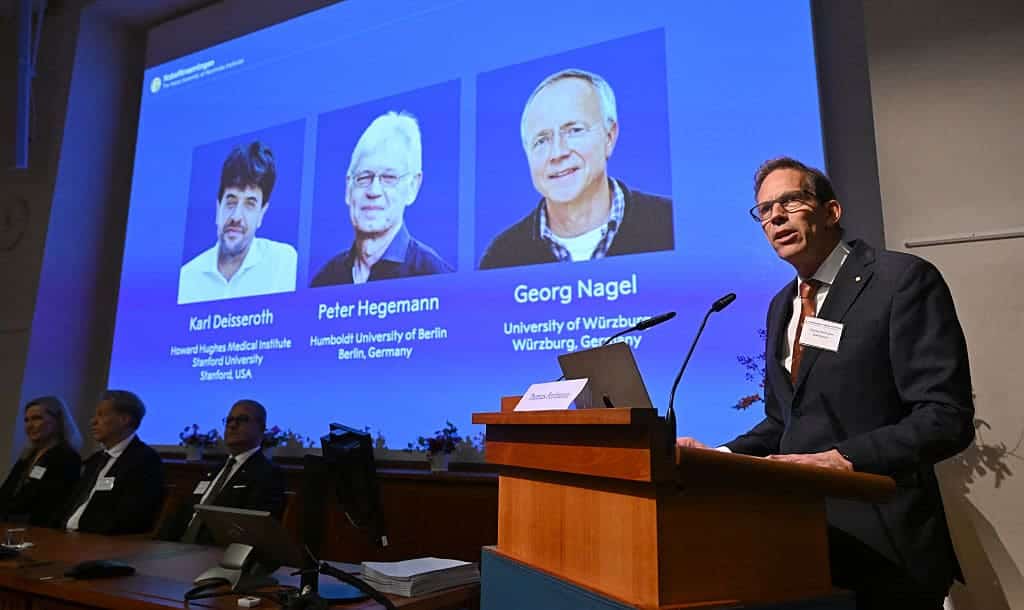
Karl Deisseroth, Peter Hegemann and Georg NagelI are the winners of the 2026 Nobel Prize in Physiology or Medicine, dedicated to optogenetics.
Karl Deissereth, Peter Hegemann and Georg Nagel won the 2026 Nobel Prize in Physiology or Medicine”for their discoveries regarding light-activated ion channels and optogenetics“.
The 2026 Nobel Prize in Physiology or Medicine recognizes optogenetics, a technique that allows us to observe how nerve cells shape memories, emotions and behaviors in the living brain.
Peter Hegemann and Georg Nagel discovered an extraordinary protein, channelrhodopsin, in a unicellular alga; Karl Deisseroth transformed this protein into a switch for nerve cells, which can be activated by light. The awarded scientists have laid the foundations for a new era of neuroscience.
Optogenetics allows us to map the brain with a precision that would once have been unimaginable. During the 20th century, neuroscientists began to ask which areas of the brain presided over different functions, but the methods for understanding this did not allow us to trace a cause-effect relationship. It could not be asserted, for example, that a certain type of nerve cell caused a certain behavior. Understanding how the brain works therefore resembled a blurry photograph.
Optogenetics has changed our understanding of the brain because it allows us to control nerve cells with light. Using this technique, scientists are now able to detect which neural circuits govern behaviors, memories, sensations that are relevant from a neurological point of view or for those studying psychiatric diseases.
Therefore, optogenetics has a key relevance in neuroscience, because it allows us to understand how the brain works in detail. But it is also proving to be fundamental from a clinical point of view: for example, it has been used to partially restore sight in people suffering from retinitis pigmentosa, because it has allowed the patients’ retinal cells to be modified to make them sensitive to light.
Who are the awarded scientists?
Karl Deisseroth, American, born in 1971, is Professor of Bioengineering, Psychiatry and Behavioral Sciences at the Howard Hughes Medical Institute and Stanford University (USA).
Peter Hegemann, born in Germany in 1954, is Professor of Neuroscience at the Humboldt University of Berlin (Germany). The Nobel-winning discoveries were made at the Max-Planck-Institut für Biochemie in Martinsried (Germany).
Georg Nagel, born in Germany in 1953, is professor of Molecular Plant Physiology at the Department of Molecular Plant Physiology and Biophysics (Botany I) of the University of Würzburg (Germany). The award-winning discoveries were made at the Max-Planck-Institut für Biophysik in Frankfurt (Germany).
A switch for nerve cells
The idea of being able to activate individual nerve cells through light had also been entertained by Francis Crick, the molecular biologist awarded the Nobel Prize for Medicine in 1962 jointly with James Watson and Maurice Wilkins for the discovery of the double helix model of DNA.
Karl Deisseroth, Peter Hegemann and Georg Nagel turned his vision into reality.
The discovery lays the foundations for a scientific curiosity only apparently unrelated to neuroscience. In the early 1990s, Peter Hegemann wondered how the unicellular algae Chlamydomonas could react so quickly to the light that it could swim towards it. These algae perceive light thanks to an eye spot (an orange dot on the surface of the cell) which contains a molecule capable of reacting to light.
By measuring the electrical signals generated in the algae when the eyespot was illuminated, Hegemann noticed that, just half a millisecond after the light reached the eyespot, an electrical pulse was generated – an incredibly rapid reaction compared to other biological systems. For example, the response to light in the human eye takes at least 10 milliseconds, 20 times longer.
Hegemann hypothesized that the process must be much simpler than the multistep chemical reaction that occurs in the human eye. He hypothesized that a single protein complex captured light and acted as an ion channel, a hypothesis that however left other scientists skeptical: at the time, several types of ion channels (proteins that allow the selective passage of ions into and out of the cell) were known, none of which were capable of reacting autonomously to light.
At the beginning of the 2000s, after years of unsuccessful attempts to isolate the light-sensitive protein in algae Chlamydomonasin the mapping of the organism’s DNA just elaborated by a Japanese team, Hegemann identified two genes very similar to other proteins known to be able to capture light.
Working with Nagel, a fellow biophysicist who used frog egg cells to study proteins, Hegemann discovered that his hypothesis was correct: the two reported genes produced proteins – channelrhodopsin-1 and channelrhodopsin-2 that ended up on the surface of the cells, and which had unique properties: they were ion channels that opened when exposed to light.
From algae to nerve cells
It is channelrhodopsin-2 that has assumed crucial importance for optogenetics. When the protein is illuminated with blue light, within 0.2 milliseconds a channel opens through it and charged ions can flow into the cell, generating an electrical impulse. Nagel and Hegemann understood that regardless of the type of cell the protein was introduced into, that cell became photosensitive.
When they introduced that gene into embryonic human kidney cells, those cells became sensitive to light and produced electrical impulses.
In 2003, Hegemann and Nagel published the results of their experiments, arguing that the protein could be a powerful tool for generating electrical impulses in cells on command, using light.
Karl Deisseroth deserves the credit for having transferred all this to the clinical application of neuroscience. The scientist had a background as a doctor in a psychiatric clinic and was tormented by questions such as: what prevents patients suffering from depression from feeling joy? What causes autism, or delusions in schizophrenia?
In agreement with Nagel, Deisseroth introduced the gene for channelrhodopsin into the nerve cells of rats, and by illuminating them with blue light he was able to trigger a nerve signal that spread to other cells. In 2005 he published the results of the discovery, considered epochal, even though being able to control the activity of nerve cells in living animals was still a distant goal.
The birth of optogenetics
Deisseroth, Hegemann and Nagel shared their results with other researchers and began numerous collaborations, with Deisseroth’s laboratory as a reference. Progress was very rapid from then on. It began with the discovery of other proteins capable of activating (and deactivating) nerve cells at different wavelengths of light. In 2006, the technique was officially called optogenetics, and the following year Deisseroth used it to activate neurons in the motor cortex of living mice, using it to control the movements of their whiskers.
That same year, Deisseroth used optogenetics to controlledly awaken sleeping mice and confirm that a newly discovered type of nerve cell actually controlled wakefulness.
In 2012, optogenetics was used to demonstrate which nerve cells serve to form a memory. Together with the Japanese scientist Susumu Tonegawa, Deisseroth used it to reactivate an engram, the set of neural pathways that is formed when a memory, for example a fearful one, is created. By manipulating these cells with light it was possible to make the mice feel fear even when they were not in danger.
A new way to decode the brain
Since then, optogenetics has been used to identify the neural circuits that regulate the perception of pain, social behaviors, thirst, food intake, reward and attention, those that control circadian rhythms or the onset of fever when we get sick, or those responsible for the different components of complex behavior, such as caregiving.
Scientists have used it to demonstrate how interactions between the brain and other organs, such as the heart or gut, can influence our behaviors.
Optogenetics is enabling understanding of the basis of psychiatric and neurological disorders, for example depression, anxiety, schizophrenia, Alzheimer’s disease and Parkinson’s disease.
Optogenetics is also revolutionizing the treatment of diseases that lead to blindness, such as retinitis pigmentosa, a condition that destroys photoreceptors in the retina. The introduction of a protein similar to channelorhodopsin into the retina of a blind person allowed him to partially recover his vision and distinguish and grasp objects on a table.
Another hope concerns its use to improve cochlear implants, devices for people with profound deafness that replace the function of the inner ear by stimulating the auditory nerve with electrical impulses. Optogenetics could allow the auditory nerve to be activated with greater precision.
Nobel Prize for Physiology or Medicine: some historical curiosities
The Nobel Prize in Physiology or Medicine, established by Alfred Nobel’s will in 1895, is awarded by a jury of medical professors from Karolinska Institutet, a Swedish medical university. The Nobel Prize in Physiology or Medicine is awarded to the authors of discoveries of vital importance, which have changed the previous scientific paradigm and which are of enormous benefit to mankind.
Nobel winners receive a medal, a diploma and a document indicating the amount of the prize, which this year amounts to 12 million Swedish crowns, approximately 1 million 66 thousand euros.
In 2025, it was awarded to Mary E. Brunkow, Fred Ramsdell, and Shimon Sakaguchi for their groundbreaking discoveries about peripheral immune tolerance, the mechanism that prevents the immune system from harming the body. These are fundamental studies to understand the origin and improve treatments of autoimmune diseases, to develop new therapies against cancer and to improve the science of transplants (to learn more).
From 1901 to today, 116 Nobel Prizes in Physiology or Medicine have been awarded: 40 to a single winning scientist, 36 shared by two scientists and 40 shared between three (the maximum number of winners possible). The youngest scientist ever awarded remains Frederick G. Banting: he was 31 years old when, in 1923, he was awarded the Nobel for the discovery of insulin. The oldest is – for now – Peyton Rous, who was 87 when, in 1966, he was awarded for the discovery of viruses that induce tumors.
Only 14 out of 232 people have been awarded so far: one of these is the Italian Rita Levi-Montalcini, who in 1986 won the Nobel Prize for Medicine for the identification of the first growth factor, together with the American biochemist Stanley Cohen (read the story of how Levi-Montalcini got to the Nobel).
In this small group, the American biologist Barbara McClintock was the only one to have won a Nobel Prize for Medicine not shared with others: in 1983 she was awarded for having discovered the existence of transposons, portions of DNA capable of moving from one chromosome to another.
