
In California, United States, a ten-lane highway had become a difficult barrier for wild animals to overcome. Especially for the pumas, whose populations were isolated by the growth of infrastructure and urban expansion. To try to reverse this situation, in 2022 the construction of a huge ecoduct on Highway 101 began, a project that seeks to reconnect natural habitats and facilitate the movement of fauna.
Four years later, the project is practically finished. Named Wallis Annenberg Wildlife Crossing, this green bridge is considered the largest wildlife crossing in the world and is scheduled to open on December 2, 2026. Its objective is not only to avoid accidents, but also to help recover the genetic connection between populations of animals that have been separated for decades.
The California ecoduct that seeks to save pumas from isolation
Construction on the Wallis Annenberg Wildlife Crossing began in mid-2022 in Agoura Hills, Los Angeles County. The project was designed to bypass US-101, which separates the Santa Monica Mountains from the Simi Hills and other surrounding natural areas.
According to the California Department of Transportation (Caltrans), this highway represents a practically insurmountable barrier for numerous species that need to move between both territories. Among them are pumas, coyotes, gray foxes, red lynxes and deer.
The problem is especially serious for big cats. Being confined to a relatively small territory, they have fewer opportunities to find specimens with which to reproduce outside their population. This favors endogamy, that is, reproduction between related individuals, and reduces genetic diversity.
The United States National Park Service has been studying this situation for decades. In fact, research on pumas in the region has documented that 41% of matings recorded since 2002 have occurred between closely related specimens, according to data collected by the Los Angeles Times in October 2026.
For this reason, the ecoduct aims to do more than offer a safe place to cross and avoid accidents: it wants to allow animals to move again, find a partner and share genetic material between populations.
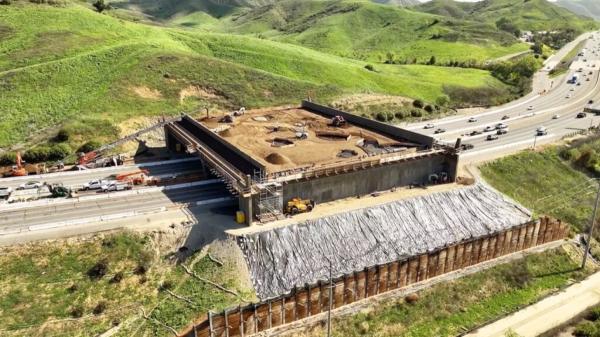
This is the largest green bridge in the world
The Wallis Annenberg Wildlife Crossing stands out for its dimensions. The structure that crosses the highway measures approximately 64 meters long and 53 meters wide, dimensions that allow it to cover the ten traffic lanes and create a natural surface on the asphalt.
It is not a conventional bridge, but rather an infrastructure designed to integrate into the landscape. Its surface is covered with native vegetation and has an environment that seeks to reproduce the natural conditions of nearby habitats.
The idea is that animals can cross it without realizing that they are crossing a road. In this way, the project aims to reduce collisions with vehicles and recover ecological continuity between two natural spaces.
The construction has also required significant ancillary work, such as the relocation of utility lines and the creation of another pass over the Agoura road, connecting the main structure with the surrounding land.
According to the latest updates published by the Los Angeles Times, one of the most important jobs has been moving and compacting millions of cubic feet of soil to ensure that animals can access the bridge from both sides.
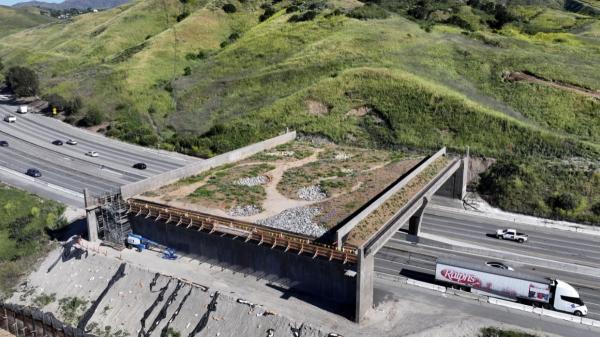
The first animals are already approaching the ecoduct before its opening
Although the bridge is not yet officially open, researchers have already observed wildlife activity in its vicinity. On November 4, 2026, the United States National Park Service announced that it will install trail cameras to study which species use the infrastructure and how they respond to this new connection between habitats.
One of the first signs came on October 28, when scientists managed to photograph a coyote climbing the southern slope of the ecoduct, still under construction. Additionally, during monitoring tasks in the area, biologists have observed pumas, deer, coyotes, red lynx and gray foxes using a trail near the future pass.
The cameras will allow us to record which animals approach the bridge, which ones cross it and at what times they do so. They will also help evaluate whether the infrastructure meets its objective of recovering ecological connectivity.
Monitoring will not be limited to counting animals. Researchers want to study changes in genetic diversity, vegetation and other indicators of ecosystem functioning. It is a work that will take years to offer conclusive results.
An infrastructure to recover the connection between natural habitats
The opening of the ecoduct is scheduled for December 2, 2026, provided that meteorological conditions, mainly related to the El Niño phenomenon, do not force the final works to be delayed. When it comes into operation, the pumas will have a new route to travel between the Santa Monica Mountains and the Simi Hills, with the possibility of accessing other territories.
The initiative can also benefit other species that need large areas of land to feed, reproduce or find shelter. Habitat fragmentation is one of the problems that makes these movements most difficult, especially in regions where roads and urbanized areas interrupt natural corridors.
However, researchers warn that building the bridge will not immediately solve the mountain lions’ genetic problems. The recovery of genetic diversity depends on the animals actually using the passage, moving between populations and managing to reproduce with specimens from other territories.
The Wallis Annenberg Wildlife Crossing therefore represents an important step for wildlife conservation in California. Four years after the start of works, the project is about to open a new route for animals in a territory where human infrastructure had made their movements difficult for decades.
If you want to read more articles similar to In 2022 they began to build an ecoduct to save the California pumas: 4 years later, the largest bridge for animals in the world is almost finished, we recommend that you enter our Biodiversity category.
