In 2025, six out of ten new European city buses were zero-emission, almost all battery-powered. In Gorizia a company is also testing hydrogen and biomethane: here’s what you need to understand.
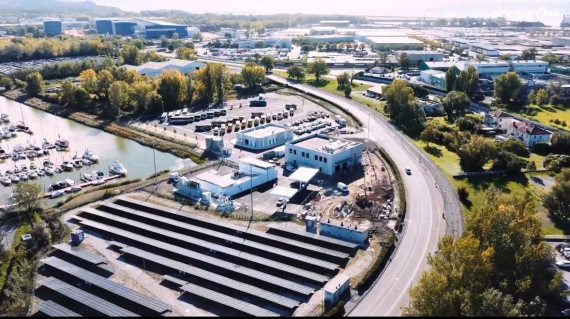
In Monfalcone, in the province of Gorizia, since 31 October 2026 there has been a bus depot which produces its own fuel. On the 38,000 square meters of the Lisert headquarters, the Provincial Transport Company (APT) has lined up a photovoltaic park, the plant that extracts hydrogen from water, the storage tanks and the station where the buses will fill up. According to ASSTRA, the association of public transport companies, it is the only case in Italy in which the entire supply chain is located in a single site.
The case also affects those who do not live in Friuli Venezia Giulia, because APT makes a choice that goes against the grain. In Europe, the game for urban buses seems to have already been decided: in 2025, according to the environmental organization Transport & Environment, 60% of new vehicles registered in the Union were zero-emission, and 56 points out of 60 were battery-powered vehicles. Hydrogen stopped at 4%. The Gorizia company instead uses the battery, hydrogen and liquefied gas, each on different lines. It’s a good test bed to understand what each technology can do, and how much it costs.
From the sun to the tank
The journey begins from the sun: 2,834 photovoltaic modules, spread over 17,000 square metres, for a power of 1.67 megawatts (MW). The electricity powers a 1 MW electrolyser, the machine that uses electricity to split water molecules into oxygen, released into the air, and hydrogen. At full capacity, up to 453 kg per day come out. The gas is compressed and stored, then distributed by two dispensers at 350 bar for heavy vehicles and one at 700 bar, set up for cars.
Hydrogen is called “green” when the electricity used to produce it comes from renewable sources. In Monfalcone photovoltaic covers almost all needs, explains the company chaired by Caterina Belletti.

A power plant on board
Filling up will be nine 12-metre Iveco E-Way H2s, destined for the urban lines of Monfalcone, Ronchi dei Legionari and Staranzano. They will enter service gradually, after testing and staff training. They are to all intents and purposes electric buses, but instead of a large battery they have four cylinders on the roof with 31 kg of hydrogen and a fuel cell: there the gas reacts with the oxygen in the air and generates the current for the engine. Only water vapor comes out of the exhaust.
The manufacturer declares a consumption of 7.05 kg per 100 km. With the maximum production of the plant it would therefore cover, in theory, around 6,000 km per day. A second tender, for another six vehicles plus three optional ones, is being evaluated.
The energy bill
The limitation of hydrogen is that, on the road, some of the energy is wasted.
First, electricity is used to produce gas; then, on board the bus, the fuel cell transforms the gas back into electricity for the engine. In each of the two steps a portion of the energy is lost, especially in the form of heat.
Let’s deal with the technical data of the system. At full power, in 24 hours the Monfalcone electrolyser absorbs 24 MWh of electricity and produces 453 kg of hydrogen: approximately 53 kWh for every kilo. A bus that consumes 7.05 per 100 km therefore requires over 370 kWh of electricity to travel.
How much does a battery-powered vehicle consume? The most documented comparison on Italian roads was carried out by Eurac Research in Bolzano, following the vehicles of the SASA company for approximately 500,000 km between January 2021 and April 2022. The result, published in 2023 in the Journal of Energy Storage: the battery buses used between 137 and 154 kWh per 100 km, the hydrogen buses between 9.3 and 10.1 kg, i.e. 2 to 2.45 times the energy, not counting that spent to produce the gas. At public prices at the time, a kilometer cost 0.55 euros with the battery and 1.27 with hydrogen.
However, the same study highlights a point in favor of fuel cells: their consumption fluctuates little, while that of battery-powered vehicles rises significantly in the most unfavorable conditions, especially due to the effect of temperature. And for Wolfram Sparber, who heads Eurac’s Renewable Energy Institute and is one of the authors, both technologies have held up in daily service.
Elsewhere the accounts have closed the question. In January 2022, the French metropolis of Montpellier canceled a project for 51 hydrogen buses and chose the battery: according to administration estimates, the operation would have cost 0.95 euros per kilometer against 0.15. Luca Di Benedetto, general director of APT, does not hide the unknown: «We are talking about young technologies for which there is not yet a consolidated history of operation and maintenance costs».
To each his own line
Why then focus on three solutions? «There is no single perfect solution for everything», replies Di Benedetto, who spoke at the Mondadori Academy Forum Orienta in Lecce, «but every technology has its range of action». The battery performs best in the city, between short routes and frequent stops: at the end of 2025 APT had 19 electric buses in service and in Grado, since September 2024, the urban network runs only on electricity. The Gorizia depot recharges up to 12 at once, at night and slowly, to preserve the batteries. Homemade hydrogen instead responds to an objective that the company set itself in 2020, recalls the director: to bring over half of the vehicles to zero impact without depending on others.
On the longer extra-urban lines, APT uses liquefied natural gas (LNG), i.e. methane cooled to become liquid: at the end of 2025 there were 17 vehicles. The Gorizia station is set up for BioLNG, the version obtained from organic and agricultural waste. «We valorise waste, reduce particulate matter and drastically reduce CO₂», says Di Benedetto of biomethane.
By how much? It depends on the raw material. A 2021 study by the CNR Institute on Air Pollution, promoted by the Italian Biogas Consortium and Iveco, estimates a reduction in greenhouse gases of up to 121.6% compared to diesel, therefore with a negative balance, but in the most favorable case: livestock waste more than 60% of the mixture and recovery of the processing CO₂. It remains a combustion engine: according to the International Council on Clean Transportation (ICCT), which monitors the market, only battery and fuel cell buses are zero emissions.
The European race
The rules push in a specific direction: in the Union, 90% of new urban buses will have to be zero-emission from 2030 and 100% from 2035. Five countries have already achieved this in 2025, according to Transport & Environment: Bulgaria, Denmark, Estonia, Latvia and Slovenia. Italy, with almost two thirds, is the only large EU market above average. The picture is different for interurban and coaches, where the share is stuck at 4% (ICCT, 2025).
Hydrogen remains a concentrated niche: 62% of fuel cell city buses sold in the EU in 2025 went to Germany. In Italy the push came from the PNRR, which set the objective of at least 3,000 zero-emission buses in service by June 2026. In Bologna Tper began in May 2026 to put a fleet on the road that will reach 127 hydrogen vehicles, for 74.9 million euros; in Modena SETA presented 12 of them in September 2026.
APT’s plan, called ecoMove, is worth 59 million euros by 2030, 39 of which from public funds, and includes 76 new vehicles: the low or zero impact share of the urban fleet should rise from 26 to 81%. The heaviest item, 29 million, is hydrogen. Di Benedetto is already evaluating the doubling of the plant and said to the audience in Lecce: «What you see applied here today will be the industrial standard of your cities in a few years». To verify this, we will need the numbers that are currently missing, and that the nine Monfalcone buses will begin to produce: real consumption and operating costs.