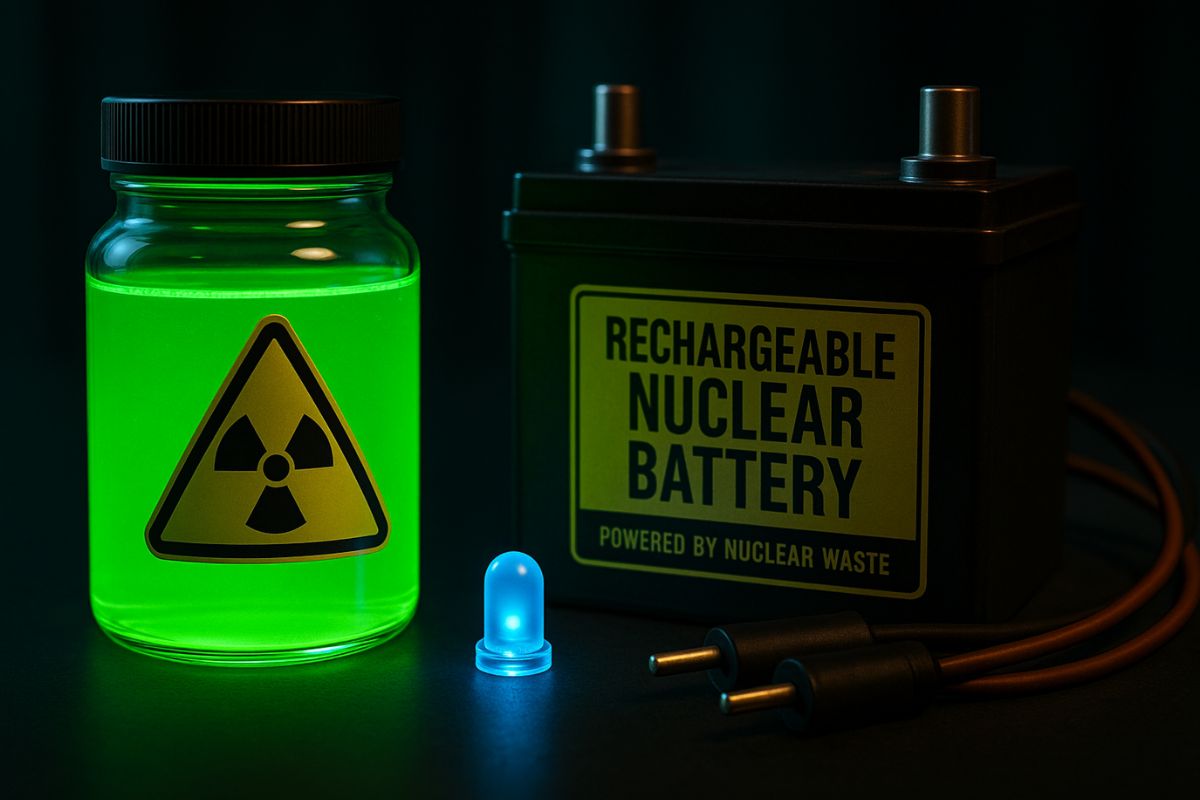
Japanese researchers have succeeded in designing a rechargeable battery that uses depleted uranium, a by-product of uranium enrichment. If this solution proves viable, it could transform nuclear waste into a valuable source of energy.
Uranium is used in nuclear power stations to produce low-carbon energy, but this generally virtuous production of electricity is accompanied by a significant constraint: it produces nuclear waste that cannot currently be recycled or recovered. But this could change in the future, thanks to the research work of a team of scientists from the Japan Atomic Energy Agency (JAEA).
A rechargeable battery based on depleted uranium
Although the idea is reminiscent of the way Doc Brown powers his DeLorean in Back to the Future 2, this time it’s not a science fiction concept. What we have here is a prototype of a battery based on depleted uranium, with very promising capabilities.
In concrete terms, the Japanese researchers have reinvented redox flow battery technology, which involves circulating liquids containing chemical materials in an electrochemical cell to store or release energy. The energy is stored in two different tanks containing liquid electrolytes, one positively charged, the other negatively. Logically, the greater the capacity of the reservoirs, the greater the capacity of the battery to store and release energy.
And so, in this case, depleted uranium replaces vanadium, which is usually used as the electrolyte on the negative side, while iron takes care of the positive side. It was worth thinking about.
A solution as brilliant as a radioactive cockroach
Japanese researchers have been working on this idea for over 20 years. However, the JAEA has made a major breakthrough in this field by introducing iron into the design of the uranium battery. Ferrous ions, in their various states of oxidation, help to stabilise the electrolytic solution. Scientists have succeeded in obtaining a voltage of 1.3 volts, close to that of a conventional alkaline battery, by combining iron- and uranium-based electrolytes. Enough to power a simple diode, of course, but that’s just the beginning.
The prototype then underwent ten charging and discharging cycles, with no change in performance. What’s more, during the cycles, the uranium electrolyte solution regularly changed colour, reflecting its different states of oxidation.
A technology that is still far from viable
Of course, we might well wonder about the risks involved in using such a technology. On the scale of the prototype, the researchers are reassuring. “The radioactivity of the uranium in the prototype is not a problem on this laboratory scale”, explains Kazuki Ouchi, deputy principal investigator at the JAEA. In addition, depleted uranium is 60% less radioactive than natural uranium and does not generate excessive heat, which tends to minimise the risks. However, if this nuclear waste were to be used on a larger scale, strict precautions would have to be taken, particularly in terms of containment and safety.
The scientists’ goal is ambitious: they now want to develop flow cells with integrated electrodes, in order to create a battery with a much higher capacity. It could use 650 tonnes of depleted uranium to store 30,000 kilowatt-hours, equivalent to the daily consumption of 3,000 households in Japan.
As for the envisaged use of this technology, it essentially concerns the storage of renewable energies, particularly solar and wind power, which can prove unstable over time. Time will tell whether Japanese researchers will succeed in meeting the technological challenges surrounding their idea, as well as the financial challenges, since producing such batteries could prove very expensive.
Source : https://www.jaea.go.jp/english/news/press/2025/031301/
