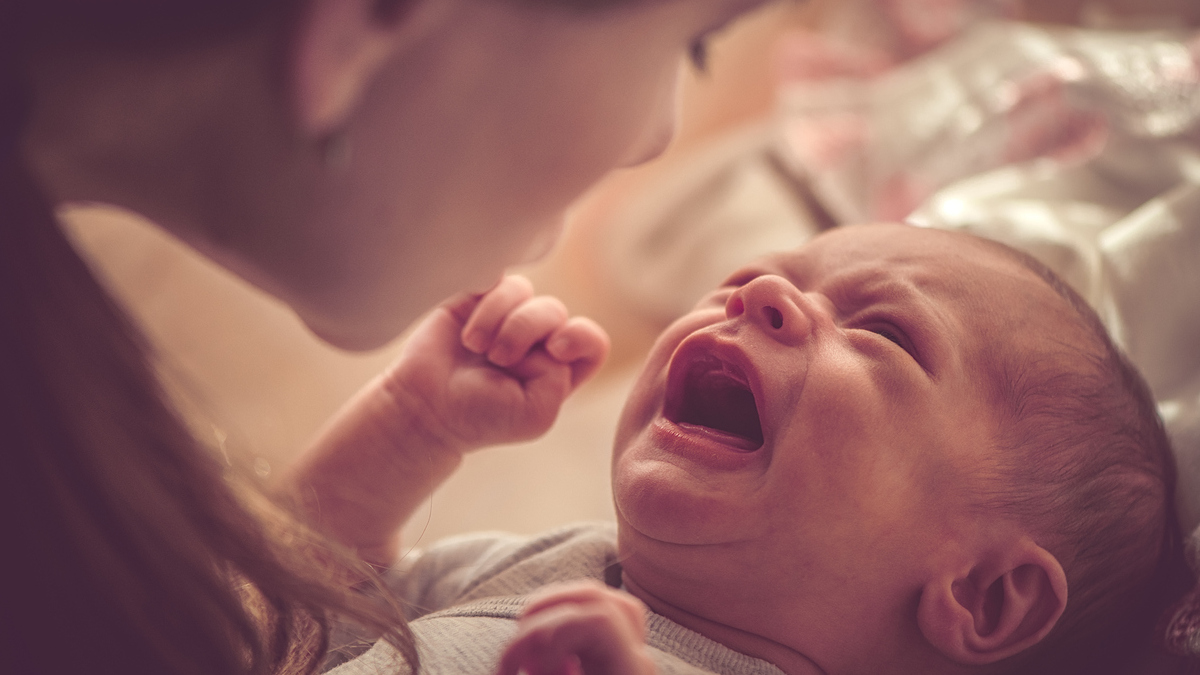
What are the causes of the air in the belly of babies and why, very often, an improper use of the term “colic” is made? What are the recommended maneuvers and remedies to help our little ones expel the excess gas
Roberta goes to the pediatrician with little Emanuele in his arms, just 20 days. “In these days he only crys … his face becomes red, he agitates, I feel that he has a swollen belly … everyone tells me that it could be a little air in the belly,” he says to the doctor without even sitting. The doctor makes her sit down and begins to address some questions to understand if, Emanuele’s, it is truly a case of air in the belly of the newborn. And among other things, Roberta also informs about the causes of this phenomenon …
What causes the air in the belly of the newborn?
What are the causes of the air in the belly of the newborn? We must consider that both in the breastfed child and in the one with formula, a part of the sugars contained in milk (largely represented by lactose) normally remains indigerous inside the intestine; Consequently, the bacteria present in the digestive tube attack these carbohydrates causing their fermentation and therefore the development of gas. It is also possible that the child bidwhage in the bottle or the one that uses the pacifier can ingest the air in the act of sucking.
It is also true that children are not all the same: some produce greater quantities of air in the belly, or they encounter more difficulties than others to expel it.
Ultimately, the air in the belly of babies is a physiological phenomenon, which continues in the first months of life, while the little ones perfect the relative “techniques” of elimination; Only in a few cases the meteorism – disorder characterized by the dilation of the abdomen due to the presence of excessive quantity of gases in the digestive tube – will constitute a problem capable of causing pain, crying and malaise in the child and in the family.
Certainly that child who emits air has no intestinal problem but attacks on request, grows enough (140/150 grams per week in the first three months), wets at least six diapers per day and effortlessly produces soft and normal colored consistency (to remember that abnormal colors are white, red and black).
Do colic exist?
The fact that the infants cry in the evening due to the pain caused by the air in the belly is seen as an absolute and irrefutable truth, so much so that we speak of “colic”, a term that refers to the violent pain caused by contractions of those viscera (in this case the colon) that are equipped with a muscle wall. In addition, these colic are defined as “gaseous”, that is, caused by the accumulation of gas.
The definitive and indisputable proof of this air-lolor-polling concatenation would have observed the behavior of children during the colic itself: desperate crying, red face, continuous movements of the arms and legs, swollen belly, emission of air from the seat.
Everything happens precisely inexorably in that afternoon/evening time slot that in Anglo -Saxon countries is called Baby Witching Hourthat is to say the time of the witches, a fitting definition as the little breaded and the parents in panic often appear as truly trapped in a without exit spell.
The first reflection to do is that it is normal that children cry and often scream for many different reasons, sometimes unknown to themselves and impossible to identify: on average they do it from 45 minutes to 2 hours a day in the first six months of life, but the peak occurs around six to eight weeks and the duration of the episodes is clearly reduced to 3-4 months of age.
In some cases, which seem to concern two to three children every 10, the cry becomes “excessive”, both for duration (three hours and beyond) and by frequency. However, that these episodes are due to “colic” caused by the air in the belly has never shown it any scientific study. Indeed, it has been seen that many lactants who presented an important increase in the production of intestinal gases did not show malaise or cry.
It is therefore very likely that the emission of air during these episodes is not the cause, but the consequence of crying: moreover it is known that the infant does not cry only by screaming, tear and changing the expression of the face, but putting the whole body in agitation and moving.
Many hypotheses were made on why some children shout in the evening desperate, but a clear cause has never been identified.
The various theories, in addition to that of excessive gas production, range from an alteration of the intestinal bacterial flora to an immaturity of the central nervous system, from a lactose intolerance to a “difficult” temperament of the child, from a high level of stress of parents to errors in the ways of breastfeeding. But none of these hypotheses has proved or confirmation.
The explanation that most convinces refers to a particular emotional response and behavior to stimuli. Since the last quarter in the uterus, but above all after birth, children receive from the environment a quantity of signals that affect their attention and lead them to select some information and to ignore others. Some, in the first months, is likely to react overly to the stimuli coming from the environment and therefore struggle to self -control and self -conscious: it is logical to think that the crying is unleashed in the evening, following the added, during the day, of visual, auditory, tactile stimulation and more, that the baby is not yet able to filter. In addition, it is easier for the newborn to cry in the evening because, being tired, it is more difficult to suck, with the result of making numerous close feedings (the so -called “bunch feeding”).
Once established that the air of the belly in babies almost never represent a problem, how can the little ones still help? Always remember to follow the diet on request, offering the breast or bottle when the child shows hunger signals; If, on the other hand, we think of nourishing the child at fixed and predetermined times, not respecting his times and letting him cry when he is hungry (because “it is not yet time”), it is easy for it to ingest more air.
If the mother breastfeeds it, it can be kept straight for a few minutes before going from one breast to another, but it is not recommended to detach it during the meal to make him do the burp; If, on the other hand, it takes the bottle, it will be kept vertically for a few minutes at the end of the meal. If he has not made the burglar, it can be put it off for a minute and then try again to keep him right.
What to do when the newborn has “air” in the belly?
What are the maneuvers and remedies to eliminate the air in the belly of the newborn? How can children get rid of these momentary air accumulations? On the one hand with the rut at the end of the meal and on the other hand, exposing the air from the intestine, but these maneuvers also require a certain training to become effective. In short, you have to give the child the time to learn to eliminate how much it is in excess: it is in fact not uncommon to see, in the first months, children become red in the face, shout and shake arms and legs in the effort to achieve the desired result.
To help them expel the air it can be useful to put them on the back and, keeping them for the feet, moving his legs gently as if they went by bicycle.
The breastfeeding mother’s diet should not be changed (no connection with the air in the belly of children has never been demonstrated), just as it is not necessary to change the type of milk formulated.
In breastfeeding children, some research would seem to suggest that certain probiotic details (“lactic ferments”) can shorten the duration of the crying, but since it is all to be demonstrated, since there is no solid scientific evidence in this regard, we advise against its use.
As for drugs, some pediatricians recommend Simeticone, a rather popular product product that would have the ability to dissolve the gas bubble in many small bubbles that can be easily eliminated. Authorized for the use of children also by the FDA, which is the American agency competent for drugs, has never shown that it works more than the “placebo”, which consists of a product without any pharmacological action, whose possible result is based only on the psychological effect.
