
Ctenophores are a group of marine animals with a gelatinous appearance, similar to a jellyfish. They belong to the phylum Ctenophora, with two classes: Tentaculata and Nuda. They can produce flashes of iridescent colors. Some species of ctenophores are Pleurobrachia pileus, Beroe cucumis and Mnemiopsis leidyi.
Have you ever heard of ctenophores? These are fascinating animals that have intrigued scientists for centuries due to their beauty, diversity and rarity. In this BIOencyclopedia article we are going to explore some aspects about them, such as the characteristics of ctenophores and examples of species. Learn about their biology, classification, feeding, reproduction and species here and discover why they have sparked so much interest in the scientific community.
Characteristics of ctenophores
- Ctenophores are a group of marine animals with a gelatinous appearance, similar to a jellyfish. Due to their particular gelatinous and generally transparent appearance, ctenophores are often confused with jellyfish by inexperienced eyes, but they are really two very different groups, since jellyfish belong to the phylum Cnidaria.
- Regarding the taxonomy of ctenophores, we can say that they receive this name because they belong to the phylum Ctenophora, which is classified into two classes, Tentaculata and Nuda, the main difference between them being the presence or absence of tentacles.
- They are characterized by having eight rows of ciliated combs that they use for swimming and feeding and that, in addition, have the ability to reflect light and produce flashes of iridescent colors.
- These fascinating animals have a gelatinous body with two layers of cells: the ectoderm and the endoderm, which are separated by an acellular substance called mesoglea.
- Ctenophores have a diffuse nervous system, without brain or ganglia, which is organized into a diffuse network throughout the body, similar to what is known as the nervous plexus.
- They also have an incomplete digestive system, with a single opening that serves as a mouth and anus.
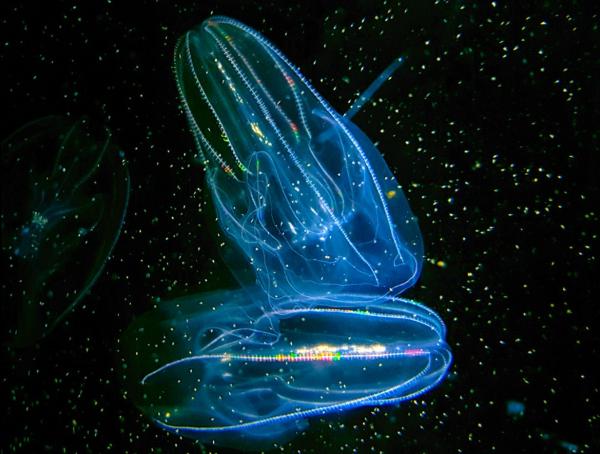
Examples of ctenophores
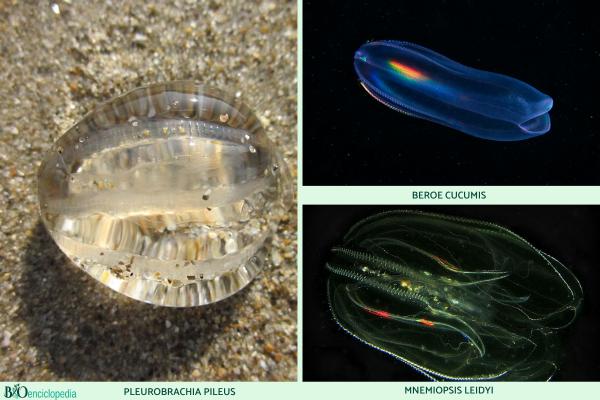
Now that we know what a ctenophore looks like, we will learn about some examples of its species, as it is undoubtedly the best way to get to know an animal group.
Pleurobrachia pileus
It is a species of spherical ctenophore that has two long, branched tentacles. It feeds on zooplankton and lives in cold and temperate waters of the Atlantic and Pacific.
Beroe cucumis
It is a species of tentacleless ctenophore that is barrel-shaped. It feeds on other ctenophores, especially those of the genus Mnemiopsis. It lives in tropical and subtropical waters of all oceans.
Mnemiopsis leidyi
It is a species of teardrop-shaped ctenophore that has four mouth lobes and four rows of combs. It feeds on zooplankton and larval fish. It is an invasive species that has caused serious ecological problems in the Black Sea and the Caspian Sea.
Feeding of ctenophores
Ctenophores have a carnivorous diet, the basis of which is mainly zooplankton, although some species can feed on larger prey, such as jellyfish or other ctenophores.
When hunting, these animals have different strategies. On the one hand, tentacled ctenophores catch their prey thanks to coloblasts, a series of adhesive cells located on their tentacles. These release a sticky substance that adheres to the prey’s body and immobilizes it. Once the prey has been caught, it is brought to the mouth with the help of the tentacles or organs called auricles.
Non-tentacled ctenophores, on the other hand, lack tentacles and coloblasts. These are filter feeders, that is, they capture plankton from the water that passes through their gastrovascular cavity. Some of these ctenophores have structures called lobes that help them create a current of water towards their mouth, which facilitates the capture of plankton, while others have projections called papillae that serve to trap food particles.
Reproduction of ctenophores
These animals, as with many other organisms that we know, reproduce sexually, that is, with genetic exchange, and are mostly hermaphrodites.
As we already know, sexual reproduction involves the formation of gametes (eggs and sperm) that are released into the water and fuse to give rise to a zygote. This zygote develops into a larva called a planula, which then transforms into an adult.
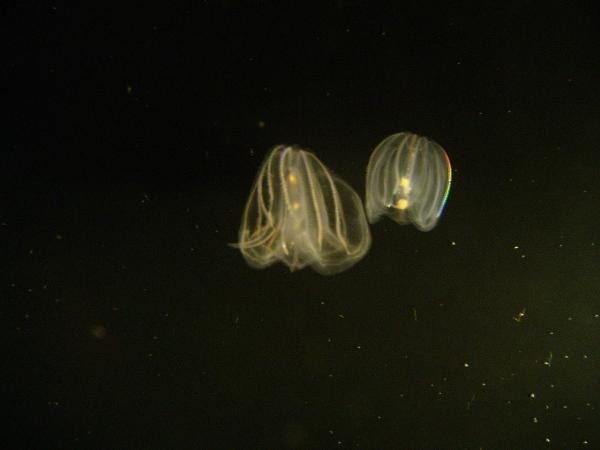
Differences between cnidarians and ctenophores
Ctenophores and cnidarians are two groups of invertebrate animals that live in the aquatic environment. Both have soft, gelatinous bodies, with a single opening that serves as a mouth and anus. However, there are many differences between them, both in their structure and in their way of life:
- Cnidarians are more diverse than ctenophorans, including about 10,000 species, while ctenophorans only about 150. Cnidarians are classified into four classes: hydrozoans, scyphozoans, anthozoans and cubozoans. Ctenophores are divided into two classes: tentacled and naked.
- Cnidarians have specialized cells called cnidocytes, which contain stinging structures called nematocysts. These are used to capture prey and defend themselves from predators. Ctenophores do not have cnidocytes, but instead have adhesive cells called coloblasts, which also help them trap food.
- Cnidarians have radial symmetry, that is, their body can be divided into several equal parts around a central axis. Ctenophores have biradial symmetry, that is, they can only be divided into two equal parts around two perpendicular axes.
- Cnidarians and ctenophores have tentacles around their mouths, but those of ctenophores are covered in cilia, structures that allow them to swim through the water. The cilia also form rows called combs or costas along the body of the ctenophores, which give them a bright and colorful appearance.
- Cnidarians can have two body shapes: polyp or medusa. The polyp is a sessile form, that is, it is fixed to the substrate, and has its mouth facing upwards. The jellyfish is a free form that moves through the water, and has its mouth facing downwards. Some cnidarians alternate these two forms in their life cycle. Ctenophores only have a body shape, similar to a jellyfish, and a planula larva.
- Cnidarians can be solitary or colonial. Some colonies of cnidarians form complex structures like corals or Portuguese man-of-war. Ctenophores are always solitary.
- Cnidarians reproduce sexually and asexually. Sexual reproduction can be external or internal, and can give rise to planktonic larvae called planulae. Asexual reproduction can be by budding, fission or strobilation. Ctenophores only reproduce sexually, by external fertilization, and also produce planktonic larvae.
Since you have already learned all this about ctenophores, we encourage you to read about Jellyfish, which are cnidarians.
If you want to read more articles similar to Ctenophores: characteristics and examples, we recommend that you enter our Biodiversity category.
- Hickman et al (2009). Comprehensive principles of zoology. Fourteenth edition. McGraw-Hill.
