
Amblypygians are an order of arachnids that are characterized by having very long and thin appendages on the first pair of legs. Some species are Phrynus marginemaculatus, Acanthophrynus coronatus, Damon diadem, Paraphrynus carolynae, Paracharon caecus and Sarax mediterraneus.
These animals are little known to the general public, but they have a great diversity of shapes, sizes and habitats. In this BIOencyclopedia article, we are going to explore what amblypygian are, their characteristics and examples of some species, as well as their ecology.
What are amblypygia?
Amblypygi are a group of arachnids that are characterized by having a flattened and short body, the first pair of legs modified into very long and cheliceral sensory whips to fragment their prey. These strange arthropods are distributed in tropical and subtropical climates, where they hide under leaf litter or in crevices. They have a great diversity of common names depending on where they are found, such as guabá, tendarapos, canclos, heart spiders, whip spiders, star spiders, king scorpions and house cleaners.
These are solitary animals that only come together to reproduce. Mating involves a complex ritual in which the male deposits a spermatophore on the ground and then guides the female over it with his sensory paws. The female picks up the spermatophore with her genital operculum and introduces it into her reproductive cavity. The female lays between 10 and 40 eggs that she carries attached to the genital operculum until they hatch. The newborns climb onto the mother’s back and remain there until the first molt, while the mother protects them and feeds them with their own feces until they become independent. Under natural conditions, these arthropods can live between 2 and 4 years.
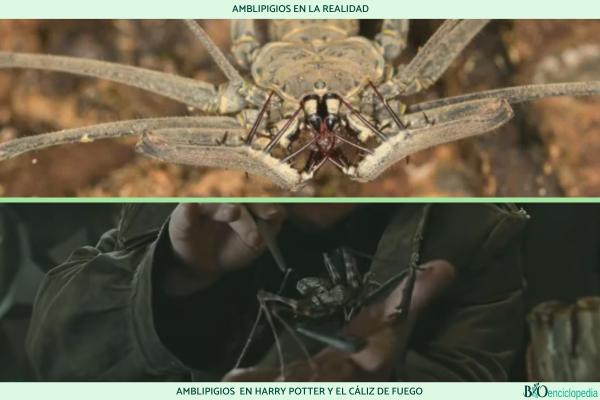
Given their striking appearance and their important ecological function as a controller of insect populations, such as cockroaches, amblypygians are animals that have aroused curiosity in the scientific community for decades, and have even inspired artists of all kinds, appearing in films such as Harry Potter and the Goblet of Fire.
Taxonomy of amblypygian
- Domain: Eukarya
- Kingdom: Animalia
- Phylum: Arthropoda
- Subphylum: Chelicerata
- Class: Arachnida
- Order: Amblypygi
Within the order Amblypygi, 5 families have been described, which are called Charinidae, Charontidae, Paracharontidae, Phrynichidae and Phrynidae. In total, there are 140 species of amblypygian known, which are distributed throughout the tropical and subtropical areas of our planet.
As we can see, these animals belong to the class Arachnida, but they are not spiders, which make up the order Araneae. Amblypygians are classified in the order Amblypygi, differentiated from the rest of the arachnids by their long pedipalps and their first pair of legs converted into long, thin and articulated sensory appendages.
Do amblypygia itch?
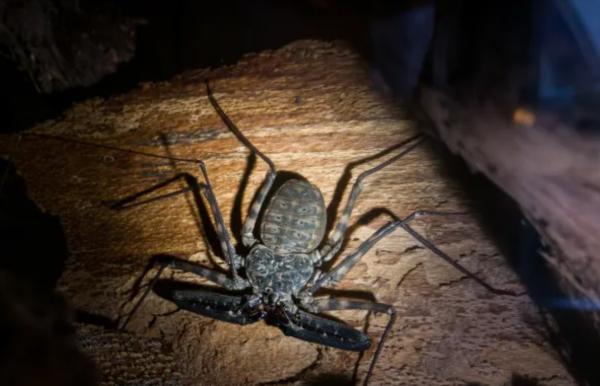
Despite their fearsome appearance, amblypygi are not dangerous to humans, since they do not have venom glands and their chelicerae are generally small in size. In reality, they are shy and not very aggressive animals that prefer to hide in dark and humid places. They can rarely sting with their chelicerae, but if this happens, the sting is similar to a tiny bite, chemically harmless to the body.
Characteristics of amblypygia
- Amblypygi have a body divided into two parts: the prosoma or cephalothorax, which is wide and flattened, and the opisthosoma or abdomen, which is elongated and segmented. The prosoma has eight eyes, two central and three on each side of the front margin. However, some species lack eyes or have very poor vision. The opisthosoma is made up of twelve segments and contains the internal organs of the animal. The genital opening opens in the second segment and is covered by an operculum that also protects the first pair of respiratory organs, called phyllotracheae.
- As for the mouthparts, in the amblypygian they are called chelicerae. They are small and pincer-shaped, but do not have a poison gland.
- On the other hand, the pedipalps are the most striking extremities of the amblypygians, which are characterized by being very long and robust, with numerous spines that they use to capture and hold their prey. The last segment of the pedipalp can bend over the previous one, forming a kind of pincer.
- Another very striking structure of the body of these arachnids is the first pair of legs, which is the longest of all. It can measure up to 30 cm and has many articulated segments. These legs are not used for walking but for exploring the environment. Amblypygians use them to detect vibrations, smells and flavors in the air and on the ground and they also use them to communicate with other individuals of their species. The other three pairs of legs are shorter and thinner than the first, they are used to move along the floor or walls and have claws at the ends that help them cling to surfaces.
Examples of amblypygia
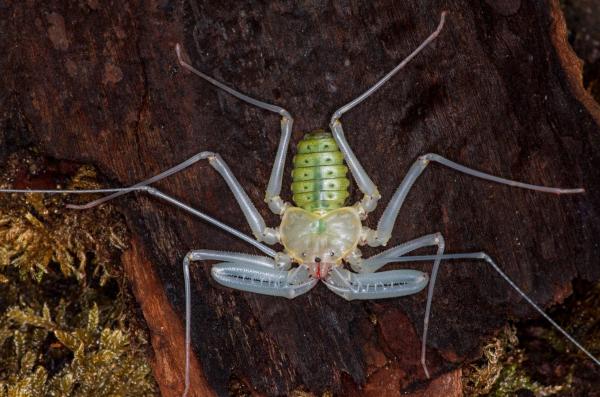
- Phrynus marginemaculatus: lives on Caribbean islands, with a 2 cm body and 10 cm long legs. It is light brown with dark spots on the prosoma and opisthosoma. It feeds on insects and spiders.
- Acanthophrynus coronatus: Found in the humid tropical forests of Mexico and Central America, with a body of 2.5 cm and legs of 15 cm. It has a black color with spines on the pedipalps and opisthosoma. It feeds on scorpions, centipedes and other arthropods.
- Damon headband: It is native to Africa and is the largest of all amblypygian species, with a body of up to 4.5 cm and legs of up to 30 cm. It has a dark brown color with light bands on the opisthosoma. It feeds on crickets, cockroaches and other arthropods.
- Paraphrynus carolynae: lives in the humid jungles of Costa Rica and Panama, with a body of 1.5 cm and legs of 8 cm. Most of its body is reddish brown, but it also has white spots on the prosoma and opisthosoma. Their diet is based on insects.
- Paracharon caecus: It is endemic to the caves of Brazil, with a 1 cm body and 5 cm legs. Its white color and lack of eyes indicate how adapted it is to cave life.
- Sarax mediterraneus: It is another species found on the islands of the eastern Mediterranean, with a body of 0.5 cm and legs of 3 cm. It has a dark brown color with light spots on the prosoma and opisthosoma. It feeds on insects and other arthropods.
Now that you know amblypygians better, we recommend reading more about other arachnids. Here you can read about the Spider and the Tarantula.
If you want to read more articles similar to Amblipigios: what they are, characteristics and examples, we recommend that you enter our Biodiversity category.
- Science Direct (sf) Amblypygi: an overview. Available at: https://www.sciencedirect.com/topics/agricultural-and-biological-sciences/amblypygi
- Beatty, R., Beer, A., & Deeming, C. (2010). The book of nature. Great Britain: Dorling Kindersley.
- de Armas, L.F. (2014). The amblypygians of Cuba (Arachnida: Amblypygi). Revista Ibérica de Arachnología, 24, 29-51.
