
Diatoms are microscopic unicellular algae of the division Chrysophyta and class Bacillariophyceae. They reproduce asexually, are generally non-motile, have pigments such as β-carotene, fucoxanthin and diatoxanthin. These microorganisms serve as natural fertilizer, insecticide and environmental indicators, among others. In this BIOencyclopedia article you will learn more about what diatom algae are, their characteristics and what they are for.
What are diatom algae?
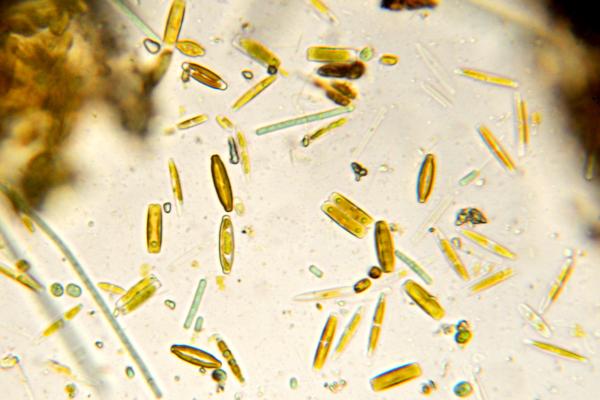
Diatoms are microscopic unicellular algae of the division Chrysophyta, class Bacillariophyceae, which inhabit aquatic, terrestrial and humid environments, and in various environmental conditions, from polar waters to tropical regions. These algae have a very ornate crystal structure composed of silica (called a frustule), which is divided into two parts that fit together perfectly, similar to a Petri dish. They are found throughout the world and are responsible for approximately 20% of terrestrial oxygen, and are also essential in the aquatic food chain.
Diatoms measure between 20 and 300 microns, although some reach more than a millimeter. Their silica shell has small pores that allow them to absorb nutrients and secrete polysaccharides. They contain chlorophyll, ß-carotene and fucoxanthin, which allows them to carry out photosynthesis.
What are the characteristics of diatom algae?
- Diatoms have yellow-brown chloroplasts with pigments such as β-carotene, fucoxanthin and diatoxanthin, and they store food in the form of carbohydrates or oils, which also helps them stay afloat.
- Diatoms reproduce asexually by cell division, but their size decreases with each generation. Eventually, they reproduce sexually, forming a zygote (auxospore) that grows and restores the cell’s original size.
- Although diatoms are generally not motile, some species can move by raphe contraction, and regulate their buoyancy with intracellular lipids. This allows them to stay in surface waters where they receive more light.
What are the types of diatoms that exist?
Based on the shape of the frustules, there are two types of diatoms: round diatoms (order Centrales) and elongated diatoms (order Pennales).
round diatoms
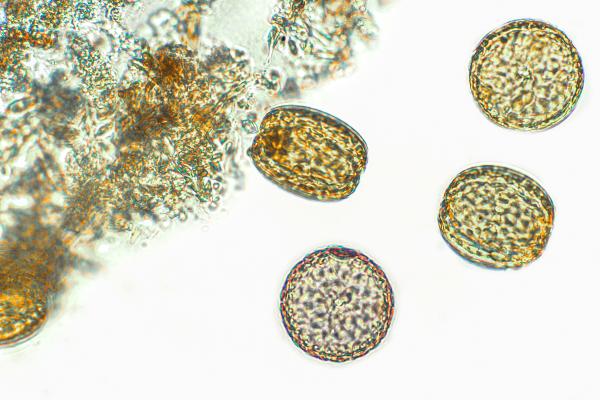
The order Centrales, also known as Biddulphiales, includes diatoms with valves that have striations arranged radially around a central point, ring or areole. These diatoms are mostly marine and are divided into two suborders: Coscinodiscophyceae (radial) and Mediophyceae (polar). The valves have radial ornamental patterns that appear as dots under a microscope, and some species have spines that help increase buoyancy or protect themselves from predators. Regarding its sexual reproduction, it is oogamic, with haploid gametes that fuse to form a zygote that grows in an auxospore, giving rise to vegetative cells.
Examples:
- Coscinodiscus
- Thalassiosira
- Stephanodiscus
- Chaetoceros Melosira
- Eupodiscus
- Asteromphalus
Elongated diatoms
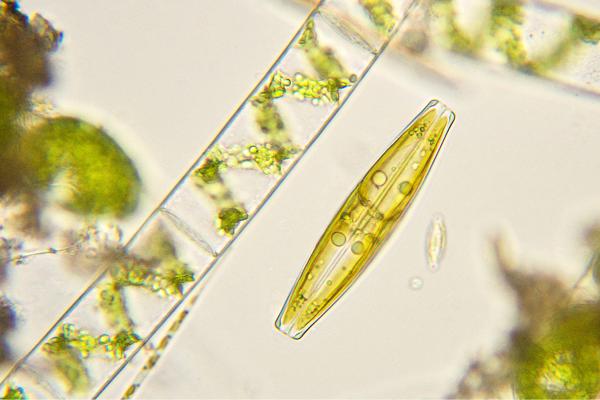
The order Pennales, also called Bacillariales, includes heteroconta diatoms with bilaterally symmetrical valves. It is divided into two suborders: Fragilariophyceae, which does not have a raphe, and Bacillariophyceae, which has a raphe or cleft in the valve. The valves of pennate diatoms can be linear or oval, with symmetrical ornamental patterns formed by striations. The name “pennales” is due to the elongated shape of its valves, which have a sternum, a longitudinal silica rib. These diatoms are mostly freshwater and reproduce sexually by isogamy or autogamy, forming auxospores from the fused gametes.
Examples:
- Navicula
- Nitzschia
- Cymbella
- Lycmophora
- Thalassionema
- Asterionella
What are diatom algae used for?
- Natural fertilizer: Diatomaceous earth is an excellent fertilizer, rich in essential nutrients for plant growth and improves soil fertility.
- Effective insecticide: Diatom powder dehydrates and punctures the exoskeleton of insects, killing them progressively, without affecting larger living beings.
- Soil improver: Used to neutralize the toxicity of heavy metals and improve contaminated soils, especially in areas affected by hydrocarbons or heavy metals.
- Biodiesel: The high concentration of lipids in diatoms facilitates the production of biodiesel, contributing to the creation of more sustainable biofuels.
- CO₂ Reduction: Diatoms capture carbon dioxide and convert it to oxygen through photosynthesis.
- Environmental indicators: Diatoms are used to study water quality and climate changes, since they are sensitive to the environmental conditions of the water. Here you can learn more about Environmental Indicators or bioindicators: what they are, types, examples and importance.
What are the parts of a diatom?
Diatoms have a unique cellular structure made up of a thick, rigid silica wall, known as a frustule. This frustule is composed of two unequal valves that overlap, a lid called the epivalve and a base called the hypovalve, joined by a belt.
The valves have perforations called areolas, arranged in grooves, which allow the exchange of substances with the environment. Additionally, diatoms have structures such as the central nodule, the raphe (a crack in the valves) and the polar nodule. These characteristics, together with the ornamental processes on the valves, give them great diversity.
Inside the cell, there are other important components. Some of the internal parts of a diatom are: pyrenoid, plastids, mitochondria, vacuole, endoplasmic reticulum, Golgi apparatus and microtubules.
Frequently asked questions about diatoms
Where are diatom algae found?
They mainly live in aquatic environments, both marine and freshwater, floating in the water column or attached to surfaces.
What role do diatoms play in the ecosystem?
They are primary producers that generate oxygen and form the basis of many aquatic food chains, in addition to participating in the carbon and silicon cycle.
What is the importance of diatoms in the food chain?
They are the main food for zooplankton and other microscopic organisms, which makes them an essential link for marine and aquatic life. Here you can read about the Food Chain: what it is and examples.
Why are diatoms considered bioindicators?
Because its presence, abundance and sensitivity to contaminants make it possible to evaluate water quality and detect environmental changes or contamination.
Do diatoms carry out photosynthesis?
Yes, diatoms are photosynthetic algae that produce oxygen and obtain energy from sunlight, like plants and other algae.
How do diatoms reproduce?
Mainly by cell fission (asexual reproduction), although they can also reproduce sexually under certain environmental conditions.
What is the difference between diatoms and other algae?
Diatoms have a silica frustule (cell wall) with ornate shapes, and their reproduction, pigments and habitats may differ from other algae.
What is diatomaceous earth and what is it used for?
It is a powder made from fossilized remains of diatoms. It is used as a natural fertilizer and insecticide, water filter, additive in animal feed and cosmetic product.
If you want to read more articles similar to Diatom algae: what they are, characteristics and what they are for, we recommend that you enter our Ecosystems category.
- Christiaan Hoek et al. 1995, Algae: An Introduction to Phycology. Cambridge University Press
- Berdan, R. 2023. Diatoms – Nature’s Jewels viewed with a Microscope. https://moticmicroscopes.com/blogs/articles/diatoms-nature-s-jewels-viewed-with-a-microscope?srsltid=AfmBOooyL_2Vp2nyO8TZb5pZZ2y_SxuLGqYwLGRvB-lc-uJi5BpYZ2JE
- Diatoms of North America. https://diatoms.org/what-are-diatoms
- APEM Group. What are diatoms and what can they tell us about water quality? https://www.apemltd.com/what-are-diatoms-and-what-can-they-tell-us-about-water-quality/
- Manaaki Whenua Landcare Research. Diatoms. https://www.landcareresearch.co.nz/tools-and-resources/identification/freshwater-algae/description-of-major-groups/diatoms
