
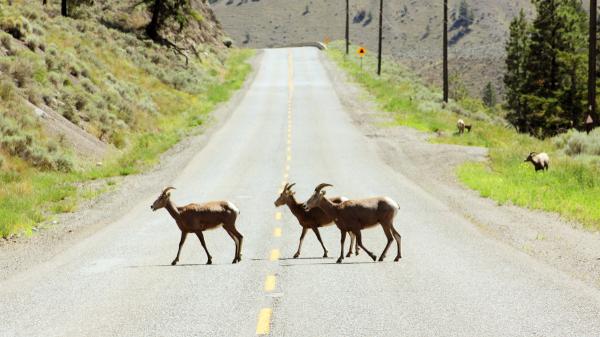
Roads allow people to connect territories, but they can have exactly the opposite effect on animals. A highway can become a barrier that separates feeding, reproduction or refuge areas and forces numerous species to risk their lives every time they need to cross it.
Arizona, in the United States, has become one of the most interesting examples of how to address this problem. The state has numerous crossings specifically designed for wildlife and some projects have managed to reduce collisions between vehicles and animals by more than 90%. Spain also has thousands of structures that can facilitate these movements and in 2026 it has updated the recommendations to design them.
What is this ingenious system that allows animals to cross roads without danger?
The so-called fauna passes can take very different forms. There are bridges covered with earth and vegetation that cross over roads, tunnels and underpasses, large viaducts and even sewers and drains adapted so that certain animals can use them.
Arizona has been experimenting with these solutions for decades. One of the most studied examples is on State Route 260, east of Payson, where underpasses and fencing systems were installed specifically for large mammals such as elk.
The results explain the growing interest in these infrastructures. The Arizona Department of Transportation (ADOT) notes that a project that connected three existing passes with fencing reduced vehicle-moose collisions by 98 percent over a six-year period.
The key is that it is not enough to build a tunnel or bridge. Fencing prevents animals from entering the road directly and directs them to places where they can safely cross the road.
Research carried out on SR-260 itself also verified through cameras and GPS collars that different species used these structures, demonstrating that they can simultaneously improve road safety and ecological connectivity.
Bridges, fences and native vegetation to return animals to their natural routes
The most recent project is in the Interstate 17 (I-17)south of Flagstaff, an important route that crosses areas used by large mammals.
The so-called Willard Springs Wildlife Overpass began construction in 2025 and is scheduled to be completed in fall 2026. The project received about $24 million in federal funding under the Wildlife Crossings Pilot Program.
The action does not only consist of raising a bridge over the highway. It includes fencing to direct animals towards the passage, escape ramps, adaptation of existing structures and recovery of vegetation using native species.
The primary goal is to facilitate the movements of elk and deer, although these structures may end up being used by many other species.
Arizona has also developed desert bighorn sheep passes on US 93 near Hoover Dam. According to an analysis published in 2026 by the Pew Charitable Trusts, projects developed on highways such as SR-260 and US 93 have achieved reductions of more than 90% in collisions with wildlife.
Spain registers about 36,000 accidents a year related to animals
The problem is far from exclusively American. The latest data published by the General Directorate of Traffic show the dimension that it has also reached in Spain.
In 2024, around 36,000 road accidents involving animals were recorded and approximately 98% caused only material damage. The figure is especially significant because these incidents have doubled in a decade and already represent approximately a third of the accidents reported on interurban roads.
The increase in populations of certain species, changes in their distribution areas and the existence of roads that cross their habitats make animals such as wild boars and roe deer frequent protagonists of these accidents.
The problem also directly affects the conservation of threatened species. The Iberian lynx is especially vulnerable to roads, to the point that the Ministry for the Ecological Transition (MITECO) considers road accidents one of the main causes of mortality associated with human activities.
This is how Spain protects animals on the roads
The same Ministry reports that since the 1990s, numerous transversal structures have been built in Spain designed to facilitate the passage of animals on roads and railway lines.
Not all are great green bridges. Many are structures originally created as drainages, passages over channels, roads or viaducts that can later be conditioned to facilitate the movement of animals.
Precisely in 2026, MITECO has published a new edition of its “Technical prescriptions for the design of wildlife crossings, perimeter fencing” and other measures to promote biodiversity in transport infrastructure. The update incorporates the scientific and technical knowledge obtained during the last decade.
Among the solutions are ecoducts, specific overpasses and underpasses, adaptation of drainage, viaducts, fences and systems that lead animals to safe places.
For species such as the Iberian lynx, the Ministry itself considers that ecoducts and viaducts are especially suitable in strategic ecological corridors, accompanied by specific enclosures capable of preventing these felines from accessing the road.
The experience accumulated in Arizona reinforces an idea increasingly accepted in engineering and conservation: a road does not have to inevitably become a frontier for nature. By identifying where animals move and correctly combining crossings, fencing and habitat restoration, it is possible to reduce road kill while keeping ecosystems connected.
If you want to read more articles similar to The US teaches Spain a lesson: Arizona builds 27 wildlife crossings and reduces accidents with animals on the road by 90%, we recommend that you enter our Other environment category.
- Federal Highway Administration: Arizona Case Study and Crash Reduction / https://www.environment.fhwa.dot.gov/env_initiatives/pel/case_arizona.aspx
