
While the planet’s average temperature continues to increase as a result of climate change, there is a region of the North Atlantic Ocean that is following a different trend. This is the so-called “cold spot”, an area located between Spain and Greenland where surface waters have cooled or increased their temperature at a much slower rate than the rest of the oceans.
Far from questioning global warming, this anomaly has become one of the phenomena that arouses the most interest among scientists. Research suggests that it could be related to changes in the large ocean currents that regulate the Earth’s climate, so understanding what is happening in this area of the Atlantic is key to anticipating how the climate could evolve in Europe and other regions of the world in the coming decades.
Why is there a huge “cold spot” in the middle of the Atlantic and what is really happening?
The so-called cold spot is an extensive region of the North Atlantic located between the eastern coast of Canada, southern Greenland and western Europe that, unlike the rest of the planet, has maintained a much slower cooling or warming trend in recent decades. This anomaly stands out on global temperature maps because it appears as a blue area surrounded by areas that show a general increase in temperatures.
Although it may seem like a contradiction in a context of global warming, scientists clarify that this phenomenon does not prove that climate change has stopped. On the contrary, they consider that it is an indirect consequence of the alterations that warming itself is causing in the Atlantic ocean circulation.
For years the possibility was raised that this region was losing more heat to the atmosphere than the rest of the ocean. However, recent research points to another explanation. The cold spot receives less heat transported by ocean currents. In other words, the problem is not that the ocean releases more energy, but that less warm water arrives from more southern latitudes.
The main suspect is the Atlantic Meridional Overturning Circulation (AMOC), a system of currents that acts as a large heat conveyor belt. This circulation carries warm waters from the tropics to the North Atlantic and returns cold, deep waters to the south. If this mechanism weakens, the heat input to that area of the ocean decreases, favoring the appearance of this thermal anomaly.
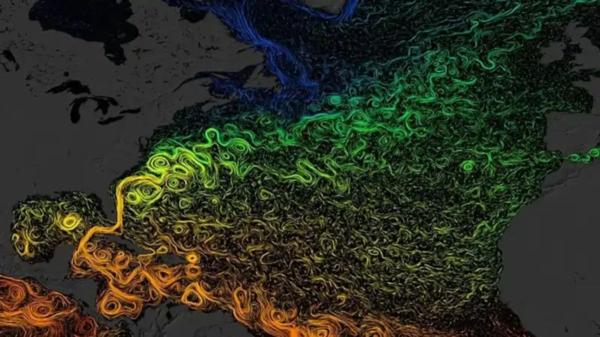
The great ocean current that could be behind this phenomenon
As we mentioned before, the AMOC is a system of currents that works like a large conveyor belt that redistributes heat across the Atlantic Ocean, moving warm waters from tropical regions to the north and returning cold, deep waters to the south. When this mechanism loses intensity, less warm water reaches the North Atlantic. As a consequence, the ocean surface in that area receives less heat input, which causes its temperatures to be lower than expected on a planet that, as a whole, continues to warm.
The researchers point out that this slowdown does not imply that ocean circulation is going to stop imminently, but it is a sign that it is responding to changes in the climate system. Among the factors that may contribute to this weakening is the accelerated melting of Greenland, which dumps large amounts of fresh water into the North Atlantic. Being less dense than salt water, it makes it difficult for water masses to sink, an essential process to maintain the functioning of the AMOC.
A recent study has reinforced this hypothesis by concluding that the cold spot is not primarily due to increased heat loss to the atmosphere, but rather to a reduction in heat transported by ocean currents. According to the authors, this change in circulation better explains the persistence of the thermal anomaly than any other mechanism analyzed.
How this anomaly can affect the climate of Europe and the rest of the world
The weakening of the AMOC not only explains the persistence of the cold spot, but could also have effects on the climate of large regions of the planet. As it is one of the main heat transport systems on Earth, any change in its intensity modifies the thermal balance between the oceans and the atmosphere.
In Europe, one of the most studied consequences would be the alteration of weather patterns. Although global warming would continue to raise the average temperature of the planet, some areas of the North Atlantic and northwestern Europe could experience relative cooling or important changes in the frequency and intensity of extreme phenomena, such as heat waves, storms or variations in precipitation.
The effects would not be limited to the European continent either. Scientists warn that a weaker AMOC could change the distribution of rainfall in different regions of the world, affect marine ecosystems and alter fisheries productivity by changing the temperature and circulation of ocean waters.
What this “cold spot” could reveal about the future of climate change
One of the main challenges is determining to what extent the AMOC could weaken in a scenario of continued warming. Although some climate models raise the possibility of a significant slowdown and even reaching a tipping point in the future, there is still a significant margin of uncertainty. The lack of long-term direct records makes it difficult to establish precisely when these changes might occur and what their intensity would be.
To reduce this uncertainty, different scientific teams are expanding observation networks in the North Atlantic using buoys, underwater sensors and oceanographic campaigns. These data allow us to understand in greater detail how water masses circulate, how temperature and salinity vary and how the AMOC responds to the melting of Greenland and the increase in global temperatures.
Experts emphasize that the existence of the cold spot does not contradict global warming. On the contrary, they consider that it may be one of the signs that climate change is altering fundamental processes in the ocean. Understanding its evolution will be key to improving climate projections and anticipating possible changes in temperatures, precipitation and meteorological phenomena that could affect different regions of the world during this century.
If you want to read more articles similar to Scientists detect a “cold spot”: this is the place between Spain and Greenland that continues to cool despite global warming, we recommend that you enter our Climate Change category.
