
In the first years of life, drawing is much more than a pastime: it helps to develop fine motor skills, coordination and autonomy. Choosing age-appropriate tools, with an ergonomic shape and easy to hold, allows children to experiment with graphic gestures in a natural way, respecting the timing of their development
This article is sponsored by

We are writing, next to us is our 2 year old son. As soon as we put the pen on the table for a second, a quick little hand reaches out and grabs it as if it had conquered a precious treasure. How many times has this happened to us?
The motivation lies in children’s extraordinary drive to emulate: our children continually observe us, see us use the pen and immediately want to do the same thing. In their eyes, that pen is a “grown-up” tool.
Yet, when they grab it, we immediately notice something strange: they grip it tightly with their entire fist and begin to vigorously move their entire arm; a completely normal method at their age, which suggests to us that the pen is not the most suitable tool to accompany them in their first approaches to drawing. There are others designed specifically for their motor skills, but navigating between the different proposals is not always easy. For example, are colored pencils or markers better? Below we will answer this question and see what characteristics drawing materials should have in the first years of life.
How does the child’s hand work?
To understand what happens when children draw, we need to take a little journey into the physiology of their hands.
At 2 years old, our hand is not simply a “miniature” version of that of an adult: the bones are not yet fully formed and have growth cartilages still in the developing phase, just as the small muscles that allow precision movements of the fingers (fine motor skills) are still fully developing.
When our children grasp a pencil or pen, it is completely natural for them to do so with a fist grip (or “palm grip”). Not yet having the subtle control of the fingers or the stability of the wrist, they compensate by taking advantage of the larger muscles: they use the shoulder as a pivot and the forearm as a lever.
That’s why their movements are large, energetic, sometimes almost uncontrollable. And there’s more: since the movement starts from the shoulder, the paper on the table is “tight” for them. This is how, without any intention of causing mischief, their trace ends up on the wood of the living room table or on the walls of the corridor.
From wax “pebbles” to triangular crayons: accompany the grip without forcing
What can we parents do when faced with this fundamental need to leave a mark? The pedagogical response is to offer the right tool depending on age, a principle that is found in the philosophy of Faber-Castell products for early childhood, developed to accompany the different stages of the child’s hand development.
From 2 years old and up, rather than forcing them to hold a thin object in their hand, we can provide our children with tools that adapt to the shape of their hand. In early childhood, wax crayons represent the ideal ergonomic solution. In particular:
- From the first moments of curiosity, our children can easily hold drop-shaped or small stone-shaped wax crayons: with the whole palm, exactly as they would with a stone collected in a meadow, with extreme naturalness.
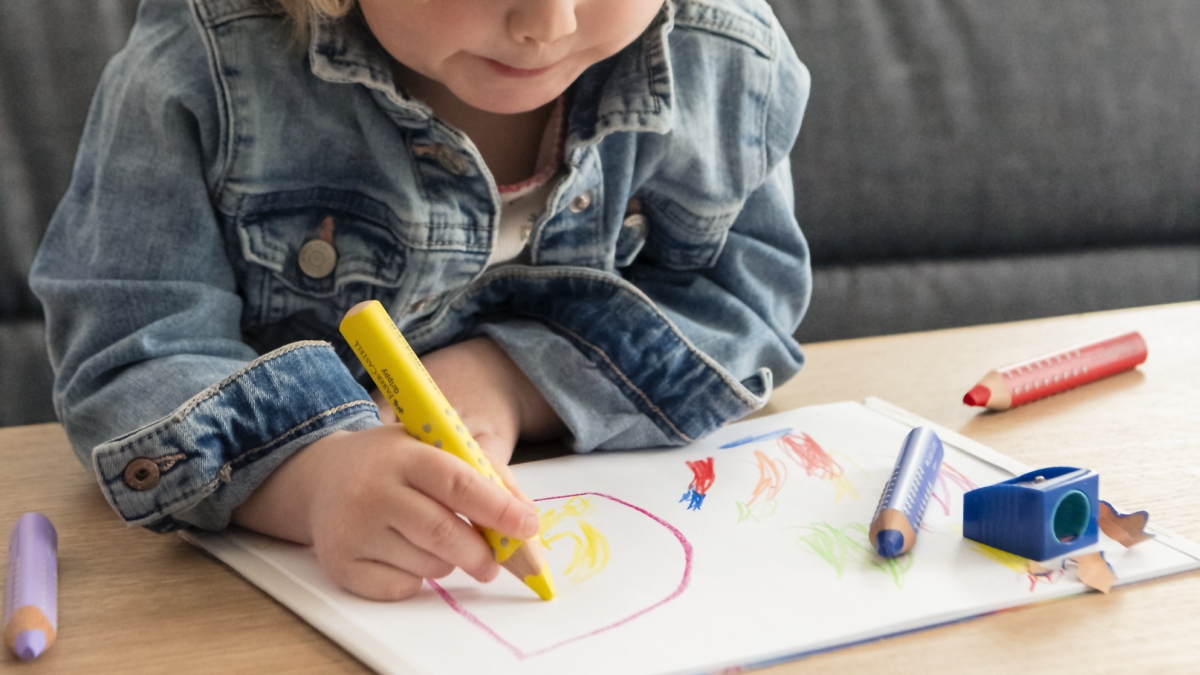
- From 2 years old we can provide small tools such as pencils Grippy 3-in-1 (pastel, wax and watercolour), which thanks to their ergonomic barrel are easy to hold and accompany the first attempts at drawing.
- Subsequently, always under 3 years of age, we can also offer triangular wax crayons, perfect for encouraging the developmental transition of grip. Their shape with three flat faces prevents the crayon from slipping between the fingers, spontaneously guiding the little hand from the fist grip towards an initial setting of the fingers, without ever forcing it.
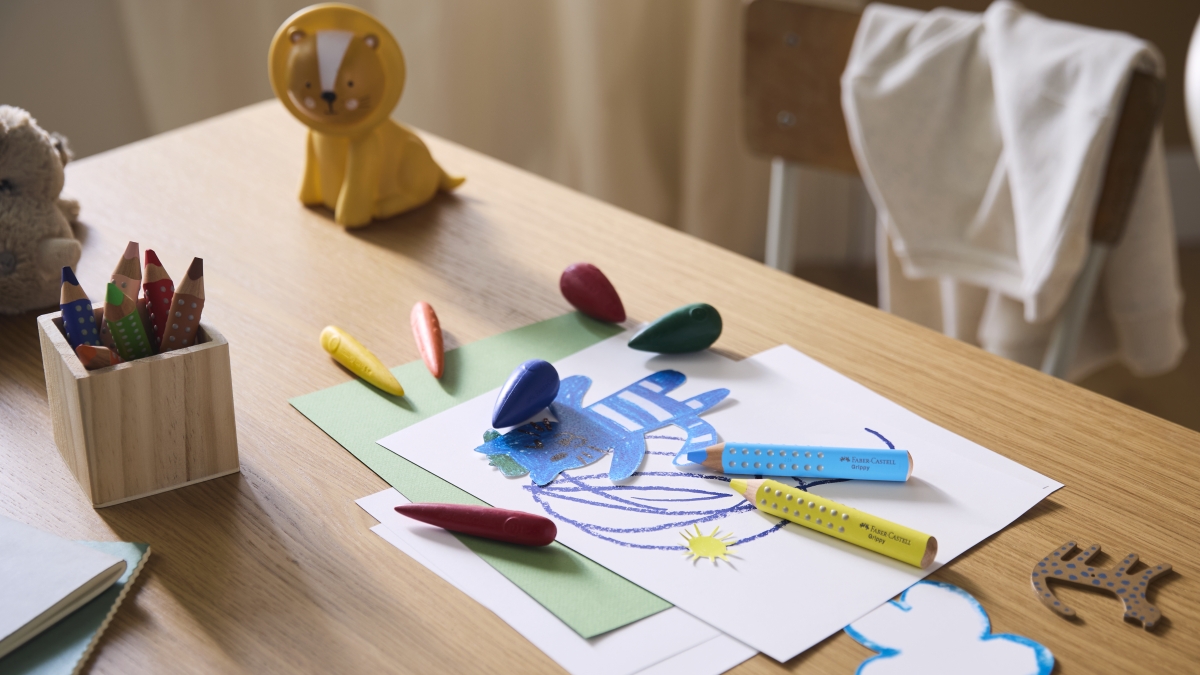
As motor control increases, therefore between 3 and 4 years of age, children spontaneously move from a fist grip to a “paw” grip (with the fingers starting to wrap around the stem), and then gradually arrive at the three-finger grip (the digital triad). To facilitate this step without tiring the fingers, we can provide them with wooden pencils with triangular shafts (such as Jumbo Grip) where the three ergonomic faces suggest where to place your fingers.
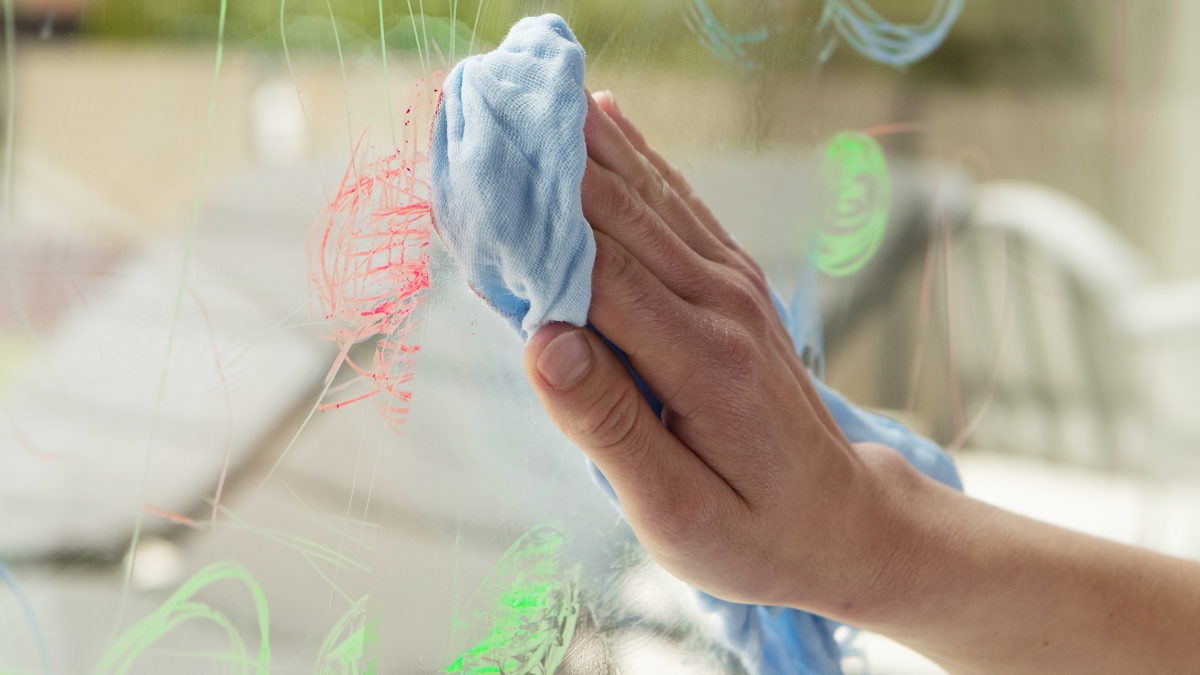
The practical advice given to us parents, in order to avoid the fear of “writings on the walls”, is to always choose washable products, such as those just mentioned.
The limits of markers
We often tend to give small children boxes of colored markers, because “they write immediately and in bright colours”. From the point of view of neuromotor development, however, these tools present two major limitations in early childhood:
- They do not train the hand muscles. The marker releases color at the slightest contact with the paper, without requiring any effort. In contrast, colored pencil or wax crayon offers a slight resistance on the paper. To make their mark, our children must apply active pressure. This exercise is a real “gym” for the hand muscles and sends important information to the brain on how to calibrate strength.
- The frustration of the tip returning. A 2-3 year old girl or boy tends to apply the same pressure on the marker as with pencils or wax crayons. Result? The synthetic tip of the marker is crushed inside the barrel, the instrument breaks.
This is why, up to 4-5 years of age, the ideal material remains colored pencil or wax crayon. If we really want to use markers, let’s focus on specific models with thick tips and safety recesses.
Because sharpening a pencil is a fantastic exercise
There is a stationery object that in the eyes of our children has a charge of magic and irresistible discovery: the pencil sharpener. From a psychomotor point of view, toe is an extraordinary activity because it requires a complex and highly refined joint movement: the rotation of the wrist.
Observing our children as they learn to use a sharpener, we will notice a very funny phenomenon: at the beginning they move both the pencil and the sharpener! They turn both hands at the same time in space, uncoordinated, trying to understand which way to apply force and how to coordinate the movements.
Then, gradually, the magic of the evolving brain takes its course. Children understand the biomechanics of the gesture: they understand that if they hold the sharpener still or blocked on the table with one hand and use the other hand to rotate the pencil with a movement of the wrist, the tip forms much faster without breaking and without effort.
Offer an ergonomic and capacious pencil sharpener, like the Grip three-hole pencil sharpenerdesigned for both standard-sized and chubby pencils Jumbo and equipped with a shaving container, it doesn’t just keep pencils functional. It is a real motor laboratory that trains bilateralism (one hand stabilizes, the other acts) and wrist flexibility, two essential requirements for future fluid writing.
Eraser: learn to correct yourself
We arrive at one of the most delicate and exciting topics of cognitive development: the relationship with error.
We parents, guided by the instinctive desire to “protect” our children or speed up homework time, tend to do something automatic when we see them writing or drawing: we keep the eraser ready in our hands. Our children are tracing a letter or a word and our adult sight, faster and more trained, intercepts the error before they have even finished writing. And so we “start the attack”: we grab the eraser and erase the wrong line on the sheet, trying to “help” them.
From a neuropedagogical point of view, this type of intervention is not exactly the best. If our goal is for our children not to be afraid of making mistakes and to develop solid self-esteem, the eraser should never be in our hands, but always and only in those of our children.
What do scientific discoveries tell us about how the brain works? They show us that the process of learning and memorizing correct information passes through a precise circuit:
- Identifying the error. The child’s brain must notice the inconsistency.
- Conscious corrective action. Our children perform the mechanical gesture of holding the eraser and erasing the incorrect trace.
- The rewriting. The hand traces the correct version.
If we parents intervene first and erase the error for them, we interrupt this neurological circuit. In this way our children not only do not understand where they made a mistake, but they will tend to repeat the mistake in the future precisely because they were not the ones who identified it and erased it and they did not experience the value and satisfaction of the repair.
The deletions made personally by our children have an inestimable pedagogical value: they are tangible evidence of an awareness! By deleting on their own, their brain “archives” the sensation of the error and stores the correct version, strengthening their confidence in their self-correcting abilities.
Instead of erasing for them, we can limit ourselves to gently indicating the point: «Let’s look carefully here, there is something that can be improved. What do you think?”. After that, we invite them to take the ergonomic eraser and let them erase and rewrite.
The eraser in our children’s hands is an instrument of cognitive power: it transforms the error from a “failure” to a simple “stage of improvement”.
Painting, mixing and autonomy: beyond drawing
Artistic exploration in childhood also passes through contact with fluid color and water, an area in which the choice of the right accessories becomes a powerful catalyst for autonomy.
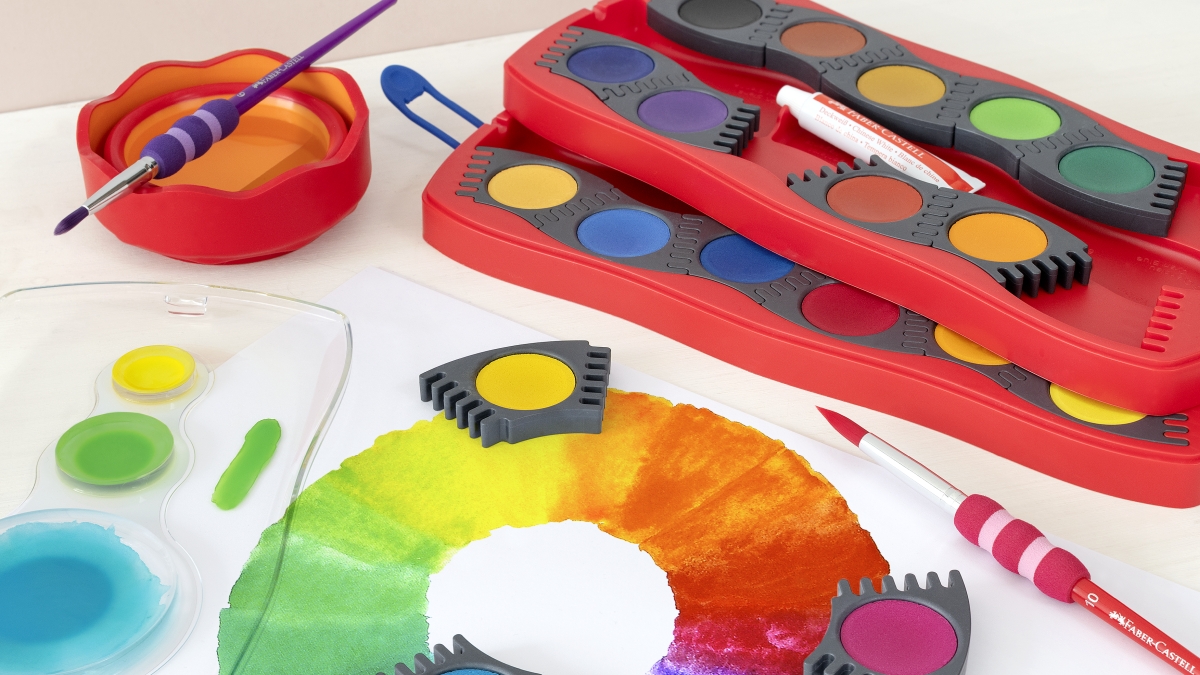
When we use watercolors designed to be “playable”, whose tablets connect to each other like pieces of a puzzle (as in the case of watercolors Connector), we transform the preparation of the activity into a precious exercise in hand-eye coordination and logic.
Fewer screens, more matter: a gift for our children’s brains
In an era in which even the youngest children are increasingly exposed to smartphones and tablets, let’s remember that sliding your finger on smooth glass does not develop hand muscles or the perception of force.
Offering our children daily time to spend in contact with pencils, soft waxes, paper and water colors means giving them an irreplaceable learning experience. Through the graphic gesture and the resistance of physical matter, our children not only prepare their hand for future writing, but train patience, concentration, self-correction of errors and the wonder of seeing their emotions take shape on the paper. of strength.
Offering our children daily time to spend in contact with pencils, soft waxes, paper and water colors means giving them an irreplaceable learning experience. Through the graphic gesture and the resistance of physical matter, our children not only prepare their hand for future writing, but train patience, concentration, self-correction of errors and the wonder of seeing their emotions take shape on the paper.
