Between record heat and low snowfall, in 2026 Swiss glaciers lost 5.5% of their mass, marking the second worst result ever recorded (after 2022).
Swiss glaciers, among the most affected by climate change, have lost almost 20% of their mass in five years. 2026 ranks second in terms of ice loss ever recorded, behind only the record of 2022. This is indicated by the new study by the GLAMOS (Glacier Monitoring in Switzerland) network, published after a record summer for temperatures and a winter with little snowfall: this year the Swiss glaciers have lost 5.5% of their volume.
“This year, glaciers have lost enormous amounts of ice,” said Matthias Huss, director of GLAMOS, calling 2026 “a catastrophic year.”
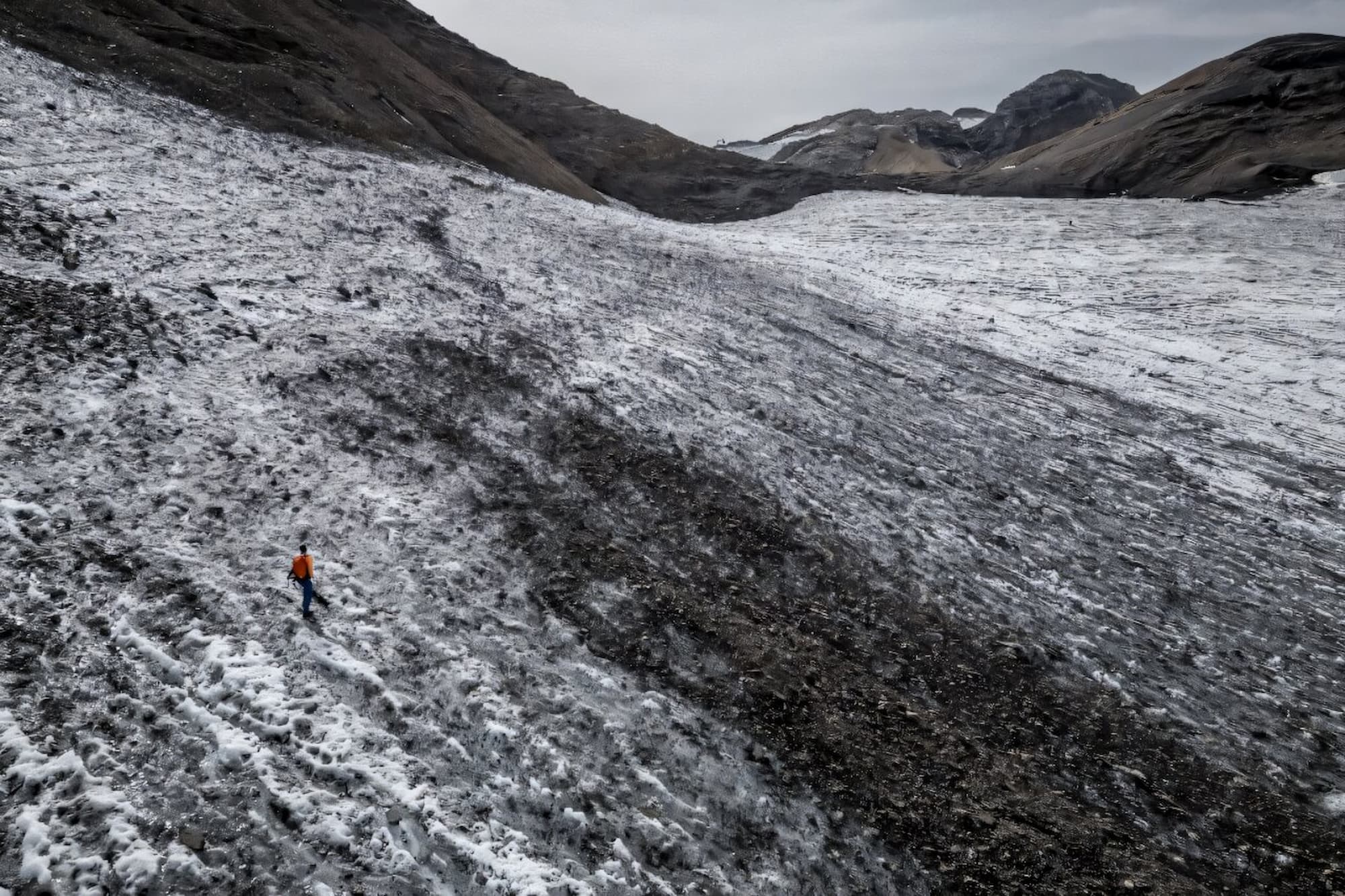
The Scex Rouge glacier
Huss commented on the fate of the Scex Rouge glacier, at almost 3,000 meters above sea level. “This is a glacier that is not surviving,” he said. “Probably in 10 or maybe 15 years there will be no more ice.” The glaciologist carefully dismantled the four-meter-long aluminum measuring pole inserted in the center of the glacier. At the end of July, when it was installed, it was completely embedded in ice. Today more than three meters protrude from the gray surface. “We’re not surprised, because we know how quickly the glaciers are retreating,” Huss explained, “but seeing the colors of the mountains where there’s no snow anymore, where there are only these rocks and these dark glaciers, relics of the past… it’s incredible.”

An unprecedented acceleration
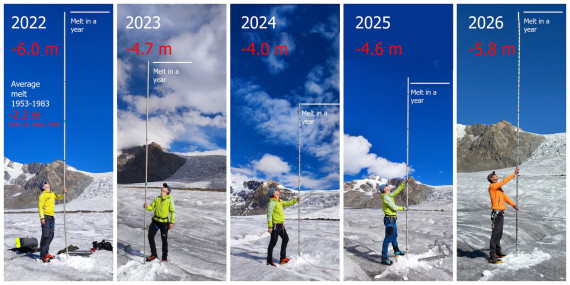
Between 2022 and 2026, the rate of melting of Swiss glaciers was “more than double that of any five-year period previously monitored”, reads the report, which highlights a volume loss of almost 20% since 2021.
The retreat has been underway for some time, but has recently accelerated sharply. Between 1990 and 2000, 10% of the Swiss ice volume disappeared; in the last 10 years the loss has reached 27%. GLAMOS’ conclusions are based on measurements carried out in September on 23 reference glaciers, the results of which were then extended to the almost 1,300 glacial formations still present in Switzerland. The data is presented in the annual report of the Swiss Academy of Sciences (SCNAT). GLAMOS is based at the Federal Institute of Technology Zurich (ETH) and the universities of Freiburg and Zurich.
Extreme heat and little snow
The report comes after a summer in which June, July and August were the hottest months on record in Switzerland since measurements began in 1864, according to the Federal Office of Meteorology and Climatology.
The winter of 2025-2026 was also among the 10 least snowy since measured. Between May and September, heat and drought caused excessive melting even at the highest altitudes. For 76 days, heat waves pushed the freezing point above 4,000 metres, more than double the average and a Swiss record. The snow cover that protects the glaciers had already partially disappeared during the June heat waves and in September there was no more snow even at 3,500 metres.
“Alpine glaciers have no chance of surviving in the long term under such conditions,” GLAMOS said. The average ice thickness of some glaciers has decreased from 2.5 to 4 meters, while the most exposed glacial tongues have lost up to 10 meters during the summer. The researchers had to reposition the measuring stakes higher up, even on the highest glaciers, because the ice had melted in its original locations.
Record touched, but not exceeded
Despite the higher temperatures, the overall loss did not surpass the 2022 record: many glaciers had received more snow before the summer melt than four years ago. Additionally, less Saharan dust settled this year, and more sunlight was reflected back into the atmosphere rather than absorbed by the snow.
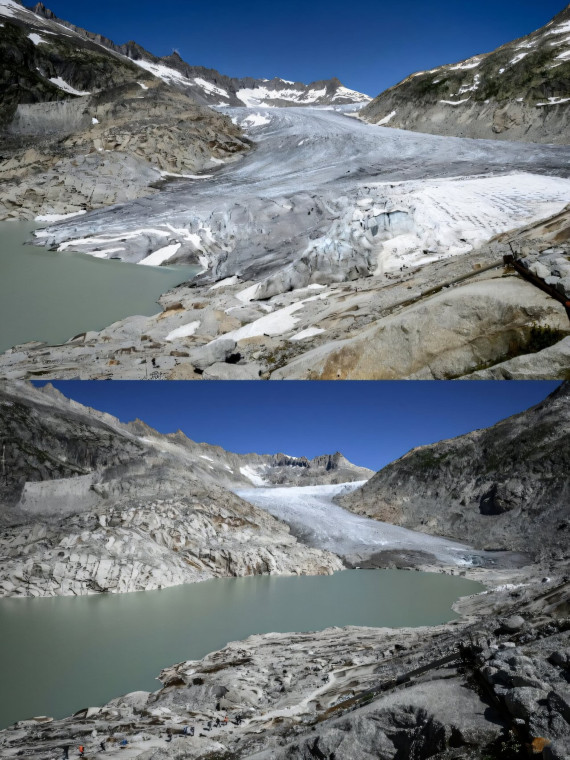
There was no shortage of exceptions. three major glaciers recorded record melting: the Rhone, the Aletsch (the largest in the Alps) and the Clariden. Some smaller glaciers have disappeared completely and permanently, including Bella Tola, in Valais, and Griessfirn, in the canton of Glarus.

The water question
With the retreat of glaciers, concern about the future availability of water resources is growing. Between July and September the glaciers released around 2,200 billion liters of water, an amount “hard to imagine”, Huss said: more than four times the annual drinking water consumption of Swiss families.
If the melting has contributed to alleviating the summer water shortage, this relief is destined to run out, because the glacial surface continues to shrink irreversibly.
