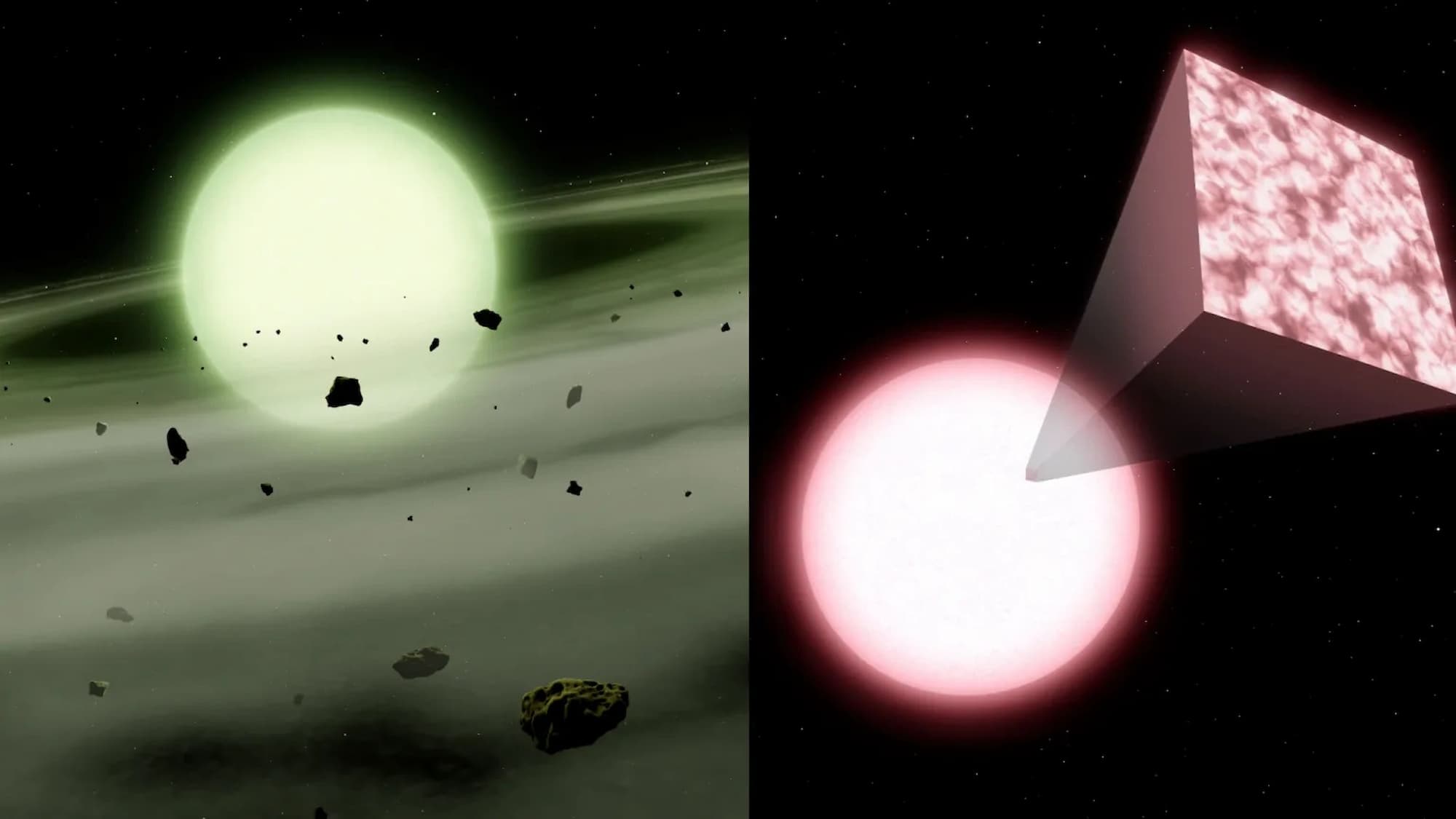
It’s a question of density, and not just temperature as previously believed: the remains of ancient planets create white dwarfs with colors never seen before.
For decades we thought that the color of a star depended only on temperature. A study by the University of Warwick shows that, for the densest stellar remains of the Galaxy, this is not always the case: among them there are pink, yellow, purple, blue stars and, for the first time, a truly green one.
If you ask an astronomer what color the stars are, the answer is almost always a question of thermometer. The coldest tend towards orange, those like the Sun towards white, the hottest towards a pale blue: the same progression as iron in the forge, which goes from red to orange to incandescent white. It was believed that even white dwarfs, the compact remains that stars like the Sun leave at the end of their lives, respected the rule…
Are orange, white and blue the only possible colors in the night sky?
No, answers research led by Mark Hollands, Warwick Prize Fellow of the Astronomy and Astrophysics group of the British university, published on RAS Techniques and Instruments. If we could get closer, some white dwarfs would appear green, pink, cyan, yellow or purple.
“Most stars, including white dwarfs, behave like a perfect radiator and their color is determined almost only by temperature,” explains Hollands. «But no one had really explored other possible causes. These very dense stars, however, produce unexpected colors and some surprised me.”

The secret is density
What breaks the rule is the extreme density. In the atmospheres of the coldest white dwarfs the matter can reach about one gram per cubic centimeter, like water and millions of times more than the solar photosphere.
Under these conditions, trace elements, such as carbon, calcium and sodium, interact with the dense helium plasma and absorb light over a much wider range of wavelengths than normal. The result is that the color deviates from what was expected.
How do you “see” a star that you can’t see
No white dwarf is close enough for us to observe its color with the naked eye, so the researchers reconstructed it. They started from the spectra, the “fingerprints” of starlight broken down by wavelength, as a prism does with sunlight. Then they ran them through a model of human color vision, resulting in the hue that a human eye would perceive.
In short, a spectrum reveals not only temperature and chemical composition, but also the true color.
A palette with precise rules
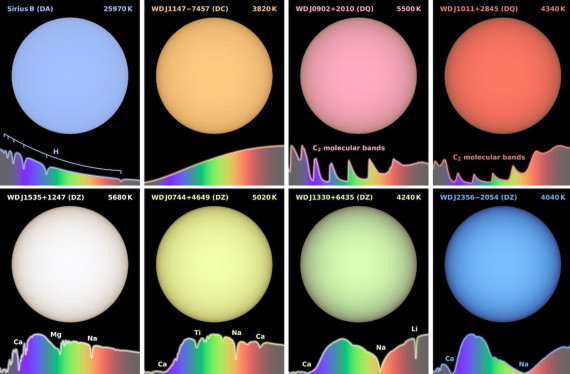
Applied to white dwarfs in the sky, the method revealed very distinct groups, each linked to the composition of the atmosphere. And so carbon-rich dwarfs tend towards pink or purple; those polluted by debris from asteroids and comets, remnants of ancient planetary systems, turn yellow; the coldest ones, with mixed atmospheres of hydrogen and helium, take on cyan or pale blue tones, due to the effect of collisions between hydrogen molecules and helium atoms in ultra-dense atmospheres.
The first green star in the Galaxy
The most sensational case is WD J1330+6435, around 4,000 degrees Celsius, which has swallowed rocky material from its own planetary system. Its atmosphere has thus become enriched with calcium, lithium and sodium, and in the team’s models it appears a chartreuse green. As far as the authors know, no other star, living or dead, has ever been credibly described as green: it would therefore be the first known green star in the Galaxy.
“Sodium absorbs the orange part of the spectrum and leaves a ghostly green glow,” Hollands says. «Imagine being on a planet and looking at a green star: it seems like a science fiction scene». This white dwarf was already known to astronomers. It is located about 87 parsecs, over 280 light years, much further away than the other white dwarfs in the same sample, all within 40 parsecs of the Sun.
As for lithium, according to one hypothesis it is the sign of a continental crust particularly rich in lithium, presumably formed on Earth-like planets that orbited the progenitor stars. However, the problem of the exact origin of its material remains open: more rigorous abundance measurements will be needed to determine it.
At the other extreme: the reddest star
On the red side, the team spotted what could be the reddest star ever recorded: WD J1011+2845, just 48 light-years from Earth. A deep convective zone has brought carbon from the core to the surface, and the molecules that form distort the light so intensely that almost all of it is concentrated beyond 600 nanometers. The effect is a vivid salmon pink, unlike any ordinary star.
But the average remains white
To understand how common this variety is, the researchers studied a representative sample: the 151 white dwarfs within 20 parsecs (about 65 light-years).
Five had an unusual color: two yellow and three pink. Hence the estimate of approximately one white dwarf in thirty with unusual light. On the other 146 the team measured the color temperature, the same quantity used to describe light bulbs (3,000 K for “warm white”, 6,000 K for “cold white”). The median value is around 6,800 kelvin: for us, white.
The result dismantles a cliché in astronomy, that of typically blue white dwarfs. It is the warmest and bluest ones that appear overrepresented, because being brighter they are seen from further away and dominate investigations based only on brightness. «One in thirty may not seem like much», observes Boris Gänsicke, of the Department of Physics at Warwick, «but out of the entire population of white dwarfs in the Universe it is still an enormous number of stars with unusual colours. However, if we take the median of a representative sample, the average white dwarf is, in fact, white.”
