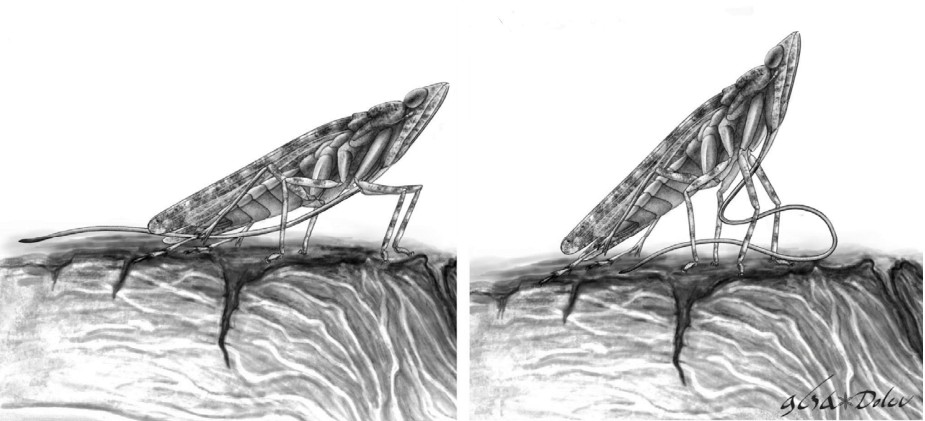
It is still today one of the most famous cinematographic images of all time and one of the most scientifically fascinating: we are talking about the insect trapped in the amber of Jurassic Parkin whose stomach park researchers found dinosaur DNA. The story of Cretodorus noonoo it’s not as science fiction, but that doesn’t mean it’s less interesting: this insect that lived 99 million years ago was identified and described thanks to some specimens perfectly preserved in amber, as told in a study published in Insects. And it’s not just any insect: Noo-Noo, as it was nicknamed, had mouthparts unlike those of any modern insect.
A special mouth
The amber in which the new insect was found comes from Myanmar, also known as burmite and is among the oldest in the world, dating back to around 100 million years ago. Noo-Noo was identified thanks to 13 specimens, all belonging to the Neazoniidae family. The latter, now extinct, is part of the Fulgoroidea superfamily, whose modern representatives are insects that feed on the fluids of plants, which they “pierce” with specialized mouth appendages.
Also Cretodorus noonoo it had highly specialized mouthparts, and also large ones: a proboscis that alone was twice as long as the rest of the body. However, if its modern relatives have needle-shaped, rigid and pointed proboscises, Noo-Noo’s mouth was bendable, with a shape similar to that of certain straws (the comparison is the study’s authors’, not ours). This also explains the choice of name: Noo-Noo is… the sentient vacuum cleaner friend of the gods Teletubbiesand in fact the flexible hose of a vacuum cleaner is another structure that can resemble the mouth of our insect.
What did Noo-Noo eat?
Having just been discovered and described, there is still a lot we don’t know about Noo-Noo: for example, what it did with such a long mouth. The authors of the study explain that their first hypothesis was that it worked in a similar way to the spirit trumpet of butterflies, but upon closer inspection they noticed that it faced backwards, and was therefore poorly suited to sucking nectar. Further analyzes on the specimens revealed no traces of pollen, which should have been present if this insect had fed on it.
The explanation given by the authors is instead that Noo-Noo fed on the sap of the trees, and that the long and flexible mouth was used to slip into the folds of the bark.
Hypothesis strengthened by the presence of two “hooks” at the tip of the proboscis, which probably widened when the structure was ready to suck the sap, anchoring it to the wall of the tree. The study also reads another fascinating hypothesis, although still to be proven: Cretaceous forests were frequently affected by fires, and trees in these “fire zones” often developed particularly hard bark and large quantities of amber to repair the damage. This characteristic of theirs, we read in the study, could have paved the way for the birth of particularly sophisticated feeding strategies – such as, precisely, the long flexible mouth of Noo-Noo.
