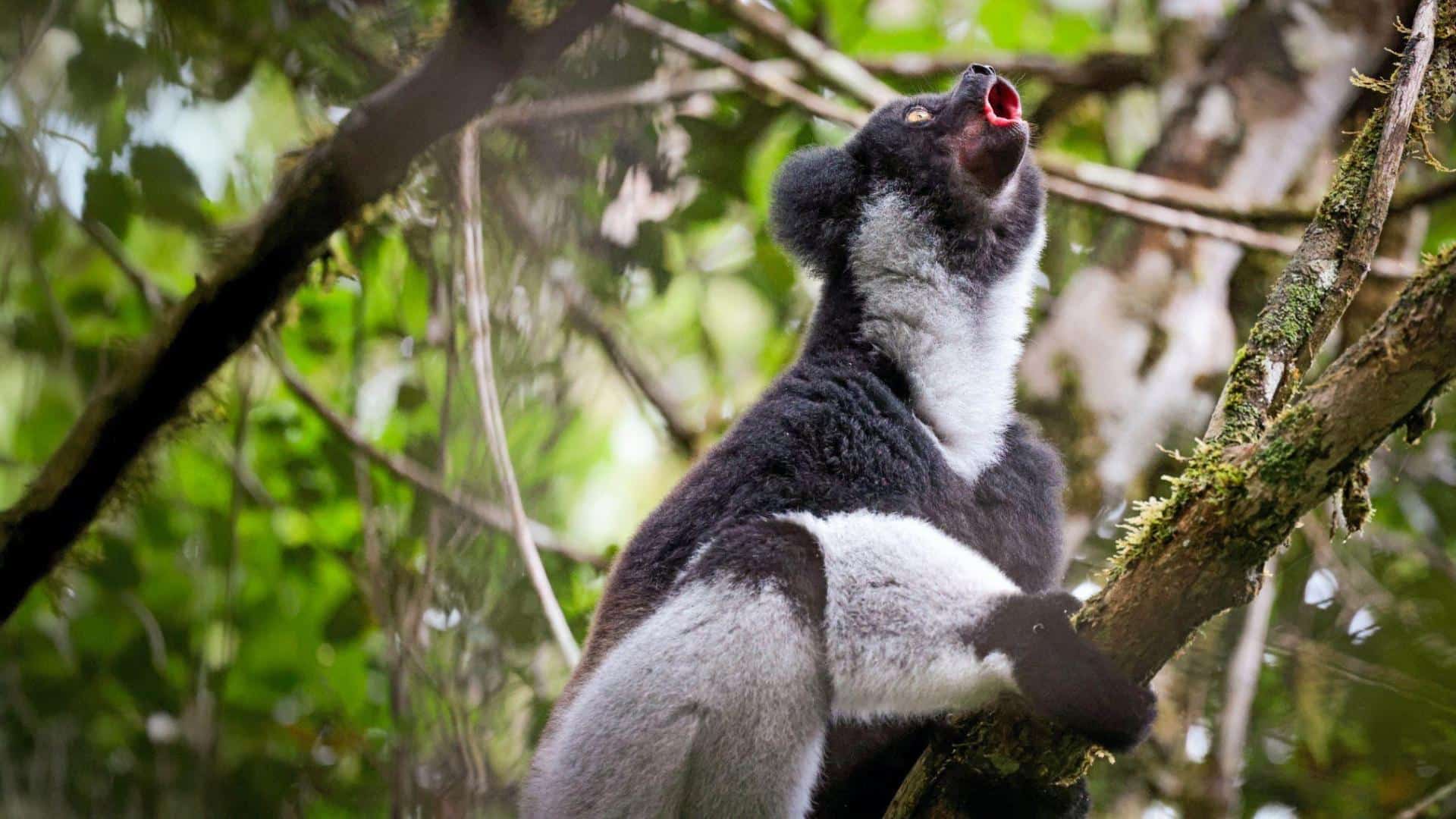
In the Maromizaha forest, Madagascar, you can attend real concerts. The performers are groups of indri, the largest of the lemurs that inhabit the forests of the large African island: they feed only on leaves, live in family groups made up of a couple and their children and are known for their songs (listen to them below) that resonate among the trees. Now it has been seen that, to make themselves heard better in the forest, they employ a technique similar to that used by opera singers: we have dedicated an in-depth study to the research on Evidence Network n° 409. «To amplify the song, they open their mouth more», explains Filippo Carugati, researcher at the University of Turin, who conducted the study with Chiara De Gregorio of the University of Warwick (UK) and other colleagues, and who in this interview tells us about the particularity of the singing of the indri.
The song of the indri is unique, at least among lemurs…
«Yes, the indri is the largest of all lemurs and the only singer among the more than 100 species of this family of primates from Madagascar. His singing is a complex, choral vocalization in which all the members of the group take part. They do not sing at the same time, but usually in male-female duets. For example, the dominant couple, male and female, starts, then perhaps the female stops and a daughter enters who then duets with the male, then the male stops and the daughter duets with a son and so on. There are times when even three specimens sing at the same time. At the beginning the indri make an introductory part which is called roar which takes a bit to get everyone activated and say “Ok guys, we’re about to sing”. Then the real core of the song starts, with phrases descending in frequency.”
What is the function of this song?
«The main one is to signal the occupation of the territory. And the singing is contagious: it stimulates the response in the neighboring group, which always says through singing “We are occupying this territory instead”. And then, like a wave in a stadium, the song travels within the forest and spreads. Then there are two other more specific types of singing. The first is a longer, more aggressive, more lasting territorial song, which however occurs when individuals from different groups meet on the edge of the territories and a vocal battle of active defense of the territory begins.
Which in fact sometimes leads to physical aggression between the two groups. The second is a very short song, emitted when a specimen in the forest becomes very detached from the group and gets lost. It starts what is known as a cohesion song, to which the other specimens respond; he understands where their position is and reunites with them.”
Among the primates, there are many singers…
«For the indri and for others we are not talking about simple vocalization, but of a real song: strong in volume and organized in a structure with different elements, generally defined as “notes”, which in the case of indri form real sentences with notes modulated with an increasingly lower timbre. Singing is found in only four groups of primates. Among the lemurs, there are only the indri. Other well-known singers are tarsiers: some of these small primates have even been discovered to emit ultrasonic songs. Many titi, or callicebi, monkeys from South America sing. And then there are the gibbons, great singers. These four groups are phylogenetically distant, a sign that song evolved independently at least four times in primates, not counting us humans. So protomusical structures emerged several times.”
The song of the indri must be loud to be heard in the forests of Madagascar.
«Exactly, because the sound disperses very differently in such a dense forest, with very tall trees and a hilly slope. All these singing primates live in dense tropical forests, not surprisingly. Habitat is certainly important in developing skills to navigate distant sound. And the indri have a very “powerful” song: when you listen to them standing right under the tree where they are found, the sound is really very strong.”
For the new studio you filmed and recorded them in the Maromizaha forest.
«Yes, the University of Turin has a research and conservation center there where various species of lemurs are studied, especially the indri, from a vocal point of view. In this study we integrated the audio with the visual data: in my PhD I developed a methodology based on artificial intelligence to estimate the position of a series of points on the nose of the indri directly on the videos. In this case we needed to map the mouth opening. Then we paired the sound with the mouth opening.
And we have shown that there is a very close association between mouth opening and the frequency emitted.”
And how does this change their singing?
«As for us humans, sound is generated by the vibration of the vocal cords, which gives the fundamental frequency. However, it changes as it passes through the vocal duct, because resonance frequencies, called formants, are formed. In practice, we mainly hear the formants, therefore spectral components different from those that were generated by the vibration of the vocal cords. And by changing the shape of the duct – this is what happens for example by opening the mouth – the fundamental frequency and the formants can be “coupled” so that the sound becomes clearer and more intense. This is what opera singers do and what we have also detected in the indri. Much of the singing is modulated precisely by the opening and shape of the mouth, managing to emit a louder sound. So what we have seen is that this technique used by sopranos is already generally present in a lemur that separated from our species 74 million years ago, evolving in the isolated world of Madagascar.”
And for Indians, as for opera singers, making themselves heard is important.
“Certain. The opera singers had to make themselves heard throughout the theater, before the arrival of the microphones, the indri had to make themselves heard from a great distance in the forest. And this sound is efficient in managing the territories of these primates, which are perfectly delineated.”
