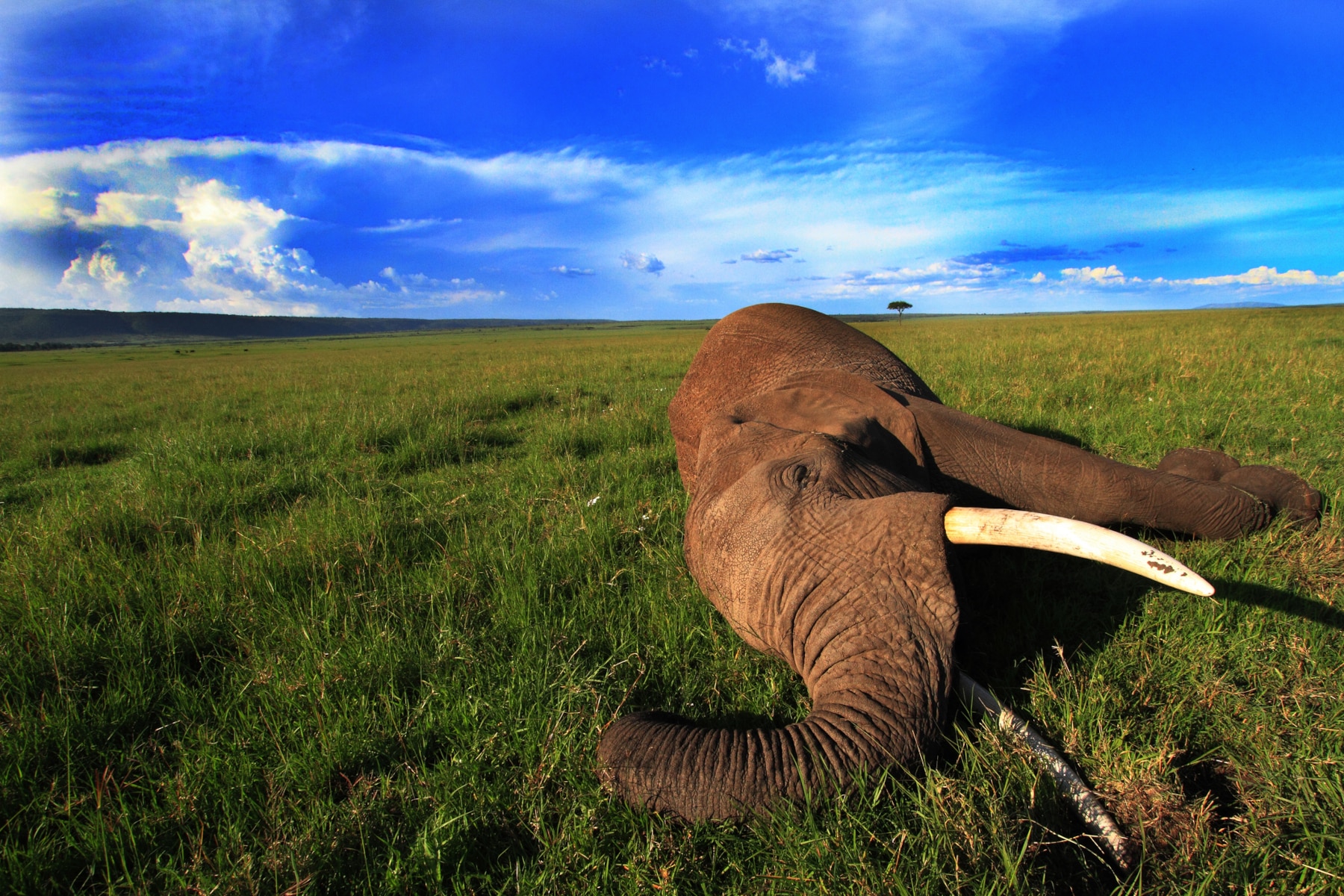
The ecological role of African elephants has been well known and studied for decades. Without them, the savannah in which they live would look completely different, and probably wouldn’t even be a savannah: elephants eat large quantities of vegetation, cut down trees, dig deep holes in search of water… What we haven’t studied enough is how much this role persists even after their death. Now, a study published on Proceedings of the National Academy of Sciences try to answer this macabre question, confirming that the savannah would not be what it is without elephants, even deceased ones.
The telltale corpse
The study, conducted by a team at UC Santa Barbara, has a long history behind it. Dave Thompson, one of the authors, tells us that in 2009 he even witnessed the death of one of the most famous elephants in Kruger National Park, South Africa. The animal, named Alexander, had died a stone’s throw from one of the park’s main roads, which Thompson traveled every day for another project: “Observing the decomposition of that corpse in the space of just a couple of months intrigued me” said the biodiversity expert, who from that intuition began to organize a broader study on what happens to elephant carcasses.
Seventeen years later, the results of their observations have been published, showing that the dead elephants are essential to the savannah, and modify it as much as they did when they were alive. The first and most obvious effect that their demise has is that, being very large, they “wipe away” the vegetation of the place where they fall, effectively leaving a large empty space in the shape of, well, an elephant corpse, in which, as the authors themselves write, “plant communities are completely reset”.
The return of the plants
A decomposing body, however, also releases chemical substances into the soil, including nutrients such as nitrogen but also compounds such as ammonia, which block the regrowth of plants, at least initially. Soil bacteria, on the other hand, “party” thanks to the large amount of nutrients they receive. As time passes, the toxic substances flow out and the plants also begin to return: at first only a handful of species that grow very quickly, then gradually larger ones.
Even this regrowth, however, is slowed down: when the elephant carcasses have disappeared, what remains is a patch of particularly nutritious vegetation, which the herbivores quickly “attack”.
That’s why the team selected a number of “burials” and fenced them off, with the aim, over the next few years, of studying the regrowth rates of plants without external disturbances. What is certain is that elephant carcasses continue to modify their ecosystem up to 8 years after they have been completely decomposed: further proof of the extraordinary impact they have on their ecosystem.
