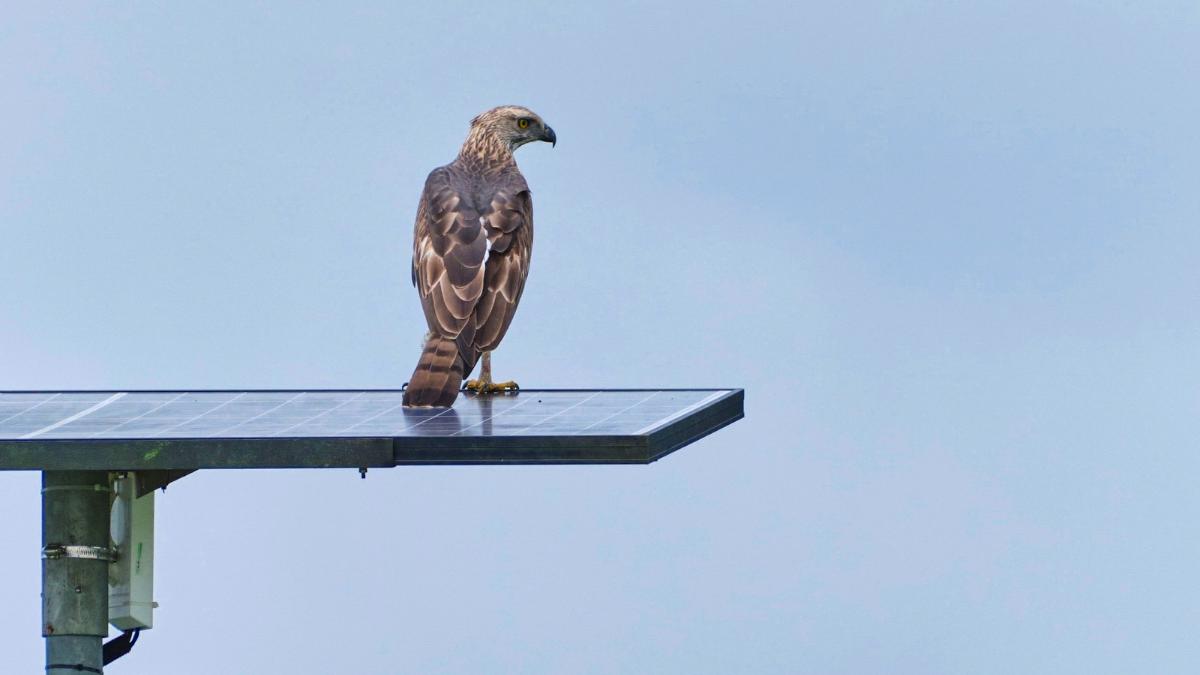
Photovoltaic solar plants have become an important piece of the energy transition, but their impact on wildlife continues to raise questions. Now, research led by the University of Malaga has documented how six species of birds of prey use a photovoltaic installation in Seville to rest, monitor the terrain and search for food.
The finding is especially interesting because the monitoring lasted for two and a half years, from the launch of the infrastructure. During this period, the researchers observed that the birds took advantage of the panels, posts and fences as points from which to locate possible prey. Furthermore, they did not record any birds of prey injured or killed by collision with these structures.
The Seville solar plant used by six species of birds of prey
The research, in which the University of Extremadura and specialized entities also participated, was carried out in a photovoltaic plant located in the Guadalquivir valley, in the province of Seville. The facility occupies about 299 hectares and has a nominal power of 150 megawatts.
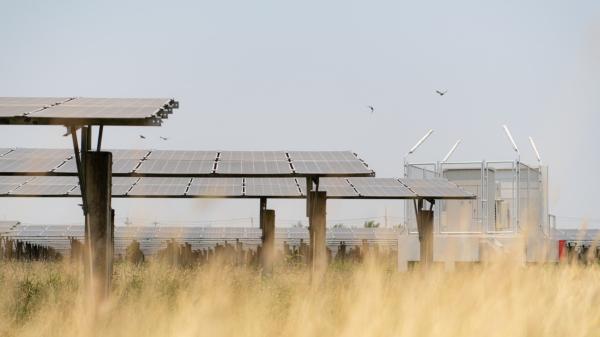
The environment is an agricultural area dominated by cereal crops, where trees and other elevated places that birds of prey can use as perches are scarce. In this landscape, the metal structures that support the solar panels offer points from which the raptors can observe the terrain and detect animals that serve as food for them.
The team carried out periodic observations from fixed points and walking tours of the interior of the premises. Thus he was able to study both the presence of the birds and their behaviors, instead of limiting himself to counting the specimens sighted.
What are the six species of birds of prey observed?
The researchers recorded six different species, although not all of them appeared with the same frequency or in the same quantities.
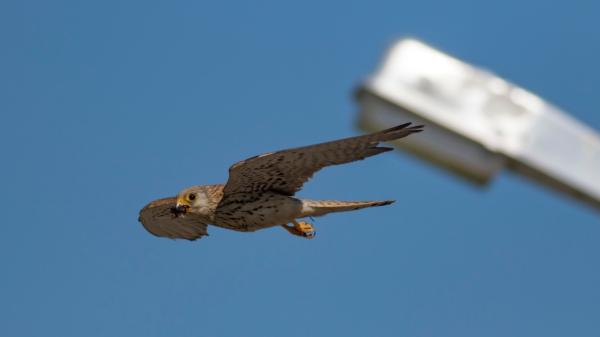
Among them are the black kite, the buzzard, the common kestrel, the red kite, the booted eagle and the European owl. The black kite was the most abundant species, while the common buzzard and the common kestrel stood out for the frequency with which they appeared during the sampling.
The red kite was also regularly observed, while the booted eagle and the European owl had a more discreet presence.
Beyond the diversity of species, the interest of the study is in checking how they take advantage of space. The birds perched on the panels, posts and fences to rest or survey the ground. Some were also observed hunting among the rows of photovoltaic modules.
This behavior shows that the structures of an energy installation can perform additional functions than those intended to produce electricity, at least under certain conditions and for some species. They can be a shelter, a rest area and also a hunting area.
Why solar panels can attract birds of prey
The presence of these birds is not explained solely by the high places they find within the facility. Prey availability and reduced pressure from human activity may also play a role.
According to the researchers, an abundance of rabbits, hares, partridges and small mammals were observed within the enclosure. The restriction of hunting activity favors some protection for these animals, which constitute a potential source of food for raptors.
In this way, the plant brings together several useful elements for these birds: points from which to observe the terrain, spaces to locate prey and places to rest.
In addition, some species that glide can take advantage of the upward currents of warm air generated by the panels to gain height with less effort. This behavior allows them to reduce energy expenditure during flight.
The results suggest that a photovoltaic installation can offer use opportunities for certain species, even in open agricultural landscapes. However, this does not mean that all solar plants have the same effect nor that their construction necessarily improves the biodiversity of the area.
Researchers call for more studies on photovoltaic plants
One of the most striking data from the monitoring is that no injured or dead birds of prey were detected due to collisions with the panels, their support structures or the fence during the two and a half years of observation.
This result provides relevant information about the coexistence between these birds and the studied facility, but should be interpreted with caution. The absence of collisions recorded during this period does not demonstrate that the risk is non-existent in other plants or that negative effects cannot occur on other groups of animals.
The researchers themselves warn that the work has focused on a single installation. Therefore, it does not allow us to determine what the raptor community was like before its construction or what consequences the accumulation of several solar plants in the same territory would have.
For this reason, they consider it necessary to repeat similar studies in other areas and maintain long-term monitoring programs. They also propose expanding research to analyze how the expansion of these infrastructures affects steppe birds, especially linked to agricultural landscapes where photovoltaic parks are usually installed.
The research thus provides an important conclusion: solar plants do not have to only represent a transformation of the habitat, but can also be used by some wild species. Knowing under what conditions it happens and what effects it has on the fauna as a whole will be essential to plan future energy installations with biodiversity conservation criteria.
If you want to read more articles similar to Six species of birds of prey find refuge in a solar plant in Seville: they use it to hunt and rest, we recommend that you enter our Ecosystems category.
