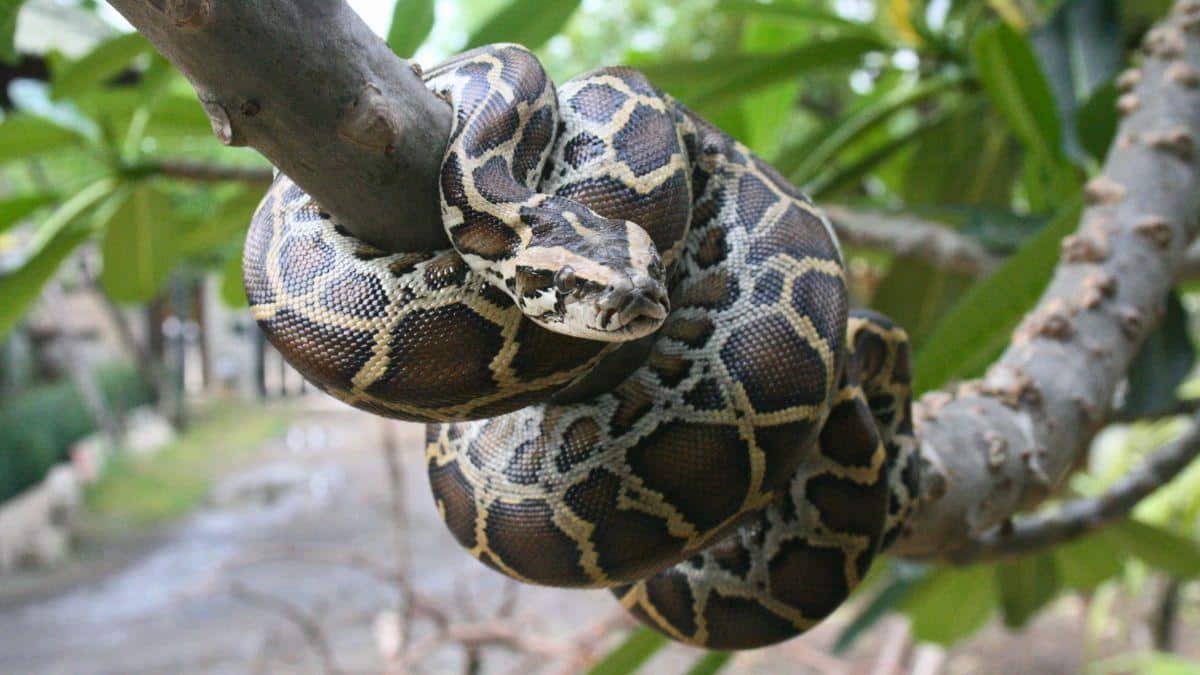
When a group of researchers arrived at a Burmese python nest (Python bivittatus) in South Florida found something he didn’t expect. At least four vultures were around the nest, feeding on the eggs of one of the most problematic invasive species in the Everglades, a vast subtropical wetland system in that area of the United States.
It is not yet a new weapon capable of stopping the expansion of these enormous snakes on its own. The episode corresponds to a single nest and scientists are cautious about its implications. But the behavior is important because it shows that a native species has begun to take advantage of an especially vulnerable phase of the python’s reproductive cycle as food.
The finding was described in February 2026 in the scientific journal Reptiles & Amphibians by researchers linked to the University of Florida.
Researchers found four vultures devouring python eggs
The story began before the encounter with the birds. Researchers were tracking a female Burmese python using radio telemetry in the Francis S. Taylor Wildlife Management Area in southern Florida.
Thanks to its movements and observations, they estimated that it had laid the eggs around May 23, 2023. On June 6, they returned to remove the clutch before the snakes hatched, as established by the research permit.
They then found at least four vultures actively feeding on the eggs.
The scientific work published in Reptiles & Amphibians describes 17 affected eggs. Three had been displaced and only fragments of their shells remained. The other 14 were perforated and had their contents exposed or missing.
No hairs, footprints, scales or excrement appeared to indicate the intervention of another predator, and the perforations were compatible with those produced by the beaks of vultures.
The female python was still nearby: she was located submerged in shallow water about 12 meters from the nest.
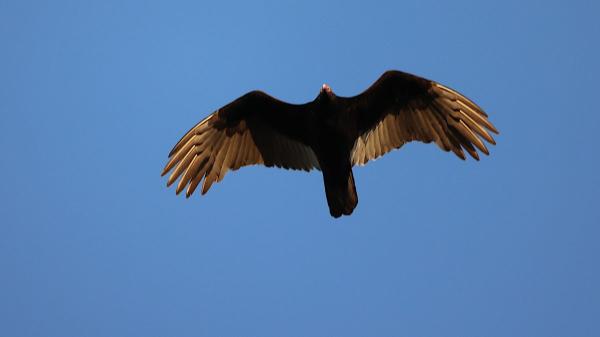
They were unable to identify the vultures, but they documented unprecedented behavior
The episode demands precision. The researchers were unable to identify the species of the birds because they quickly fled when approached.
Both the American black vulture (Coragyps atratus) like the gallipavo aura (Cathartes aura), and both had been previously observed in that sector.
Therefore, attributing the behavior specifically to the black vulture goes beyond what the research shows.
It is also unclear how they gained access to the nest. Female Burmese pythons typically remain coiled around their eggs during incubation. Scientists propose two possibilities: that several vultures managed to push the snake away or that it temporarily moved away and the birds took advantage of the opportunity.
What they do consider new is the result. According to the authors, it constitutes the first recorded case of a native bird species preying on a Burmese python nest in Florida.
Why it is so difficult to stop the spread of the Burmese python in Florida
The Burmese python comes from South and Southeast Asia, but has maintained a breeding population in Florida for decades. Its ability to reproduce helps explain the difficulty of controlling its expansion.
The US Geological Survey (USGS) indicates that clutches usually contain between approximately 29 and 50 eggs, although exceptionally they can exceed a hundred. In Florida, females typically lay eggs between May and June.
Removing eggs before they hatch prevents dozens of new snakes from entering the ecosystem. Precisely for this reason monitoring programs try to locate breeding females and their nests.
Research from the University of Florida published in 2026 highlights that removing large breeding females may be especially relevant to reducing future population growth.
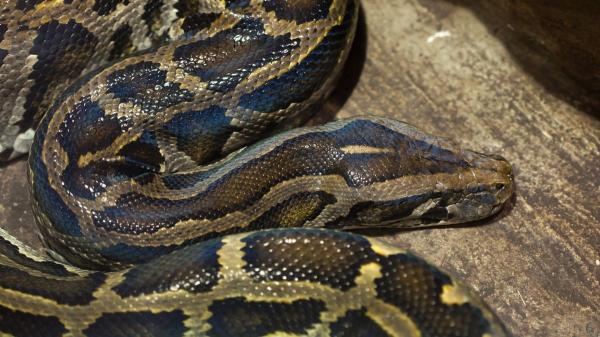
An invasive that has changed the fauna of the Everglades
The significance of the discovery is best understood by looking at what has happened since pythons became established in South Florida.
The USGS considers the Burmese python to be firmly established in the Great Everglades ecosystem and pose a serious threat to native wildlife. Their camouflage and elusive behavior also make it extraordinarily difficult to estimate how many exist.
One of the most cited studies on its consequences compared mammal censuses carried out before and after the spread of snakes. The results were spectacular: raccoon observations decreased by 99.3%, opossum observations decreased by 98.9%, and bobcat observations decreased by 87.5%. The researchers also did not detect rabbits during subsequent sampling.
The study, published in PNAS and collected by the USGS, spatially and temporally related these declines to the proliferation of pythons.
Can vultures help stop the python invasion in Florida?
The discovery opens up a fascinating possibility, but it would be premature to conclude that the vultures will be able to contain the invasion. There are already examples of local fauna killing pythons. Another USGS investigation found evidence of predation of young specimens by American alligators, cottonmouth snakes and native mammals.
The new case adds eggs to those interactions. If vultures learned to regularly locate nests and the behavior spread, they could destroy clutches before they hatch. But that is, for now, a hypothesis.
The researchers themselves point out that very little is still known about the predators of python nests. What was observed in Florida does not solve the enormous ecological problem created by this invasive, but it shows something interesting: the ecosystem does not remain completely passive in the face of a newly arrived species. Some native species may begin to recognize it as a new food resource.
Now we will have to check if that nest was an exception or the first visible sign of a much more widespread behavior.
If you want to read more articles similar to Native vultures devour eggs of the Burmese python, an invasive species, and open a new way to stop its expansion in the Everglades, we recommend that you enter our Biodiversity category.
- National Park Service – Burmese Python Management / https://www.nps.gov/ever/learn/nature/npspythonmanagement.htm
