Listen to the audio summary of the article
Listen on Spreaker.
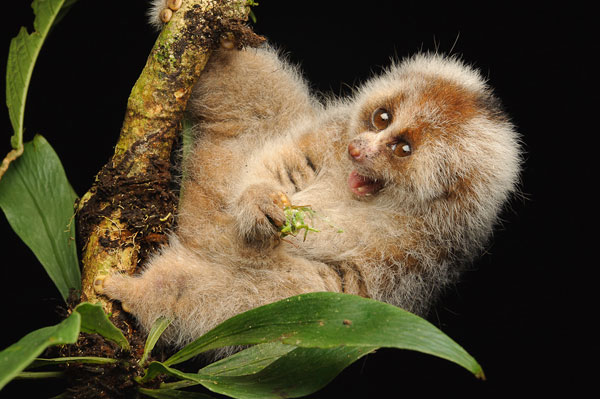
What does Leonardo DiCaprio have to do with a small poisonous mammal that lives only on a small island in Indonesia? The actor is one of the founders of the Re:wild project, which deals with conservation and among its activities includes the research of the so-called “lost species“, the lost species, those that are not yet officially extinct but are so rare that we have not observed them in nature for decades. This is the case of the Bangka slow loris, which Re:wild includes among the “lost primates” and which, as we discovered thanks to the work of the Alobi Wildlife Rescue Center published in the magazine Spixianais far from lost – but that doesn’t mean it isn’t still in danger.
Lost and found
Like other representatives of the genre Nycticebusthe Bangka slow lory is a small venomous mammal: less than 30 cm long, it produces (from its armpits!) a toxin that it transmits through its bite. Recognized as a separate species only in 2013 thanks to the analysis of specimens preserved in museums, it has not been observed in the wild for almost a century: there are anecdotes about its presence, but its name has not appeared in a scientific publication since 1937. The causes of this crisis are linked above all to the oil palm plantations, which on Bangka Island are literally devouring entire pieces of the island.
However, the work of the Alobi Wildlife Rescue Center, which began caring for the Bangka slow loris in 2015, has revealed that this primate has not truly disappeared. On the contrary: in the last 10 years, the center has rescued more than 90 of them, most of which were found near human settlements (and in some cases even rescued from captivity); most of the rescued lorises bore signs of injuries of some kind, including burns from electric shocks: all clues that demonstrate how the loss of its habitat is leading this animal to increasingly risk itself, approaching inhabited areas probably in search of food and shelter.
Rediscovering them is just the beginning
The best news relating to these rescues, which after ten years have reached a sufficient number to deserve a report in the scientific press, is that the lorises were saved in four different regions of the island of Bangka, as well as in the city of PangkaLpinang: a sign that, although rare, the animal is still widespread throughout the island. The other good news is that, of the “over 90” specimens saved by the center, 86 have recovered and have been reintroduced into the wild, in seven different sites on the island, all as close as possible to the remaining forests.
The discovery that the Bangka slow loris is not yet extinct highlights that “anchor”: the conservation status of the species remains critical, and knowing that it is still among us does not change the fact that long-term strategies are needed to save it, from censuses and genetic studies to more intense protection of what remains of its habitat. The authors of the study also argue that, to increase the hopes of recovery of the Bangka slow lory, it is necessary to establish a semi-captive population that acts as a “reservoir” for the reproduction of the entire species.
