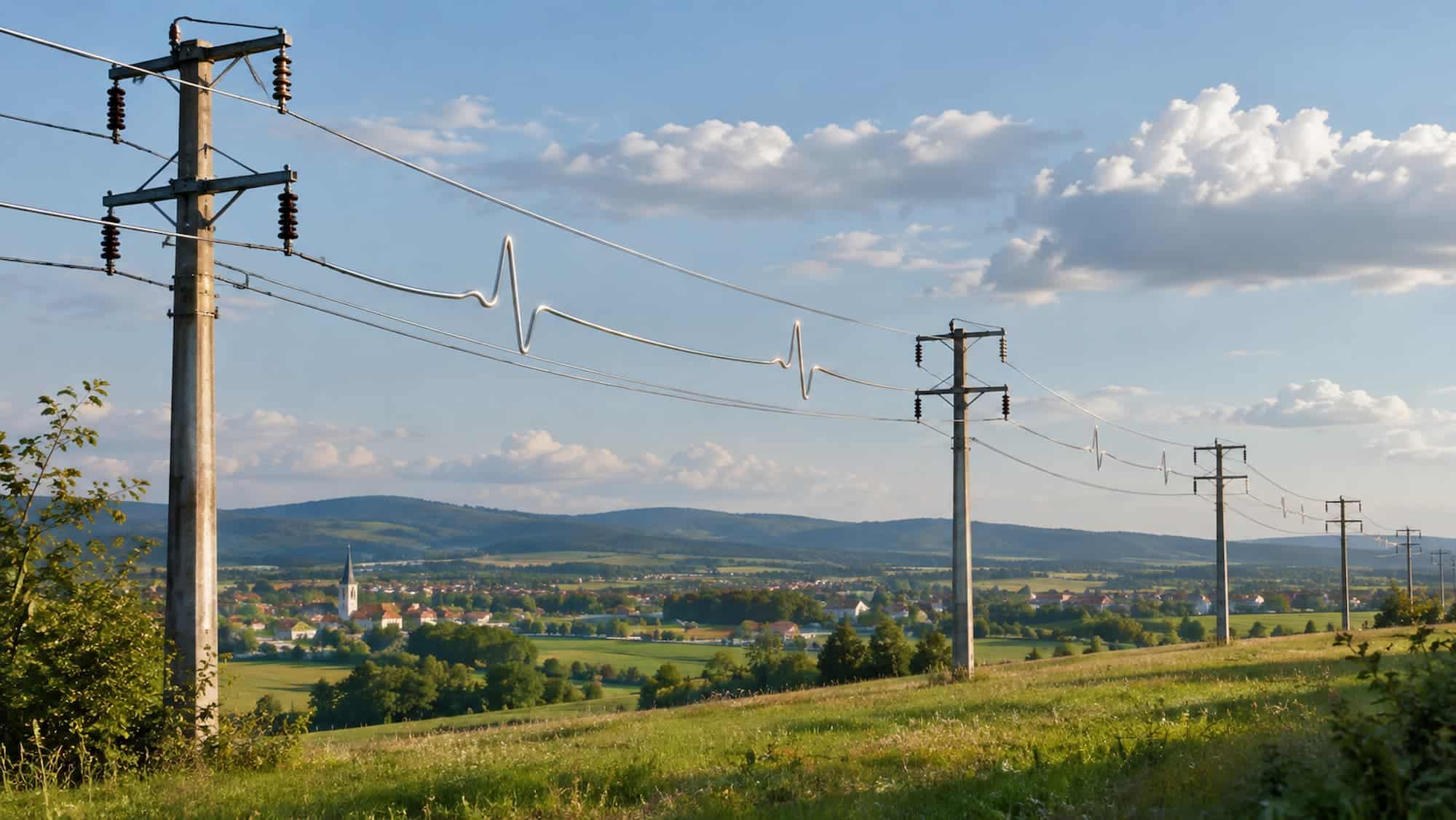
For years, experts have been recording a frequency oscillation every 60 seconds on the electricity grid. A study now explains why: millions of batteries and UPS synchronized on the same second.
Listen to the audio summary of the article
Listen on Spreaker.
The European electricity grid has a small “beat”, a recurring pulsation, which returns on time with every exact turn of the second hand. It’s not a strong enough pulse to make light bulbs blink or turn off the television, but it’s regular enough to have intrigued experts for years. Why does the frequency of electricity rise and fall slightly in exactly one minute?
Software and synchronized batteries are to blame
The puzzle was solved by a group of scientists led by the Forschungszentrum Jülich, Germany. The cause is not to be found in a large power plant or in mysterious electromagnetic phenomena – as had been hypothesized in the past -, but in the software of some battery systems that carry out periodic checks synchronized on the clock.
The research, published on Nature Energyrevealed that the same anomaly affects the electricity grids of multiple continents, offering a demonstration of how millions of microscopic digital operations can be felt even on a colossal infrastructure.
Hertz question
To understand the phenomenon, we must remember that an identical current does not always flow in European sockets: the alternating current, in fact, continuously changes direction, completing 50 cycles per second, i.e. working at the nominal frequency of 50 hertz, a value that also reflects the instantaneous balance between the electricity produced and that consumed. If production exceeds demand, the frequency tends to rise, if the opposite happens it tends to fall.
The network managers therefore intervene continuously to keep it very close to 50 Hz. However, by analyzing years of measurements, the researchers found a tiny oscillation that repeats itself with almost metronome-like precision every minute. In the continental European grid, a typical variation of just 0.003 Hz already corresponds to a coordinated imbalance of around 80 megawatts, which is small compared to the size of the entire system, but whose value is far from invisible to instruments.
Synchronized batteries
The decisive lead came by studying the buildings on the Jülich campus, where the technicians discovered that the mysterious 60-second rhythm appeared precisely in the presence of UPSs, the uninterruptible power supplies equipped with batteries that keep computers and other equipment powered when the power suddenly goes out. Analyzing their operation, they noticed that the electronic management systems performed a brief battery self-test every minute, causing a small peak in absorption.
Taken individually, of course, what has been described generates an irrelevant effect, but things change when many devices follow the same digital clock: the tiny variations add up, pass through transformers and local lines and end up becoming detectable even on the high voltage network.
The manufacturer of the analyzed equipment confirmed the origin of the phenomenon and, after being informed, modified the software to eliminate this rigid periodicity.
Small but growing
At the moment the oscillation does not pose a danger to the stability of the network, but this does not mean that it is completely harmless. In Scandinavia, for example, it has exceeded 0.01 Hz in some periods and the continuous corrections necessary to compensate for it can contribute, in the long term, to the wear of turbines and other systems used to regulate the frequency.
And the phenomenon could become more evident with the growing diffusion of batteries, data centers and connected devices, all controlled by software potentially synchronized with each other. Fortunately, the solution is much less complicated than the problem: it would be enough to prevent thousands of devices from performing their routines in the same second, introducing small random delays or starting controls when really necessary rather than rigidly following the clock.
