
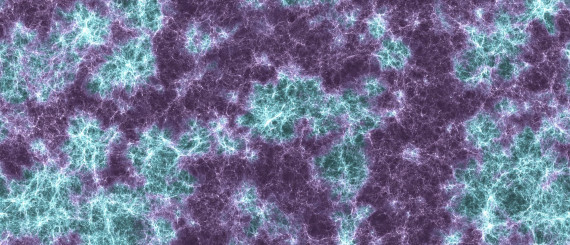
Developed with the Frontier supercomputer, the Lumina model reconstructs the interaction between ordinary matter, dark matter and radiation in the first 2 billion years after the Big Bang
.
The James Webb Space Telescope (JWST) and, soon, the Nancy Grace Roman Space Telescope, working together, are showing us the first chapters of the history of the Universe in a level of detail never seen before. But to really understand what we are looking at, we need something more than a beautiful photograph: we need a point of comparison.
This is where Lumina comes in, the new model developed by researchers at the Center for Astrophysics | Harvard & Smithsonian and published in the journal Monthly Notices of the Royal Astronomical Society. It is one of the largest and most detailed simulations of the early Universe ever created: it reconstructs how ordinary matter, dark matter and radiation interacted during the first 2 billion years after the Big Bang.
A theory that is put to the test
For centuries, astronomers have been observing the sky and building models to explain how stars, galaxies and large cosmic structures are born. Today, supercomputers make it possible to transform those hypotheses into precise predictions. The mechanism is simple: if the observations coincide with the predictions, confidence in the hypothesis grows; if they do not coincide, the way is opened for new discoveries.
“To understand what we observe with the JWST, we need to translate our hypotheses into detailed predictions. After years of work, with many ups and downs, it is incredibly rewarding to see the results and watch our predictions come to life in the videos,” explained Oliver Zier, first author of the study and researcher at the Center for Astrophysics
Record numbers
Lumina is the largest radiation-hydrodynamic cosmological simulation ever created. The name is complicated, the idea is not: the model interacts gas, dark matter and light, the three fundamental ingredients that gave rise to stars and galaxies. The result is the story of how the first galaxies came into being and transformed the gas around them. In the simulation the volume encompasses a space over 100 times larger than comparable models of the past, equal to a cube of approximately 1.5 billion light years per side. It’s a scale comparable to what today’s most powerful telescopes can observe.
Lumina is the first program capable of capturing the reionization of helium (helium reionization is the moment in which the very intense light of the first quasars, the bright nuclei of galaxies powered by black holes, stripped electrons from the helium atoms that filled the space between galaxies, transforming them into electrically charged particles) as it happens, letting its effects immediately influence the evolution of the model.
“For the first time we can follow the transformation of hydrogen and helium into their current form in such a huge volume of the Universe, while at the same time being able to distinguish the galaxies and other bright objects that drive this process,” said Aaron Smith, associate professor of physics at the University of Texas at Dallas and co-author of the study.

The brute force of supercomputers
Running Lumina required more than 15,000 graphics processing units (GPUs) on the Frontier supercomputer, one of the fastest in the world, at Oak Ridge National Laboratory in Tennessee. A computing power that has made it possible to embrace an enormous portion of the Universe without giving up the details necessary to study the birth of galaxies, stars and black holes. And the work is only just beginning.
The team designed Lumina as a platform open to new ideas: in the future it will serve to understand how gas moves between galaxies, how the radiation born with the Big Bang shaped the cosmos and how the regions where stars were born most intensely evolved over time.
