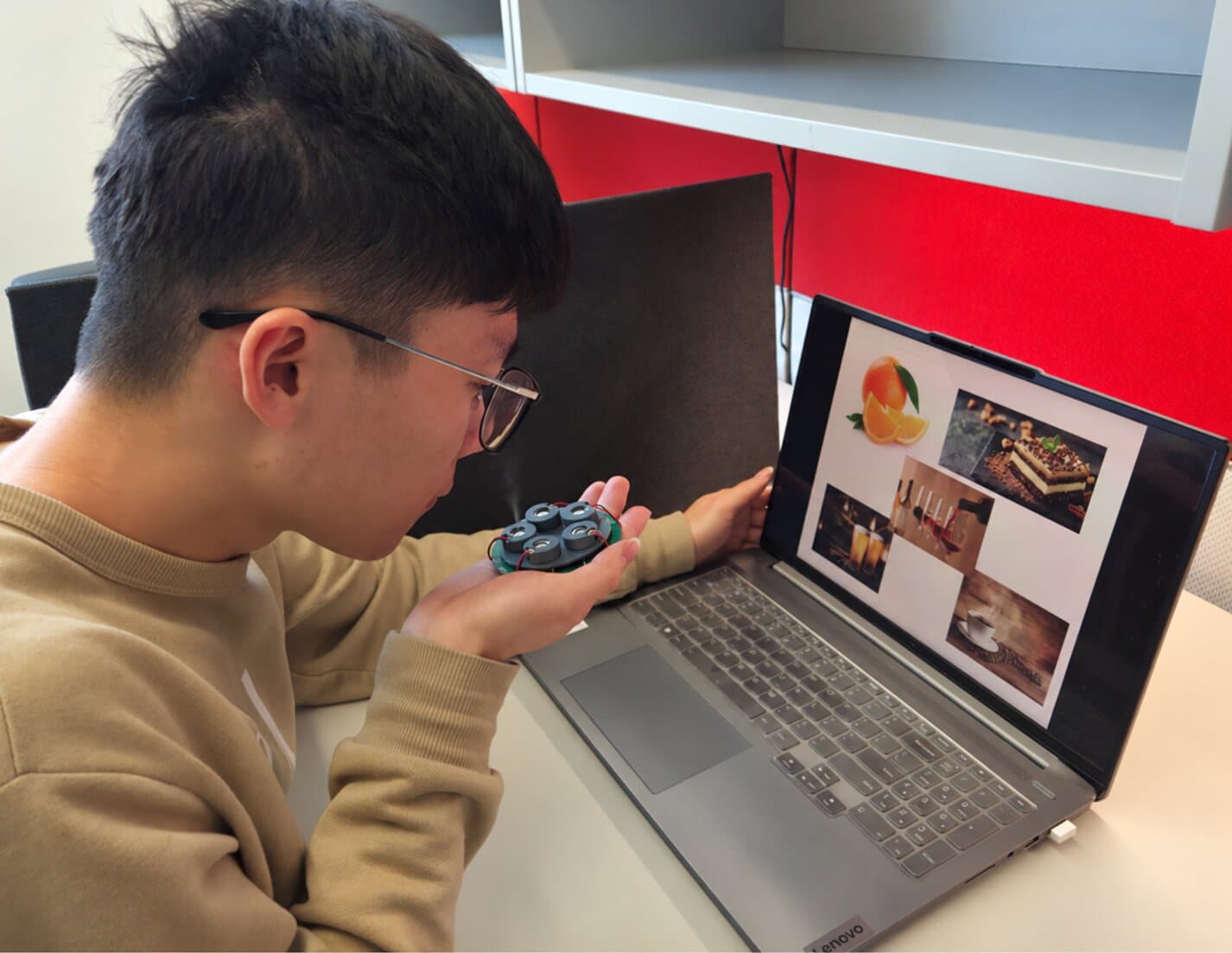
Scentronic is a sort of digital nose that allows you to reconstruct the essences transmitted through algorithms and electrical impulses. It could also help in the diagnosis of smell disorders.
Photographs, music and videos have been crossing the Internet for decades now, but for smell the matter is decidedly more complicated. An image can be transformed into pixels and a sound into harmonic waves, but a smell arises from the interaction between numerous different molecules and our olfactory receptors. However, researchers from Ohio State University and the Zhejiang Laboratory in China have developed Scentronic, an experimental system that tries to do just this: recognize an aroma in one place and make a similar version perceived by a person in another. No molecule is “teleported” through the Internet, obviously, but the system analyzes the smell, translates it into digital data and sends this information to a receiving device, which releases a similar fragrance already contained within it.
An electronic nose
The process begins with a sort of artificial nose made up of different sensors capable of reacting to the volatile compounds present in the air, i.e. the molecules that reach our nose and produce the sensation of an odor. Each aroma generates a slightly different combination of electrical signals in the sensors and an artificial intelligence algorithm compares this pattern with those acquired during training, establishing which category it belongs to. In the first experimental prototype, the researchers used five everyday fragrances – coffee, beer, red wine, cake and orange – recognized by the system with an accuracy of around 96%.
Once the aroma has been identified, only a few impulses travel through the Internet which indicate to the remote device which olfactory stimulus to reproduce and with what intensity. In some tests the command reached the receiver in just 0.6 seconds, while recognizing more complex food odors can take several seconds.
How odor is reconstructed
On the other side of the connection the aforementioned Scentronic comes into operation. Also made in wearable versions similar to a bracelet or necklace, the device contains small reservoirs of scented liquids and tiny devices that vibrate rapidly, spraying them into the air in the form of a very fine mist. It therefore does not chemically reconstruct every odor received, like a printer that reproduces any photograph, but can only generate the aromas for which it already has the corresponding substance.
This is an important limitation, but the experiment still gave encouraging results. Fourteen volunteers were able to correctly identify individual fragrances produced by the device in approximately 73% of cases and pairs of aromas, such as coffee and orange, in 71%.
Researchers have even experimented with a “digital cup” capable of associating odors and flavored liquids, giving rise to more complex sensory experiences.
Digital perfume
However, before we can smell a bottle of perfume from a store’s website, a lot of progress will still be needed. The prototype, as explained, only recognizes a few categories, but in the real world odors are often extremely complex mixtures. Just think of coffee, whose aroma derives from hundreds of different molecules. It would therefore be necessary to enormously expand the library of available substances, miniaturize the tanks, make them easily refillable and verify the safety and fidelity of reproduction. In the future, a smartphone could control an external accessory, while integrating everything directly into the phone would be much more difficult due to space and weight problems.
Potential applications go beyond shopping, however: video games and virtual reality could add olfactory sensations to images and sounds, while in medicine similar systems could be used to study or diagnose smell disorders.
