
Dug 400 meters deep, the plant uses a multi-barrier system of copper and bentonite to isolate nuclear waste for a million years.
Onkalo is the Finnish answer to the thorniest issue of nuclear power, that is, what to do with the waste. With atomic energy expanding again, including in the search for low-emission sources, better answers are needed. There is broad consensus that the best solution is to bury them, but the problem is time.
Plants like this, explains Allison Macfarlane (University of British Columbia, former president of the US Nuclear Regulatory Commission), must remain intact for at least 100,000 years, perhaps a million: geological time scales.
The Great Pyramid is about 4,500 years old, while some deposits will have to contain waste for a period more than 20 times longer, during which civilizations could rise and fall and ice sheets advance and retreat.

The waste problem
Much nuclear waste has low radioactivity and is relatively easily managed. The real challenge concerns spent fuel and core shielding materials: elements such as iodine-129, in fact, have a half-life of almost 16 million years.
Over time there has even been speculation about sending this waste into space, but expert Allison Macfarlane rejects the idea, recalling the shuttle disaster Challengers: the possible explosion of a carrier would disperse highly carcinogenic material into the atmosphere. The only concrete alternative remains the traditional one: burying them at great depths, an operation that is far from simple.
The failed precedent: Axis II
Since 1967, West Germany has stored over 125,000 drums of low- and medium-level waste in the former Axis II salt mine. Rock salt seemed ideal because it was waterproof and capable of closing cracks on its own. In 1988 it was discovered that salt water had penetrated it. According to a 2011 report by the International Panel on Fissile Materials, miners had dug too close to the edge of the salt deposits and had not filled the caverns sufficiently, weakening the structure and fracturing the salt faster than it could seal.
The risk of collapse had been reported as early as 1979, but the warning was ignored. Public opinion only learned about it in 2008 and today Germany has to recover around 47,000 cubic meters of waste.
The recovery hypothesis
An alternative to permanent storage assumes that permanent burial may not be necessary: around 97% of spent fuel is recyclable and future technology could offer more advanced options. The French Cigéo project is based on this principle (planned for the 2050s within waterproof clays) equipped with a funicular designed to bring waste to the surface in case of need
. As Allison Macfarlane points out, in France public opinion wants the certainty of being able to intervene if something goes wrong.
Passing down the memory
Then there remains the issue of memory: preventing future civilizations from drilling into the ground by mistake, unaware of the underlying danger. In the United States, for the Waste Isolation Pilot Plant in New Mexico, repelling monuments were thought of, a hypothesis later discarded since the mysterious ruins often end up attracting the curious and treasure seekers. Macfarlane doubts whether it is possible to conceive of a danger sign that would be understandable after millennia.
This is why France is experimenting with 20-centimeter sapphire disks capable of preserving up to 40,000 microscopic pages resistant to scratches, heat and chemicals. Sweden instead focuses on a 42-page digital document constantly translated and updated for the Forsmark site, also relying on cultural transmission: rooting this information in education could prove to be more lasting than any physical support, exactly as the oral traditions of the Australian aborigines have handed down the memory of the rising seas which occurred 7,000 years ago intact..

The Finnish approach
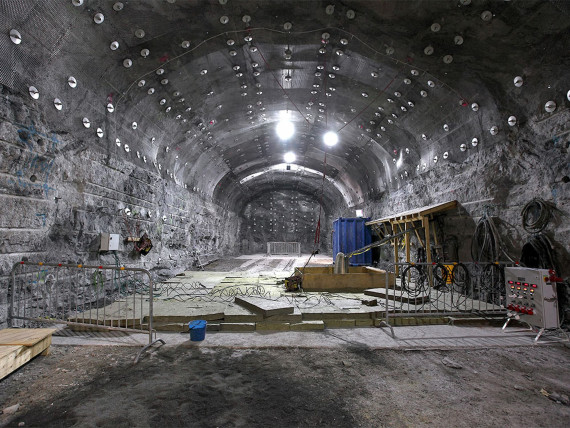
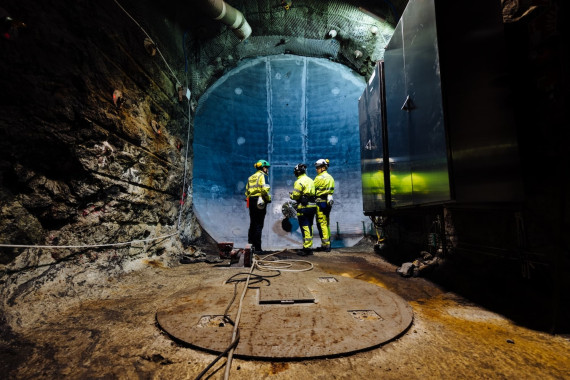
Finland chose not to warn anyone. Decades ago, researchers searched for a subsurface so poor in resources (like oil) that it never attracted excavation, so the deposit could be sealed and forgotten. They found it in Olkiluoto, in the south-west of the country, where Onkalo has been working since 2004. «As you get deeper into it, the environment becomes quieter and the rock more present», says Petteri Vuorio, director of development of the facility. The rock is mainly gneiss, very dense and impermeable, carefully mapped to avoid fractures; the tunnels only run in intact areas. Added to this is the KBS-3 multi-barrier system, developed by the Swedish SKB. The spent fuel ends up in a cast iron container, sealed in a copper vessel with walls 5 centimeters thick, the metal which in studies remains almost unchanged in radioactive and high-pressure environments. The container is lowered into a hole in the rock and surrounded by compacted bentonite. This clay swells on contact with water, forming an almost impermeable barrier and cushioning any movements of the rock.
As geologist Clare Bond of the University of Aberdeen explains, the artificial reef would have to do it on its own. In October 2026 the Finnish government granted the operating license and the first shipments will arrive in the coming months. Once full, everything will be filled with bentonite and sealed: the facility will disappear into the rock.
The site was under a thick ice sheet just 20,000 years ago and may do so again; crustal uplift as the ice retreats can cause fractures, but these scenarios have been largely downplayed.
And the others?
Onkalo won’t be the last. In Forsmark, Sweden, work has begun on the same copper-bentonite-rock system, with operations expected in the 2030s. Canada has similar projects, still some way off. The UK, which has the world’s largest stockpile of reactor-grade plutonium, is still choosing the site: two candidates in shale formations in north-west England, near Sellafield, with multilayer containment similar to Finland’s.
