
In 1916, the United States began introducing a species of ladybug from Asia to combat agricultural pests naturally. Its ability to feed on aphids and other harmful insects made it a promising tool for protecting crops and reducing the use of chemical insecticides.
However, that initiative had unexpected consequences. Decades later, the Asian ladybug (Harmonia axyridis) had managed to establish wild populations and expand across different continents. Its ability to reproduce, adapt to new environments and feed on other ladybugs has made it go from being an ally of agriculture to becoming a threat to some native species.
The Asian ladybug arrived in the United States as a natural solution against pests
In the early 20th century, the United States began introducing the Asian ladybug (Harmonia axyridis) with the aim of combating agricultural pests without depending so much on chemical insecticides. This insect, native to Asia, stood out for its ability to feed on aphids, scale insects and other small organisms that damaged crops.
The first documented releases began in 1916, when researchers and agricultural managers saw in this species a promising alternative to protect orchards, forests and agricultural farms. Their appetite for harmful insects could help reduce crop losses and limit the use of chemicals.
During the following years, different institutions and specialists continued to release copies in various parts of the country. In some environments, especially pecan crops and ornamental plants, the introduction had positive results by contributing to the control of aphid populations.
However, that initiative would also have unexpected consequences. Decades later, the Asian ladybug would manage to establish wild populations and expand across numerous territories, until it became an invasive species capable of competing with native ladybugs.
The first wild populations appeared decades after their introduction
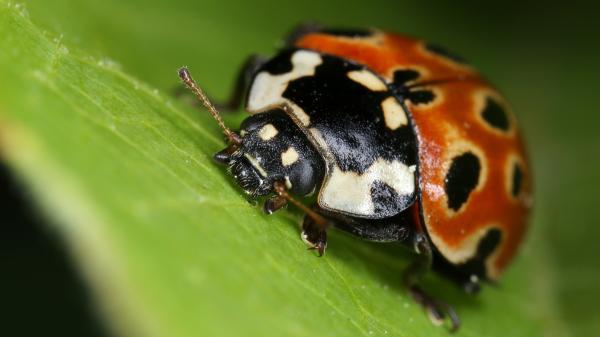
Although releases of Asian ladybugs began in 1916, the first wild populations established in the United States were not documented until 1988. The specimens were located in Louisiana, near the port of New Orleans, an area far from many of the places where controlled introductions had been made.
This discovery raised questions about how the species had managed to establish itself in the territory. Researchers were unable to determine exactly whether its spread came from intentional releases years ago, accidental introductions related to international trade, or a combination of both.
According to researchers from the United States Department of Agriculture (USDA), some specimens could have arrived accidentally through nursery plants imported into ports in Delaware and South Carolina. Once established, Harmonia axyridis It began to spread rapidly throughout North America and, later, to other continents. Its ability to adapt to different environments, from forests and orchards to gardens and urban areas, facilitated its expansion.
In addition, it has a high reproductive capacity. Their development from egg to adult can be completed in approximately 15 to 25 days, depending on temperature and food availability.
A ladybug with a very variable appearance
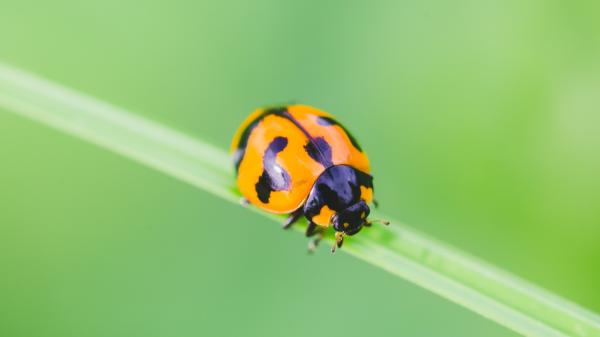
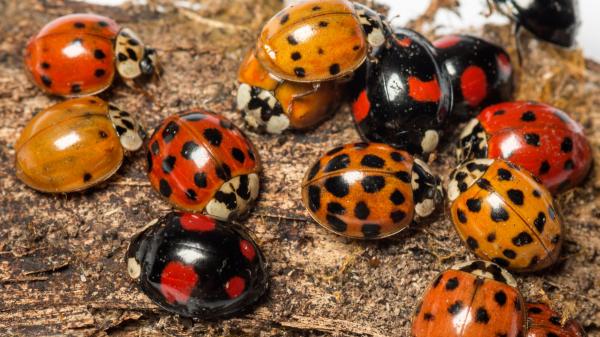
The Asian ladybug can be difficult to identify with the naked eye due to the wide variety of colors and patterns it presents. Their elytra, the hardened wings that protect their hindwings, can be black, yellow, orange or reddish. It can also have anywhere from no spots to numerous black spots.
In the United States, one of the most common forms has a color between mustard yellow and red, accompanied by 16 or more dark spots. This diversity means that it can be easily confused with some native species, especially when observed in isolation.
Like other ladybugs, Harmonia axyridis It goes through four stages during its development: egg, larva, pupa and adult. The females lay their eggs on plants during the spring and, when they hatch, the larvae begin to feed on aphids and other small insects.
The spread of the Asian ladybug threatens native species
As its populations increased, it began to compete with native ladybugs for food and breeding spaces, especially in areas where several species shared the same habitats.
One of the factors that explain their advantage is their eating behavior. In addition to consuming aphids and mealybugs, Harmonia axyridis It can feed on the eggs and larvae of other ladybugs when its usual prey is scarce. This behavior, known as intraguild predation, increases pressure on the species with which it shares territory.
Added to this circumstance is its ability to reproduce quickly and adapt to different environmental conditions. Consequently, it can reach high densities and displace other species from the resources they need to survive.
Various studies have linked the expansion of the Asian ladybug to the decline in populations of some native ladybugs in North America and Europe. Although habitat loss, environmental changes and other factors also influence these trends, their presence represents additional pressure on local biodiversity.
The story of the Asian ladybug reflects the risks that can arise when species are introduced into new ecosystems with the intention of solving a specific problem. What began as an initiative to reduce agricultural pests through biological control ended up favoring the expansion of an insect that today is associated with significant alterations in native ladybug communities.
More than a century after the first introductions, this case serves to remind us that human interventions on nature can have consequences that are difficult to anticipate. A species that initially seemed to offer an effective solution may end up altering the ecological balance it was intended to protect.
If you want to read more articles similar to In 1916, the United States released Asian ladybugs to combat aphids and scale insects and now it is an invasive species that threatens native species, we recommend that you enter our Biodiversity category.
