
Traces of a molecule derived from hemoglobin discovered in the limb of a dinosaur from 115 million years ago: however, it is not intact blood.
No, we have not found – as reported by some somewhat too hasty titles – intact blood of dinosaur inside a fossil. Nonetheless, the discovery of what appear to be fossilized red blood cells, along with hemoglobin-derived molecules, in the fossil limb of a theropod dinosaur is, nevertheless, quite exciting.
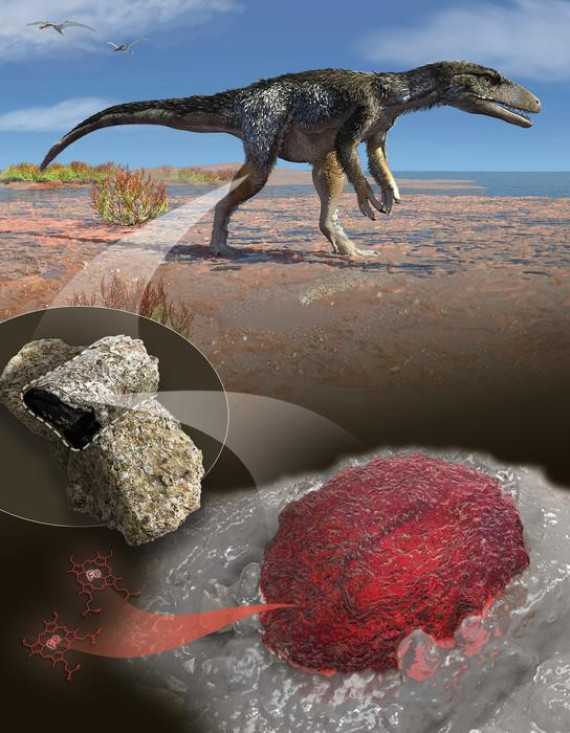
A group of scientists led by paleontologists from Curtin University, Australia, made this discovery by meticulously analyzing the chemistry of a bone from the hind leg of a Aratasaurus museunacionalia carnivorous dinosaur about 3 meters long that lived in Brazil 115 years ago. The discovery, described in the scientific journal PNASevidence that biological molecules can survive inside a fossil much longer than previously believed.
No longer a simple suspicion
There have been several announcements of alleged discoveries of proteins or cells of various types within dinosaur fossils in recent decades. Most of the time, however, it is difficult to confirm that the elements discovered actually come from the original dinosaur, and that they are not the result of subsequent contamination.
The authors of the new study went beyond appearances and analyzed what under the microscope looked like they were red blood cells also from a chemical point of view.
Inside the bone specimen unearthed in 2008, scientists identified vascular channels full of ellipsoidal microstructures. After having ruled out that they were the well-preserved remains of fungi or other microorganisms that could have colonized the dinosaur bones after its death and before the fossilization process (there was no trace, for example, of bacterial filaments, spores or biofilms), a welcome confirmation arrived: the presence, within those microstructures, of heme, a molecule associated with red blood cells.
Heme is the oxygen-carrying component of hemoglobin, confirmed for the first time in a fossil thanks to advanced analytical techniques, such as high-performance liquid chromatography coupled to mass spectrometry.
What scientists were observing was therefore a possible trace of fossilized blood inside a dinosaur bone, the oldest discovered so far, because the previous one dates back to “just” 80 million years ago.

A time capsule
The heme most likely belongs to the dinosaur, because it was not found mixed with other plant or bacterial products, as was instead observed for the heme detected in the carpet of microorganisms in which the fossil was found. Its molecular composition was also very different from that found on the surrounding rock, originating from photosynthetic microorganisms.
Red blood cells were preserved and “ferried” to us by hausmannite, a manganese oxide mineral that helped stabilize the components of the blood (as well as the amino acids of bone collagen) for a much longer period than was thought possible. Even the geological context in which theAratasaurus However, it greatly helped conservation: the theropod found itself lying in a carpet of microorganisms in shallow water, almost completely devoid of oxygen.
«Rather than imagining an intact biological cell that survives unchanged for 115 million years, I believe it is more useful to think of the original biological structure that interacts with the surrounding geochemical environment. This may have given rise to a mineralized trace of something that, under normal conditions, would vanish very quickly” explains Kliti Grice, a Curtin University scientist who led the study. This is why it is not possible to talk about the find in terms of “intact blood” of dinosaur.
The discovery will need to be replicated
The authors themselves urge caution, and remind us that, like any potentially exciting scientific discovery, this too will have to be replicated on other fossils, in different geological contexts and on different families of dinosaurs. Now that we have techniques for the chemical and molecular analysis of fossils, it is reasonable to ask whether other museum finds cannot also preserve similar “surprises” within them.
