
The Pacific Ocean is changing color and satellite images allow us to observe how some areas that previously showed green tones are becoming bluer. Behind this change is El Niño of 2026, a climate phenomenon that is warming waters and altering the conditions that marine life needs to develop.
NASA has compared ocean images from 2025 and 2026 and has detected a reduction in chlorophyll in certain regions of the equatorial Pacific. This pigment, present in most phytoplankton, allows us to estimate its abundance and helps explain why the appearance of these waters is changing.
The phenomenon not only has consequences on sea temperature. It can also alter the availability of nutrients and affect the marine food chain, from microscopic organisms to the animals that depend on them for food.
El Niño is warming the Pacific and altering ocean currents
El Niño is a natural climate phenomenon that occurs irregularly, usually every two to seven years, and is characterized by anomalous warming of surface waters in parts of the equatorial Pacific. This process modifies the circulation of the ocean and atmosphere, with effects that can extend to different regions of the planet.
In October 2026, NASA explained that satellite observations show how the current episode is redistributing ocean heat, modifying winds and raising sea levels in some areas of the Pacific. The agency also collected forecasts from the United States National Oceanic and Atmospheric Administration (NOAA), which pointed to the possibility of the most intense episode since 1950.
One of the first signs of the phenomenon appeared in January, when satellites detected a Kelvin wave near Micronesia in the western Pacific. These waves transport large masses of warm water eastward and contribute to modifying ocean conditions.
As water warms, the interaction between the sea and the atmosphere also changes. The trade winds, which usually blow from America towards Asia in the equatorial region, may weaken or even reverse. This encourages warm water to spread towards the eastern Pacific and alters the normal functioning of currents.
NASA has documented these changes using satellite images from 2025 and 2026, which allow comparison of sea surface temperature, ocean height, and color variations.
Why the ocean is getting bluer
The color change is one of the most striking signs of the current episode. To study it, scientists use NASA’s PACE satellite, equipped with an instrument capable of analyzing different wavelengths of light reflected by the ocean.
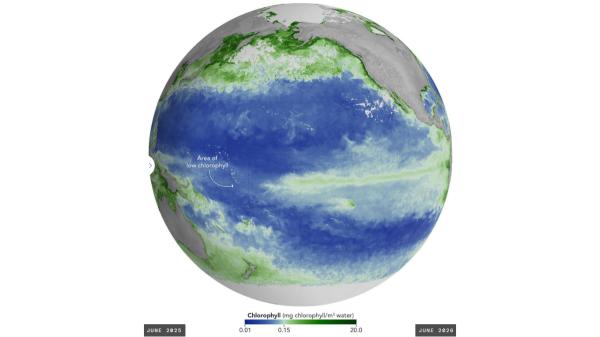
The data show that some areas of the equatorial Pacific have lost part of their green tones and present bluer colors than in the same period in 2025. This variation is related to the decrease in phytoplankton, a set of microscopic organisms that carry out photosynthesis and constitute the basis of numerous marine food webs.
Phytoplankton contain pigments such as chlorophyll, which are involved in the way water absorbs and reflects light. When these organisms are abundant, they contribute to certain ocean regions presenting greener tones. If its concentration decreases, the water can take on a bluer appearance.
Comparison of June 2025 and June 2026 measurements by NASA Earth Observatory shows substantially lower chlorophyll concentrations in parts of the central Pacific during the development of El Niño.
The explanation lies in the supply of nutrients. Under normal conditions, winds promote upwelling, a process by which deep, colder, nutrient-rich water rises to the surface. These nutrients fuel the growth of phytoplankton.
However, during El Niño, the weakening of the trade winds and changes in the structure of the ocean reduce this contribution in certain areas. With fewer nutrients available, phytoplankton find less favorable conditions to grow and their abundance may decline.
This mechanism has also been observed by the Indian Space Research Organization (ISRO), which detected a reduction in surface chlorophyll in the equatorial Pacific during 2026. Their measurements relate this decrease to alterations in winds and ocean upwelling.
Less phytoplankton can affect the entire marine food chain
The reduction of phytoplankton is not just a matter of color. These microscopic organisms are essential for ocean ecosystems, since they constitute a food source for numerous organisms and support a good part of marine biological production.
When their abundance decreases, the consequences can extend to other levels of the food chain. Zooplankton, which feed on phytoplankton, may have fewer resources, which in turn affects fish and other animals that depend on them directly or indirectly.
In certain regions, these changes can affect the areas where food resources are concentrated and force some species to move to find food. They can also impact human activities such as fishing, especially in areas where marine productivity depends on the supply of nutrients from the depths.
NASA has pointed out that changes in chlorophyll concentrations allow us to detect some of these alterations in the Pacific food web. However, satellite images mainly show changes in sea surface conditions and estimated phytoplankton abundance; They do not prove that all underwater life has disappeared.
Furthermore, the response of ecosystems depends on the region, the intensity of the phenomenon and how long unfavorable conditions remain. Some species may move, while others may experience difficulties feeding or reproducing.
Satellites make it possible to follow the evolution of El Niño in real time
Space observation is helping scientists better understand how the phenomenon evolves and what its consequences may be. NASA’s PACE mission, launched in 2024, makes it possible to analyze the color of the ocean at numerous wavelengths and study different types of phytoplankton and other components of marine ecosystems.
The agency has published a visual comparison of the apparent color of the Pacific in 2025 and 2026, which is updated as new data arrives. In it, blue tones usually correspond to lower concentrations of phytoplankton, while greens and yellows indicate higher concentrations.
These observations make it possible to follow the changes as El Niño develops and to check whether the regions with lower chlorophyll concentrations are expanding or if conditions are evolving in a different way.
Scientists hope that the observed differences could become more pronounced if the phenomenon continues to intensify, although its evolution will depend on the behavior of winds, temperatures and ocean circulation.
The 2026 episode thus demonstrates that a climate phenomenon can modify not only the temperature of the sea, but also the conditions that support life on its surface. The color change is a visible sign of these alterations and a tool to study how the ocean responds to an evolving climate system.
If you want to read more articles similar to El Niño is changing the color of the ocean because it reduces phytoplankton and threatens marine life, we recommend that you enter our Meteorological Phenomena category.
