
From the butterfly that imitates dry leaves to the octopus capable of “transforming” into 15 different species: the evolutionary mimicry strategies used by predators and prey to deceive nature.
The camouflage strategies of the animal kingdom, the result of long evolutionary processes, are often astonishing, as demonstrated by those implemented by the following species: they perform various functions including, mainly, escaping predators and surprising prey.
Orchid mantis
As its name suggests, it is able to perfectly imitate the famous tropical flowers, thanks to bright colors and the skilful use of flattened body appendages that look like fake petals. It thus manages to attract pollinating insects which, when approaching, become prey
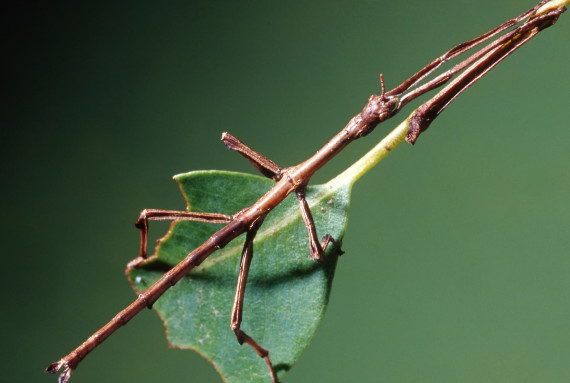
Stick insects: branches and leaves
Thanks to their morphology (elongated body, lamellar appendages, broken colours) and oscillating movements, they are able to implement perfect cryptic mimicry (without color changes), reproducing with extreme precision the appearance of branches, leaves and plant veins, to the point of being indistinguishable from vegetation, even from a short distance.

Leaf fish
Equipped with a flattened and fringed body that perfectly reproduces a leaf fallen into water, it moves oscillating like algae dragged by the current. The camouflage is completed by microvariations in the rhythm of the oscillation and by a speckled coloration that replicates the shadows and transparencies of the foliage.
Zebras
The mimicry of this inhabitant of the African lands is of a “disruptive” type: the black and white stripes in fact confuse the perception of predators, who struggle to distinguish a single individual in the group, and at the same time also disturb mosquitoes and other blood-sucking insects.
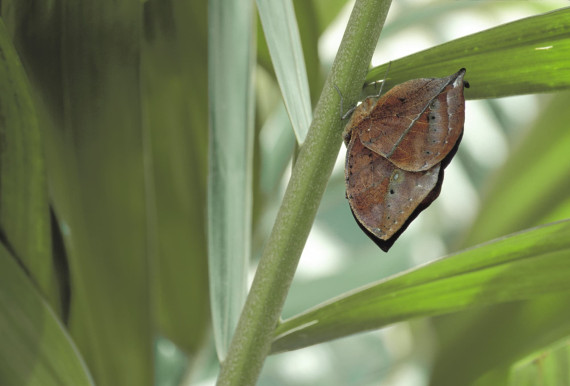
Dead leaf butterfly
Its wings, folded, impressively reproduce a dry leaf, complete with veins, spots and imperfections similar to the typical signs of decay. The camouflage is so accurate that it even includes a slight asymmetry of the wings and micro-irregularities in their surface.

Mimic octopus
Cephalopod mollusc considered one of the most extraordinary imitators of the animal world: it is in fact capable of reproducing the shape, movements, color and texture (thanks to a skin rich in chromatophores) of over fifteen different species (ranging from fish and sea snakes), in order to deceive both predators and prey.
Chameleon
This species of lizard, famous master of “chromatic mimicry” (from which it is no coincidence that the adjective “chameleon-like” derives), is able to change the tone of its skin thanks to special pigmented cells (iridophores and melanophores), and does so both to blend in with the environment and to regulate body temperature.
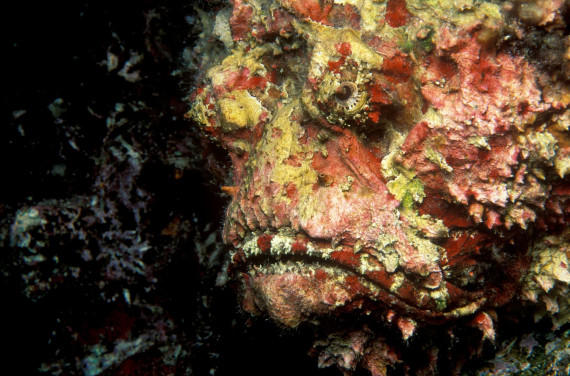
Stonefish
Among the fish with the most camouflage capabilities, its wrinkled and irregular skin perfectly replicates the rocks and corals of the seabed, on which it manages to remain motionless for hours, making it essentially indistinguishable from the environment that surrounds it.

Seppia
Equipped like the octopus with a skin rich in chromatophores, it can change color, brightness and texture in a few milliseconds, creating complex patterns that make it practically invisible on the seabed. Unlike the mimic octopus, it does not imitate other animals, but rather the surrounding environment.
Leaf-tailed gecko
Its flattened and jagged tail imitates a dry leaf, while the broken coloration of the body and the ability to remain immobile makes it literally “disappear” on the tree trunk. It is one of the most effective cases of cryptic mimicry among reptiles.
