
With the arrival of cold weather, turning on the heating becomes a routine in many Spanish homes. Electric radiators are one of the options for heating rooms without the need for large installations, but their consumption can end up causing a surprise when the electricity bill arrives.
Ángel Blázquez, an expert in household appliances and energy efficiency, has put figures on this expense and warns that keeping these devices on for several hours a day can involve a considerable outlay. In addition, it explains what aspects must be taken into account when choosing a radiator and making better use of the heat without increasing consumption.
How much does it cost to have an electric radiator on 6 hours a day?
One of the most common mistakes when using electric radiators is thinking that, because they are relatively small devices, they have little impact on the electricity bill. However, its power and operating hours can significantly increase monthly consumption.
Blázquez, in his YouTube video, explains that a 2,000-watt radiator can use much more than many users imagine. “A 2,000 W radiator turned on six hours a day for 30 days is 360 kWh, about 90 euros per month. Multiply it by three radiators and look at the bill,” warns the specialist.
This means that using three radiators of that power for the same time could reach 270 euros per month, taking as a reference the price of electricity used in that calculation. This is an estimate, since the real cost depends on the contracted rate and the price per kilowatt hour.
The expert also focuses on some commercial claims that can lead to confusion when purchasing these devices. “The big lie of ‘this radiator is 200% efficient…’. Lie. Almost all electrical appliances convert 100% of electricity into heat; the difference is in how they distribute that heat and how much it costs you to keep them on.”
Therefore, before choosing a model, it is advisable to look at its power and the use to which it will be given. As Blázquez summarizes: “At the same power, everyone uses the same amount per hour; what changes is how long you leave them on and at what temperature you are setting them.”

How to choose the power of the radiator depending on the insulation of the house
Not all rooms need the same power to reach a comfortable temperature. The square meters, the quality of the windows, the insulation of the walls and possible air leaks directly influence the amount of heat needed.
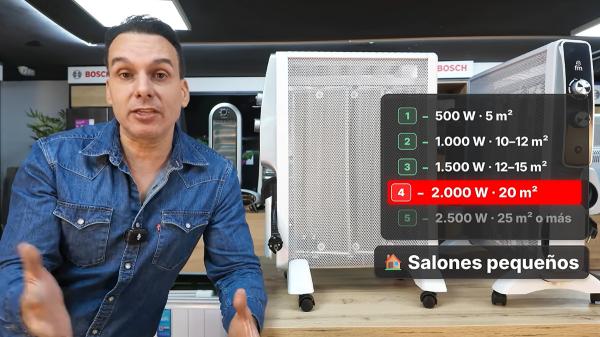
To calculate it, Blázquez shares a guiding rule: “In a well-insulated home, you need about 10 m² for each kilowatt; if your house is a sieve, divide it by two.”
Thus, a well-insulated room of about 20 square meters could need approximately 2,000 W of power. On the other hand, if it loses heat easily, it could require higher power to achieve the same temperature, although that would also mean higher consumption.
In large rooms, the specialist proposes another alternative to better distribute the heat: using two 1,000 W radiators placed at opposite ends of the room, instead of a single 2,000 W radiator. In this way, the heat can be distributed more evenly throughout the room.
The 20 degree trick to save on your electricity bill
Another aspect that most influences consumption is the temperature selected on the thermostat. Turning it up several degrees to heat the house faster is not always the best solution, especially if the radiators remain on for many hours.
Blázquez’s advice is to maintain a moderate temperature and avoid excesses: “Every degree more is paid for; set it around 20 degrees, the temperature enough to be comfortable at home.”
Along these lines, the Organization of Consumers and Users (OCU) warns that increasing the temperature by one degree above 20 °C can increase heating consumption by between 7% and 10%.
It is also important to avoid running radiators when no one is home or when a room remains empty. To do this, Blázquez recommends using timers and Wi-Fi adapters that allow you to program the devices to turn on and off.
Thus, it is possible to heat the rooms shortly before arriving home and avoid unnecessary operating hours. Combining adequate power, good insulation, and controlled temperature can help maintain comfort during the cold months without your electric bill skyrocketing.
If you want to read more articles similar to Ángel Blázquez, expert in energy efficiency: “A 2,000 W radiator turned on 6 hours a day costs about 90 euros per month”, we recommend that you enter our Energy Savings category.
