
Finland has begun filling a huge 20-meter-deep excavation with 380 million liters of water. Although it may seem like a conventional hydraulic work, its objective is to revolutionize the way of storing energy. The project, developed in the city of Hyvinkää, will allow the heat produced when electricity is cheaper to be conserved for months and used during the long Nordic winters.
The facility, considered the largest pit thermal storage tank in the world, represents an alternative to reduce fossil fuel consumption. Its construction also demonstrates how an old mining operation can acquire a second life linked to the energy transition.
How Finland’s giant heat reservoir works
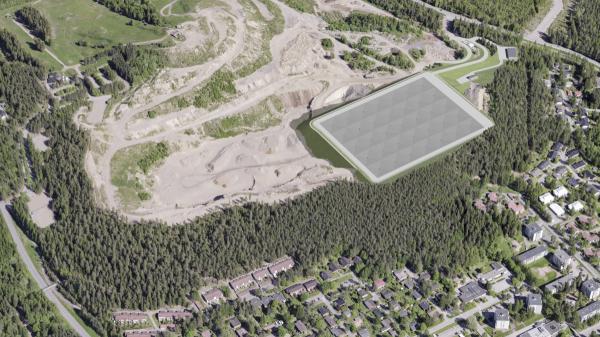
The facility is located in Kulomäki, a former gravel pit located in Hyvinkää, a city of about 47,000 inhabitants north of Helsinki. Its construction is carried out by the municipal company Hyvinkään Lämpövoima, which has taken advantage of the characteristics of the land to build a tank of extraordinary dimensions.
The excavation is 20 meters deep and has a capacity of 380,000 cubic meters. Once completed, it will be covered by a structure 225 meters long and 165 meters wide, equivalent to the area of approximately five football fields.
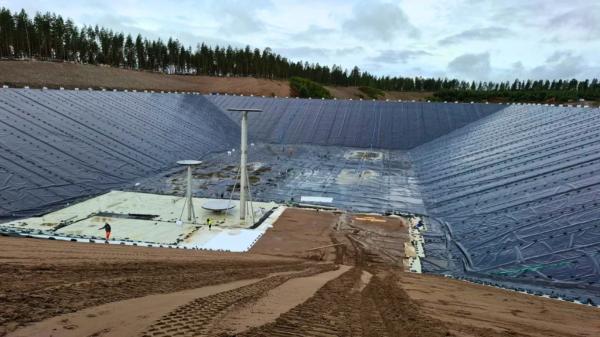
The system uses a technology called Pit Thermal Energy Storage (PTES), based on the storage of thermal energy in large water tanks.
During the warm months, the water will be heated by electric boilers and taking advantage of waste heat from industrial facilities. Its temperature will range between 40 and 90 degrees Celsius.
The operation is based on the circulation of water at different depths. When the tank is loaded, cold water is drawn from the bottom, passes through a heat exchanger, and returns hot to the top. In winter, the process is reversed to transfer the stored energy to the district heating network.
Enough energy to heat 1,000 homes for a year
The storage capacity per load will reach 18,000 megawatt hours (MWh), enough, according to the company responsible, to provide heating to around 1,000 single-family homes for a year.
That same amount of energy would be able to supply hot water to approximately 20,000 people for twelve months.
However, there is an important difference between the capacity of each load and the annual energy use. As the tank can be charged and discharged repeatedly, it is estimated that it will manage between 90,000 and 100,000 MWh of thermal energy per year.
This amount could represent around 25% of Hyvinkää’s annual district heating needs.
The project began a new stage in October 2026, when filling with water from the municipal network began. The process will continue until April 2027.
The final cover will then be installed and, according to the official calendar, heat storage will begin at the end of summer 2027. Start-up is scheduled for the fall of that same year.
A 33 million euro project to reduce CO₂ emissions
According to official information, the investment amounts to 33 million euros, of which approximately 7.7 million comes from aid from the Finnish Ministry of Economic Affairs and Employment.
The company estimates that the installation will avoid around 4,400 tons of carbon dioxide annually, in addition to generating savings of several million euros in fuel.
Hyvinkään Lämpövoima CEO Sanna Kytömäki highlighted that storing cheap and clean energy during the summer will reduce dependence on expensive fuels and help stabilize heating prices.
Environmental benefit also presents challenges. The facility is located in a groundwater area, so waterproofing, leak detection and aquifer temperature monitoring systems have been planned.
The warming of groundwater constitutes one of the main environmental risks identified. To control it, it is planned to recover part of the heat that escapes from the tank using heat pumps.
Finland commits to storing renewable energy underground
The Hyvinkää project is part of a broader energy transformation. In Vantaa, another Finnish city, Varanto, a thermal storage system in caverns excavated in the rock, is being built.
This facility, scheduled to come online in 2030, will have a capacity of 90 gigawatt hours per load, five times that of Hyvinkää.
The difference lies in the technology: while Hyvinkää uses an old gravel pit, Varanto will store hot water in huge underground cavities.
Both initiatives seek to solve one of the main problems of renewable energy: the difficulty of harnessing energy exactly when it is needed.
In countries with especially cold winters, storing available heat during warm months can reduce dependence on fossil fuels. The Finnish experience could serve as a reference for other European cities that have district heating networks.
If you want to read more articles similar to Finland pours 380 million liters of water into a 20-meter pit to create the largest heat reservoir in the world, we recommend that you enter our Energy Savings category.
