No probe has ever brought back to Earth samples collected beyond Neptune, but now tiny interplanetary grains intercepted by NASA reveal the existence of primordial water.
Listen to the audio summary of the article
Listen on Spreaker.
No probe has ever collected samples from the Kuiper Belt – the remote region of icy bodies that extends beyond Neptune’s orbit – and brought them back to Earth.
Yet, a fragment of that distant world has reached us, in the form of dust. By studying tiny grains intercepted in the Earth’s upper atmosphere, a group of NASA scientists found convincing evidence of the existence of an “ancient water reservoir”, with an isotopic composition different from that of the materials of the inner solar system, which means that that water has a sort of “fingerprint” of its own: it contains more heavy oxygen atoms (i.e. with more neutrons) than those we find on Earth or in asteroids, and this indicates that it was formed and preserved independently.
The study, led by planetary scientist Lindsay Keller of NASA’s Johnson Space Center in Houston, was conducted together with colleagues at the University of California, Los Angeles (UCLA) and published in Science Advances.
A suspicion that lasted decades
Scientists have long suspected that the ice in the outer part of the solar system contained high quantities of oxygen-17 and oxygen-18, the heavier stable isotopes of oxygen, in addition to the common oxygen-16 (oxygen always has 8 protons, but can have a different number of neutrons. This differentiates oxygen-16, oxygen-17 and oxygen-18 from each other). The evidence, however, remained scant.
Meteorites and samples of carbon-rich asteroids had provided some clues, but most of the meteorites we find on Earth come from the main asteroid belt, which is not far enough from the Sun to have “captured” material from that reservoir. Behind the research there is an old puzzle. Measurements from NASA’s Genesis mission, which collected solar wind particles, showed that the Sun is composed of oxygen-16. Earth, Mars and asteroids, however, show a much larger fraction of heavy isotopes. This imbalance between the composition of the Sun and that of the planets has been the subject of debate for years and a possible explanation involves a reservoir of ice rich in heavy oxygen in the outer regions.
Grains of dust as messengers
To get around this obstacle, the researchers looked to interplanetary dust, which is generated when comets and other icy Kuiper Belt bodies collide and shatter. The analyzed particles, each just 10-30 micrometers wide, were collected in the stratosphere by NASA’s ER-2 high-altitude research aircraft, as part of the Cosmic Dust program, which has been active from the Johnson Space Center since 1981.
To trace the origin of the specks, the team used a natural “marker”: the traces left by solar energetic particles. The longer a speck travels in interplanetary space, the more scars it accumulates. The twelve samples showed a very high density, about a hundred times higher than that of particles coming from closer regions, a sign of a very long journey from the Kuiper Belt.


The imprint of ancient water
With advanced electron microscopy from NASA and an ion microprobe from UCLA, the researchers studied the mineral and isotopic composition of the grains. Mostly hydrated minerals emerged, that is, minerals formed when water interacted with dust in the early stages of the solar system’s history. According to the models, these minerals would have originated from reactions with carbon dioxide and ice at low temperatures.
Their chemical signature tells us that the water involved was enriched with oxygen-17 and oxygen-18. This means that the original bodies, now largely frozen, had in the past experienced conditions that allowed the ice to melt and react with the rock. How that “heavy” water formed remains an open question. One hypothesis links it to ultraviolet radiation, which would have split some forms of carbon monoxide more easily than others, releasing oxygen enriched with heavier isotopes, then incorporated into water ice.
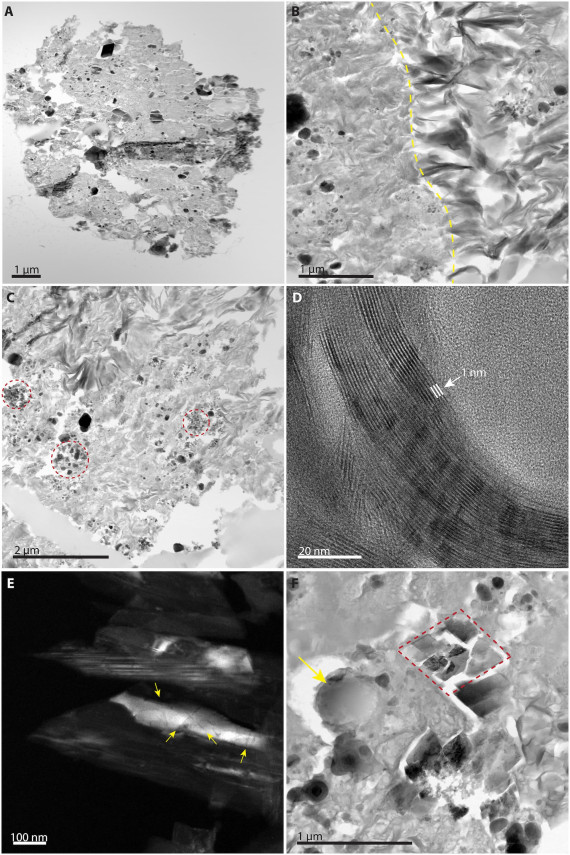

Above is an electron microscope image of an ultrathin section of one of the cosmic dust grains studied (L2079C35).
(A) The grain has a compact structure, with few empty spaces. The dark dots are tiny crystals of minerals, especially sulfides and carbonates.
(B) Detail of two types of clays present in the grain: to the right of the dotted yellow line, coarser grained clays; on the left, fine-grained clays with small sulphide inclusions.
(C) An area of fine-grained clays. The dashed red circles indicate three groups of sulfide inclusions.
(D) Extreme magnification of a crystal of saponitea clay that forms in the presence of water. The layers are about 1 nanometer (one millionth of a millimetre) apart. Credits: Science
(E) Enstatite crystal, a mineral rich in magnesium and silicon, covered with small “scars” (yellow arrows) left by energetic particles from the Sun. They are evidence of a long journey into space, compatible with an origin in the Kuiper Belt.
(F) A crystal of ferrous magnesite, a carbonate that contains magnesium and iron (red dotted outline), and a tiny globule of carbon (yellow arrow).
A less shuffled solar system than expected
The implications go beyond the Kuiper Belt. The Genesis measurements offer a reference for comparing oxygen isotopic compositions, while the paucity of similar signatures in meteorites suggests limited mixing between the outer and inner solar systems. In other words, that water reservoir would have remained largely separated from materials near the Sun since its origins, about 4.5 billion years ago.
According to the authors, the giant planets could have acted as a barrier, hindering the exchange of material. The picture, the researchers warn, may still be partial. A larger sample will be needed to understand whether this signature is widespread across many Kuiper Belt bodies or reflects the history of a smaller group of objects.