Thousands of Christmas trees that previously ended up as waste are helping to recover the beaches of Lancashire, in the northwest of England. Thanks to a simple and low-cost technique, conservation teams are managing to recover land that coastal erosion had degraded for decades.
The initiative is part of the Fylde Sand Dunes Project, a program that combines ecological restoration, citizen participation and adaptation to climate change. Their experience demonstrates how to take advantage of natural processes to protect coastlines, although rising sea levels pose new challenges to their continuity.
It also recovers a practice of using organic materials that contrasts with the large engineering works usually used to protect the coastline. Their interest has grown due to the need to find less expensive alternatives with less environmental impact. In addition, it allows neighbors to be involved in the conservation of a landscape that is especially vulnerable to human transformations.
Lancashire dunes have lost 80% of their area in 150 years
The Lancashire coast has undergone a profound transformation over the last 150 years. Urban growth, tourist infrastructure and erosion caused the disappearance of approximately 80% of its dunes, according to the conservation organization Lancashire Wildlife Trust.
These sandy formations constitute a natural defense against storms. They absorb part of the wave energy, store sediment and reduce the exposure of urbanized areas to flooding.
To recover this environmental heritage, local authorities and environmental organizations began to experiment with the reuse of Christmas trees. The reuse of Christmas trees on Lancashire beaches has a history in the 1990s, as documented Guardian in February 2026. Subsequently, these actions were integrated into broader dune restoration programs, the results of which have been recorded since the late 2000s.
The results are also reflected in the recovered area: according to official data, the actions have allowed the dune habitats to be expanded by about six hectares since 2008.
The initiative currently brings together Lancashire Wildlife Trust and Fylde and Blackpool councils, with funding from the British environmental agency Environment Agency.
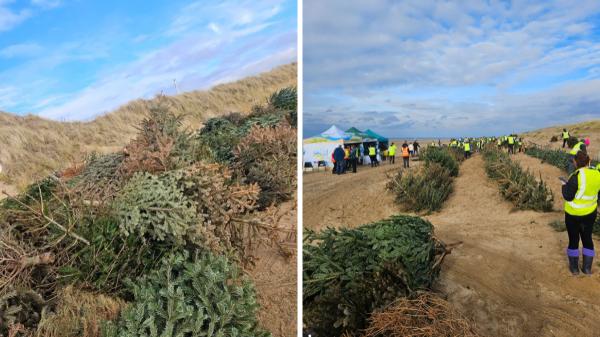
Why do they bury Christmas trees in the sand on beaches?
The procedure takes advantage of a physical phenomenon known as aeolian sediment transport. The wind moves the sand grains across the surface, but when it encounters obstacles it loses speed and part of the material remains deposited.
Volunteers dig trenches on the beach and place partially buried Christmas trees, with branches oriented to intercept wind-blown sand.
Little by little, sediments accumulate around the trunks and form small elevations. These structures can become embryonic dunes that are subsequently stabilized by native vegetation.
The technique is complemented by the planting of barron (Ammophila arenaria), a grass adapted to coastal environments whose roots help fix sediments.
The cumulative results are significant: more than 20,000 Christmas trees reused, according to Lancashire Wildlife Trust. Approximately 650 volunteers participated in the 2026 campaign, placing around 2,000 specimens along several kilometers of coastline.
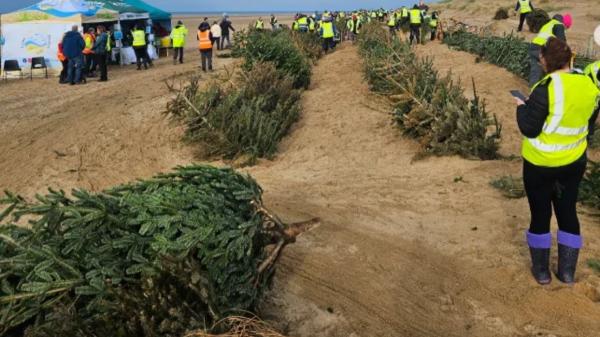
The dunes protect the coast from flooding and Spain is also committed to recovering them
The recovery of the dunes benefits threatened species such as the sand lizard (Lacerta agilis). The project has allowed the reintroduction of some 400 specimens and the creation of 22 humid depressions between dunes, especially valuable habitats for numerous plants and invertebrates.
However, climate change threatens these advances. According to the British Climate Report 2025, published in July 2026, sea level around the United Kingdom has risen by approximately 20.1 centimeters since 1901, and its rate of rise is accelerating.
Those responsible for the project recognize that, if this trend continues, they will have to increase the height of the dunes instead of continuing to extend them towards the sea.
The European Environment Agency considers dune restoration a nature-based solution, capable of reducing storm damage and promoting biodiversity, although it requires maintenance and sufficient availability of sand.
Spain is also developing similar actions. In February 2026, the Ministry for the Ecological Transition announced restoration work in six areas of La Manga del Mar Menor, with an investment of 210,000 euros. Interventions include sand collectors, elimination of invasive species and recovery of native vegetation.
Although the conditions of each coastline are different, the English experience proves that the restoration of natural defenses can complement traditional infrastructures and offer an alternative to adapt to the advance of the sea.
If you want to read more articles similar to In 2013 they began to bury Christmas trees on a beach in England: 13 years later they have recovered more than 90 meters of dunes, we recommend that you enter our Ecosystems category.