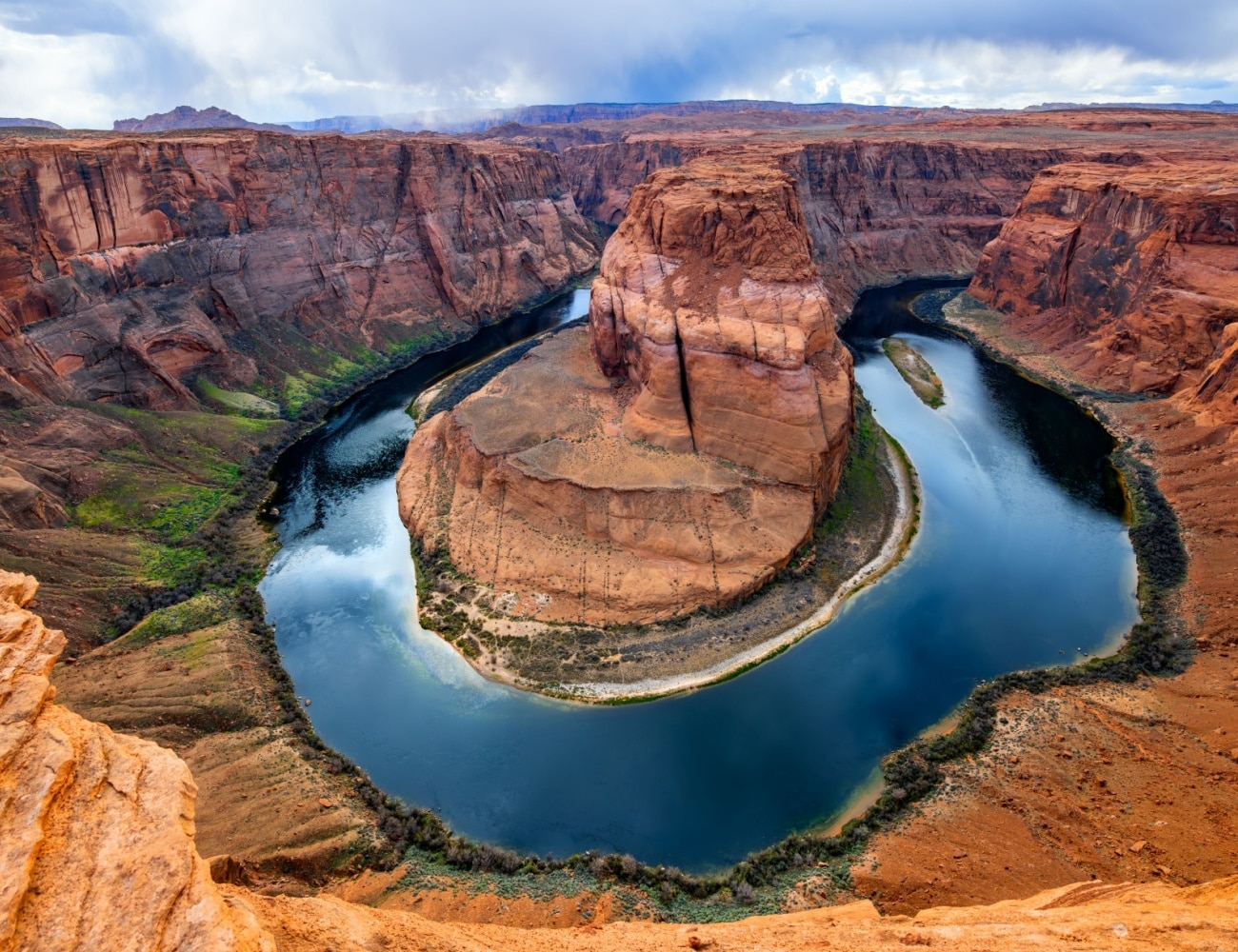
The Meteor Crater, formed 56,000 years ago by an asteroid of 300,000 tons, caused the landslide in the Grand Canyon which blocked the Colorado river, forming an ancient lake.
Two of the most iconic natural monuments in Arizona – the Meteor Crater and the Grand Canyon – could be connected by a cosmic event that took place 56,000 years ago. This is the fascinating hypothesis made by a new geological study, which connects the impact of an asteroid with the temporary formation of an ancient lake in the heart of the Grand Canyon.
Cosmic violence. It all began with a cataclysm: an asteroid of nickel and iron weighing about 300,000 tons, with an estimated diameter between 30 and 50 meters, hit the Colorado plateau at a speed of over 11 kilometers per second. The impact, equal to more than 150 atomic bombs and digs the meteor cratertoday also known as Barringer Crater, one of the best preserved meteoric craters on the planet. Located near Winslow, Arizona, The crater measures about 1.2 kilometers in diameter and 180 meters deep.
According to the study, published in Geology by an international team of researchers and the result of over fifty years of geological investigations, the consequences of that impact were not limited to the collision point. The earthquake generated – with a magnitude of 5.4 – would have traveled for over 160 kilometers in secondsreaching the Grand Canyon. Here, the seismic wave would have triggered a large -scale landslide in the Nankoweap region, Temporarily barrier the Colorado river and forming a lake 80 kilometers long and over 100 meters deep.
The tests. The existence of the so -called Nankaweap Paleolago is supported by a series of geological clues collected over time. The most important is located in the Stanton cave, located 45 meters above the current level of the Colorado river. Inside, the researchers found timber that had floated and lake sediments, deposits that suggest an exceptional full, ten times more intense than any flood known in the last millennia.
The first wooden championcollected in 1970 and dated to the radiocarbon in the 80s, indicated an approximate age of 44,000 years – Maximum test limit available at the time. Subsequent samples, taken from another Alcova 33 meters above the river and a few kilometers away, have undergone new analyzes with more advanced methods. Using both radiocarbon dating and dating to luminescence – which measures the light emitted by mineral crystals to establish their age – the researchers obtained “statistically indistinguishable” results: all data converge on a date of approximately 55,600 years ago.


A natural dam. Other crucial clues come from geological deposits found about 35 kilometers downstream of the Stanton cave, where they emerge remains of one Natural dam probably generated by the landslide.
Above this deposit there are rounded pebbles, testimony of the moment when the Colorado river began to overcome the obstacle, gradually eroding the dam over a millennium.
The set of tests – the dating of the impact, the landslide, the lake sediments and the timber – builds a coherent picture: A cosmic event had direct repercussions on the hydrography and geology of Arizonatemporarily modeling the landscape of the Grand Canyon.
Coincidences? Although the authors of the study recognize that the Nankaweap Paleolago could theoretically have also been caused by a landslide or an unprecedented earthquake, the temporal and geological coincidences are difficult to ignore.
“The impact of the meteorite, the large landslide, the lake deposits and the floating wood at dozens of meters above the river are all rare and extraordinary events”, explains Karl Karlstrom, geologist of the University of New Mexico and main co -author of the study. “The fact that their ages coincide in such a small window strengthens the hypothesis of a direct link.” If confirmed by further research, this connection between two of the most famous natural wonders in America would not only rewrite the geological history of Arizona, but would offer an extraordinary testimony of how a single instant of “Cosmic violence” can leave deep scars on earth, visible even after dozens of millennia.
