
Walking on the shoreline, we happen to note shells of different shapes and colors. The man has always been affected by their beauty, but these football carbonate structures are essential for the survival of their “owners”. Here are the secrets of their colors and shapes.
Walking on the beaches, in the summer, we can come across some extraordinary structures of the natural world: the shells. Their beauty has always fascinated humans, so much so that they were used as an ornament in prehistory, not only by us homo sapiens, but also by the man of Neanderthal, perforated and colorful with pigments. But what are they? “The shells are the exoskeleton produced by some molluscs, a” armor “that protects and supports them: something similar, in practice, to the external skeleton produced by the corals”, says Giovanni Coletti, researcher of the University of Milan-Bicocca. «They consist of calcium carbonate and produced by the cloak, the outermost layer of the body of molluscs. The cloak secretes an organic matrix of conchops, consisting of proteins, in which calcium carbonate crystals are formed. How does a shell grow? In the Bivalvi, for example, the deposition takes place after line by expanding the structure concentrically to the Umbone, i.e. the apical portion of the Valva, where the two valves are combined. In the gastropods, however, the shells generally have a spiral shape and growth takes place with the deposition of one “ray” after the other “.
The Giants of the Mediterranean
In some species we arrive in considerable dimensions: we think of the Giant Tridacna valves (TRIDACNA GIGAS), of the Pacific, which can be up to 120 cm wide. But also to the largest endemic bivalve in the Mediterranean, the Nacket (Pinna Nobilis), whose valves exceed the meter of size.
As Valentina Alice Bracchi, professor of Paleontology and Paleoecology at the University of Milan-Bicocca, adds, “football carbonate can be in the form of aragonite or calcite crystals. The mother of pearl, the internal layer of the shell of some molluscs, is for example consisting of overlapping slats of aragonite crystals ». And what does the characteristic colors give? «The calcium carbonate is white, while the conclusion can contain the pigments that give the colors. It is no coincidence that over time the old shells tend to become white, because they lose the organic part that gave them the color: some white beaches, such as those of tropical atolls, have a large component consisting of fragments of shells, “says Coletti.
Mortal poison
The “owners” molluscs of these armor can be herbivores and feed on algae and plants, or filters that retain the organic substances present in the water (it is the case of many crossroads, which remain fixed to a substrate), or still active hunters.
The latter can feed on corals, small fish or other molluscs: a predator is for example the geographical cone (Conus Geographus), gastropod widespread in the Indian ocean and in the Pacific, equipped with a trunk with a modified tooth that is shot “as an harpoon towards small fish to inject the poison (so powerful that they can kill a man).” For example, there are molluscs, such as the Murici, who pretend other molluscs making a hole in their shell with the Radula (a structure of the mouthful of the molluscs, ed) and secreting an acid substance that creates a hole, “explains Bracchi.
Mimicry on the bottom
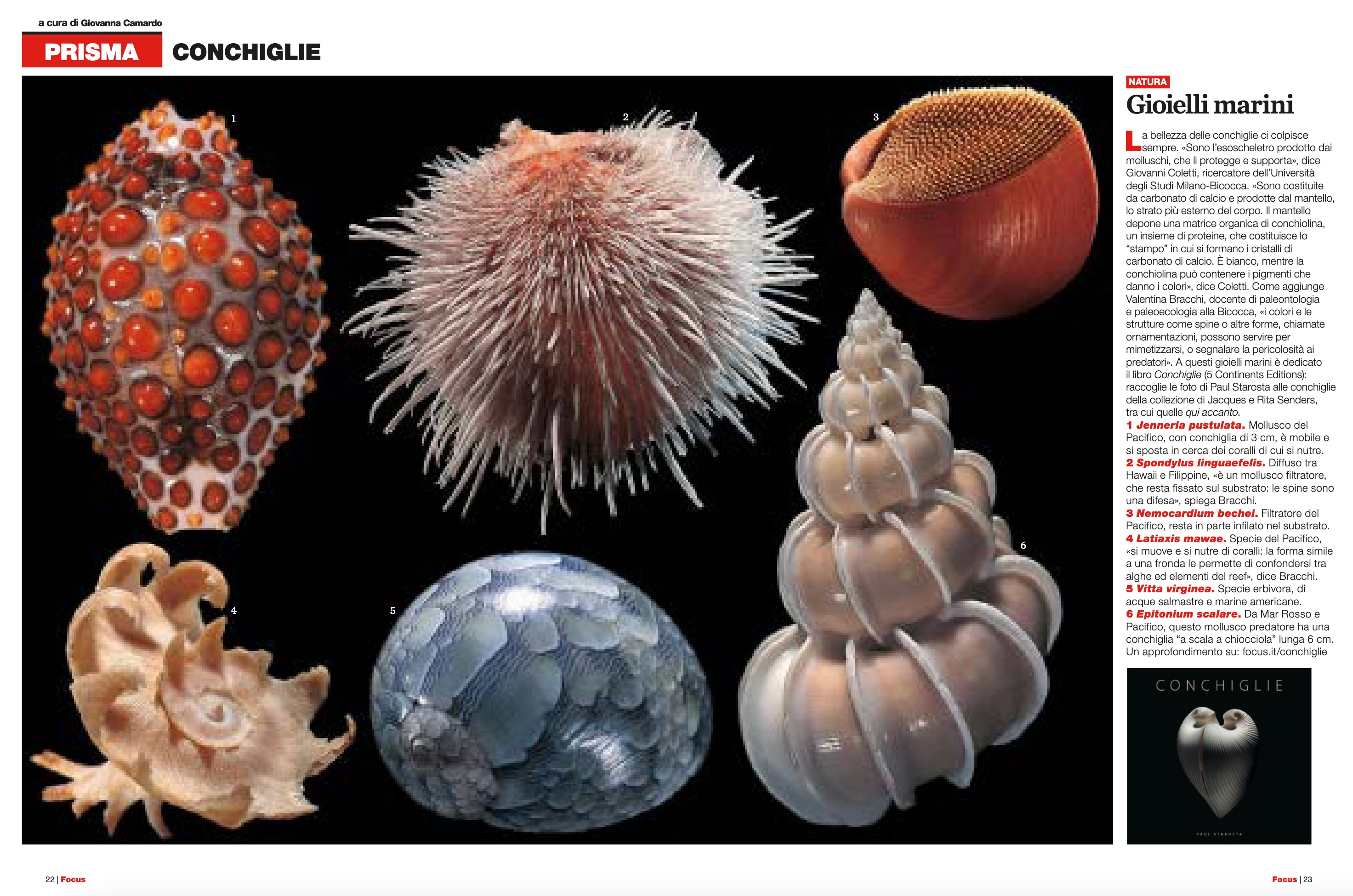
The colors and shapes that we admire in the shells are linked to the survival and hunting strategies of the different species. “The colors can serve to camouflage themselves, or on the contrary to report their danger to predators,” concludes Bracchi. «The same goes for thorns and other structures, called ornaments. The thorns can be a defense against predators: for example, it is valid for molluscs that remain fixed on the substrate. Very mobile species, however, tend to have less conspicuous ornamentations. In other cases, the structure of the shell allows the animal to camouflage itself between the algae and the structures of the coral cliffs ».
