
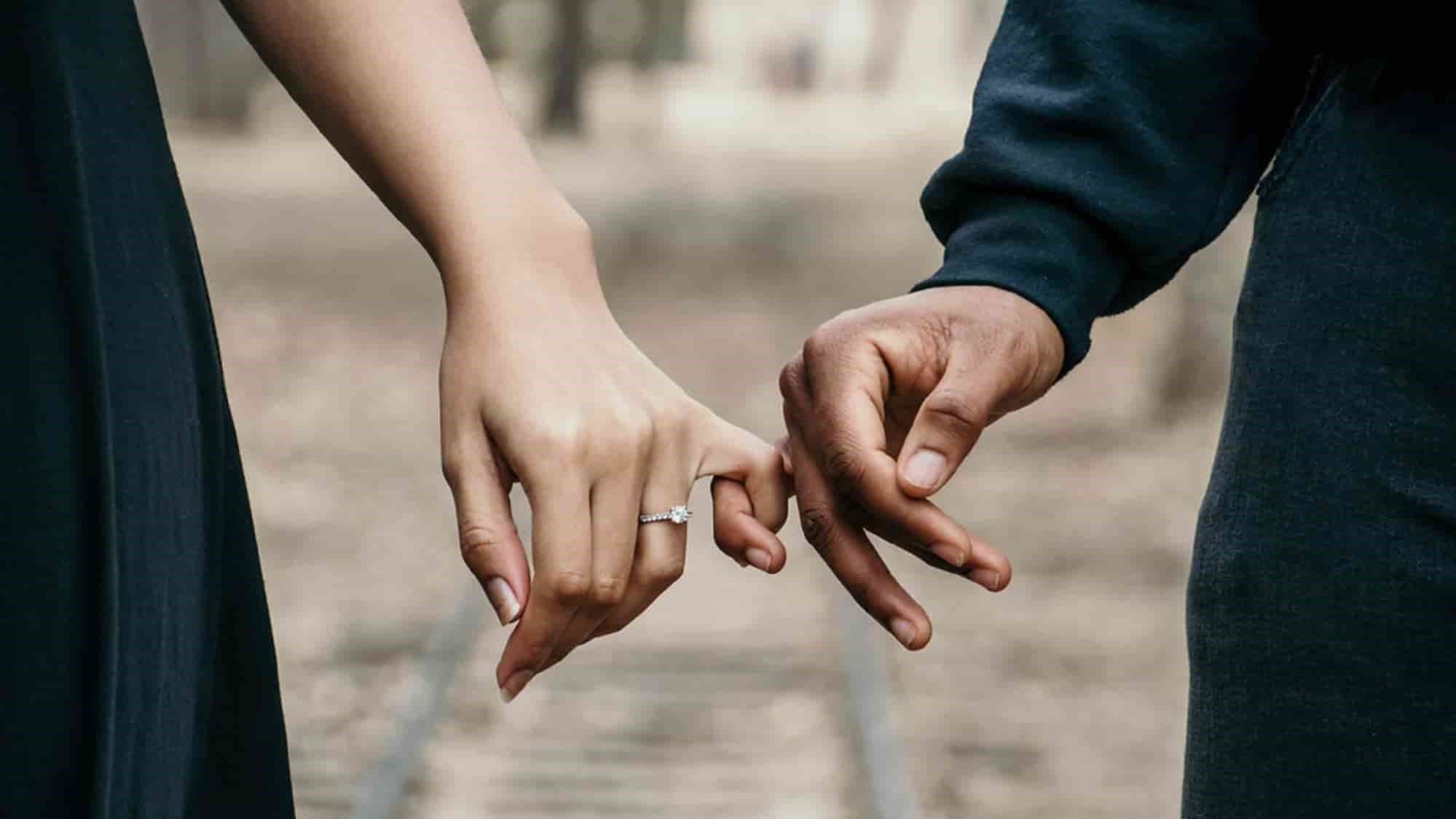
Mixed couples really are different from the others? This is a complex question. On the one hand, labeling a relationship as “different” risks creating a social distinction that is not always useful. On the other, it is undeniable that the partners of a mixed wedding they live unique dynamics, shaped by a wonderful cultural diversitywhich can manifest itself in multiple aspects:
- Cultural: which manifest themselves in different values, habits and visions;
- Religious: when partners profess different faiths or one of the two has a secular approach to life;
- Ethnic: that reflect the specific origins and background of each partner.
A mixed weddingor more precisely a couple intercultural it is therefore a union between people who come from contexts considered different. Often, this relationship was born from the encounter between different worlds, perhaps following the migration of one of the partners or his family, starting a profound path of cultural integration.
The process of choice in a mixed couple Ift
In the past, the choice of a foreign partner was often interpreted with suspicion, almost like an act of rebellion against his own culture, a challenge to the authority of parents or to the prejudices of society.
Fortunately, from the eighties onwards, i Mixed weddings They started to be seen for what they are: one of the many expressions of love and human meeting. But what a person pushes to choice of a partner of another culture? Often, just the cultural differences They become a powerful attraction factor. This can happen for various reasons: a search for complementarity, the charm for unconventional perspectives or, in some cases, the hope of facilitating integration in a new country.
Analyzing the reasons from the point of view of the partners who migrate, research in the field of migration sociology (Tognetti Bordogna, 2007) has mainly identified Two paths which can lead to a mixed wedding:
- marriage instrumental: In this case, the union can be seen as a means to obtain a residence permit and improve its social position. This choice often emerges in contexts of strong economic need or political-social instability;
- marriage like meeting opportunities: here, union arises from the genuine desire to explore another culture and to connect deeply with the cultural diversity of the other. It is a more common choice when migration is driven by curiosity and the desire to discover new realities.
From the choice to the pact
Beyond the initial choice, each couple builds a “pact“Implicit, an emotional agreement that defines the nature of the bond. In Mixed weddings three types of fundamental agreements have been identified:
- the pact of convenience: a bond based mainly on personal and practical objectives, with less central emotional involvement;
- the pact consoling: a relationship that was born to fill a void left by past experiences, looking for a form of emotional compensation in the other;
- the pact supplementary: the most solid bond, based on a strong couple alliance and well -defined personal and social identities, capable of integrating each other.
Relationship with the families of origin
Build a couple identity in a mixed wedding It is a real journey. Means undertaking one cultural transition which requires continuous negotiation between different world visions, a constant dialogue to honor the roots of both partners.
Often, one of the most delicate challenges concerns the relationship with the Families of origin. The announcement of an intercultural union can generate an initial disorientation, sometimes a real shock which risks hindering the relationship. For migrant families, for example, the fear that their child can emerge, binding to a partner of different culture, can lose their roots.
For both families, the choice of a “foreign” partner can be experienced, at a deep level, as a refusal of one’s belonging or a disavowal of family legacy. It can be perceived as a threat to cultural continuity, generating tensions and misunderstandings with diversity.
An initial reaction of hostility or refusal by the families of origin, although painful, is an event to be taken into account. It all depends on the ability of that specific family to welcome and accept the diversity. Fortunately, over time, many families take a path that leads them to “universalism“: An attitude that recognizes the richness of the intercultural union.
It is a path made of stages, which can include phases of refusal, resistance and finally acceptance, until it reaches full respect for the bond and an authentic opening transcultural.

Parenting in the mixed couple
Becoming parents is one of the most transformative challenges for each couple, and in a mixed wedding This adventure is enriched with further even deeper nuances. Partners must confront them cultural differences To make fundamental decisions such as:
- the choice of a name that can honor both cultures;
- the different ways of understanding and experiencing the role of parent;
- the role and involvement of families of origin in the education of the child;
- Religious education and the choice of language (or languages) to speak at home.
These are just a few examples of the wonderful and complex challenges that neogens are facing. Partners are required to develop strategies of copingHe shared, to allow children to draw on both cultural worlds and, at the same time, to build their own, unique and new identity. The success of this path depends on a continuous negotiation and a great team work, not only of the couple, but also of the enlarged families.
What is meant by mixed marriage?
A mixed wedding also defined as ‘intercultural’, is the union of two people who come from different contexts. This cultural diversity It can express itself in various ways:
- Difference in nationality: When one of the partners is an Italian citizen and the other is a foreigner.
- Difference in religion: If the partners profess different faiths (for example, union between a Catholic and a Muslim) or have different visions of spirituality (as between a believer and an atheist).
- Ethnic-cultural difference: Even if you have the same nationality, partners can have very different origins and heritage of traditions.
These unions are a source of incredible wealth, but also require constant dialogue to integrate values, habits and visions of the world sometimes distant.
Mixed weddings in Italy: some data
The phenomenon of Mixed weddings In Italy it is a continuously growing social reality. According to Istat data, in 2012 30,724 weddings were celebrated with at least one foreign spouse, equal to 15% of the total unions of that year.
- The prevalent type (68% of marriages with at least one foreign spouse in 2012) is represented by unions between an Italian husband and a foreign bride (Istat, 2013).
- Geographically, the phenomenon is more widespread in the north and central Italy, areas where thecultural integration of foreign communities is historically more consolidated.
These numbers do not tell only a demographic change, but also testify to a progressive and important opening of our society.
The psychological and cultural challenges of mixed couples
Living an intercultural relationship is a journey of continuous discovery, but it can also present unique challenges. A recent systematic review of the scientific literature has highlighted how a greater similarity in the way partners define, express love and approach conflicts both associated with a higher quality of the relationship (Yurteva & Charura, 2024).
Often, i problems in mixed weddings they are not born from the lack of love, but from the difficulty of managing the cultural differences. Among the most common areas of comparison we find:
- Communication: It is not just about overcoming a linguistic barrier, but of understanding different communicative styles (more direct or indirect, more explicit or implicit).
- The relationship with the families of origin: Sometimes, families can perceive the choice of partner as a ‘break’ with traditions, generating tensions and misunderstandings.
- Conflict management: Each culture has different ways of dealing with disagreements. If they are not understood and mediated, these different approaches can create friction.
- The identity of the couple: The biggest, and at the same time more enriching challenge is to create an ‘we’ who intact and enhance the cultures of both, without anyone having to give up a part of himself.
Manage the differences: from religion to education of children
Face the cultural differences It requires an open dialogue and an active commitment from both partners. Parenting, in particular, becomes fertile ground for this negotiation. The couple is called to find common ground on fundamental aspects such as:
- Religious education: Will we choose to transmit a specific faith, both or none?
- The language: Which language (or languages) will we speak at home to guarantee the child access to both cultural heritage?
- Educational values: Different parenting styles, perhaps a more protective one and the other more autonomy -oriented, can become an opportunity for comparison and growth.
The key to success lies in developing shared coping strategies, creating a family environment in which the child can feel enriched, and not divided, by his wonderful double cultural heritage.
A single couple path: like therapy can help
Everything is fine mixed wedding It is the construction of a unique world, a bridge between cultures. This path, as enriching as it is sometimes complex, can benefit from targeted support. Dressing the challenges with the right tools can transform obstacles into precious growth opportunities, both for the couple and for individuals.
A couple of couple therapy can offer a safe and non -judge space to explore intercultural dynamics, improve communication and build new shared strategies. If you feel that an external support could help you navigate the complexity and beauty of your union, we at Unebravo are here to listen to you. Start the questionnaire to find your online psychologist
