
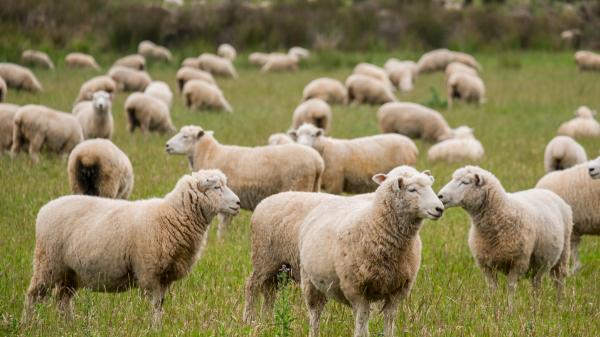
At the beginning of the 20th century, thousands of sheep occupied these lands in the Argentine province of Santa Cruz. Livestock farming was then the main economic activity and Monte León became one of the most important sheep farms in Patagonia. His story, however, took a completely different turn.
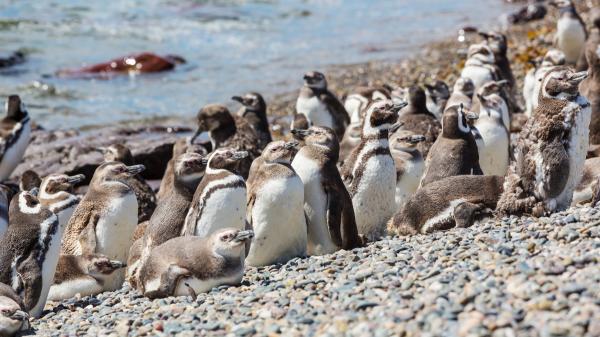
The territory is today part of the Monte León National Park, a protected area of 62,169 hectares located next to the Argentine Sea. There, where tens of thousands of sheep grazed for decades, is currently one of the Magellanic penguin colonies (Spheniscus magellanicus) most important in Argentina.
The National Parks Administration estimates the breeding population at more than 40,000 pairs and, in its official file of the protected area, it speaks of about 46,000 pairs. The change that occurred in just over a century also allows us to explore a part of the economic and environmental history of Patagonia.
From more than 40,000 sheep to a protected area
Livestock activity deeply marked the history of Monte León. The ranch was linked to The Southern Patagonia Sheep Farming Company Limited, which began its sheep farming at the end of the 19th century. By 1920, records indicate that the establishment had 40,535 sheep, 300 horses, 8 cows and 1 bull.
For much of the 20th century it continued to be a livestock farm. However, the number of animals was decreasing. Between the 1970s and 2000s only approximately 11,000 to 20,000 sheep were kept, no other animals, and finally at the end of 2001 the sheep were removed.
The future of those lands began to be defined shortly before. In 2001, the Fundación Vida Silvestre Argentina acquired the ranch thanks to funds provided by the Patagonia Land Trust. The purpose was not to continue with livestock exploitation, but to preserve the territory and later transfer it to the State.
In November 2002, the land was donated to the National Parks Administration. Two years later, through Law 25,945, the Monte León National Park was officially born.
The transformation was especially significant because Monte León became the first coastal-marine national park in Argentina, simultaneously protecting environments of the Patagonian steppe and the coast of the Argentine Sea.
More than 40,000 pairs of Magellanic penguins
One of the great protagonists of this recovery is the Magellanic penguin. This species spends a good part of its life at sea, but needs to return to dry land to reproduce, build or reuse its nests, and raise its chicks.
In Monte León you will find an extensive coastal area suitable for doing so. The official information from National Parks speaks of more than 40,000 breeding pairs, while the specific record of the park places the colony at approximately 46,000 pairs, which makes it one of the main ones in the country.
The penguins begin to arrive in the area from October. During the reproductive season they occupy their nests, lay their eggs and take turns in different tasks related to incubation and feeding the young.
The visitor can approach the colony through the so-called Penguin Trail, although the observation must be carried out respecting the indications of the protected area. We must not forget that, no matter how accustomed some specimens may seem to human presence, they are still wild animals.
The protection of the place is also relevant because the Magellanic penguin depends both on the conservation of its terrestrial breeding areas and on the conditions of the marine ecosystem where it obtains its food.
A refuge that goes far beyond penguins
The wealth of Monte León does not end in its enormous penguin pen. In its different environments, 134 species of birds and 28 species of mammals have been recorded, as well as reptiles, fish and numerous invertebrates.
In the steppe they can be found guanacos, rheas, foxes, skunks, armadillos and pumas. Seagulls, terns, cormorants and other seabirds appear on the beaches, cliffs and rocky areas. There are also roosts for fur seals.
The sandbanks that are exposed when the tide goes out hide another small biological universe made up of anemones, starfish, urchins, crabs, mussels and other mollusks. Inland, the underwater forests of large algae serve as a refuge for numerous species of fish, while in the waters of the area you can occasionally see dolphins and southern dolphins.
The park protects, therefore, much more than a colony of penguins: it preserves the meeting point between two large ecosystems, the Patagonian steppe and the Argentine Sea.
The old livestock activity has not been erased from its history either. Part of the farm’s facilities remain standing and the old shearing shed serves to explain how one of the most important sheep establishments in the region worked.
Monte León thus brings together two eras in the same landscape. The pens and buildings remember the tens of thousands of sheep that occupied these lands during the last century; The guanacos, pumas and, above all, the tens of thousands of pairs of penguins show what their main function is today: protecting one of the great natural spaces of the Argentine Patagonian coast.
If you want to read more articles similar to A livestock farm once had 40,000 sheep: today its 62,000 hectares are home to more than 40,000 pairs of penguins, we recommend that you enter our Ecosystems category.
