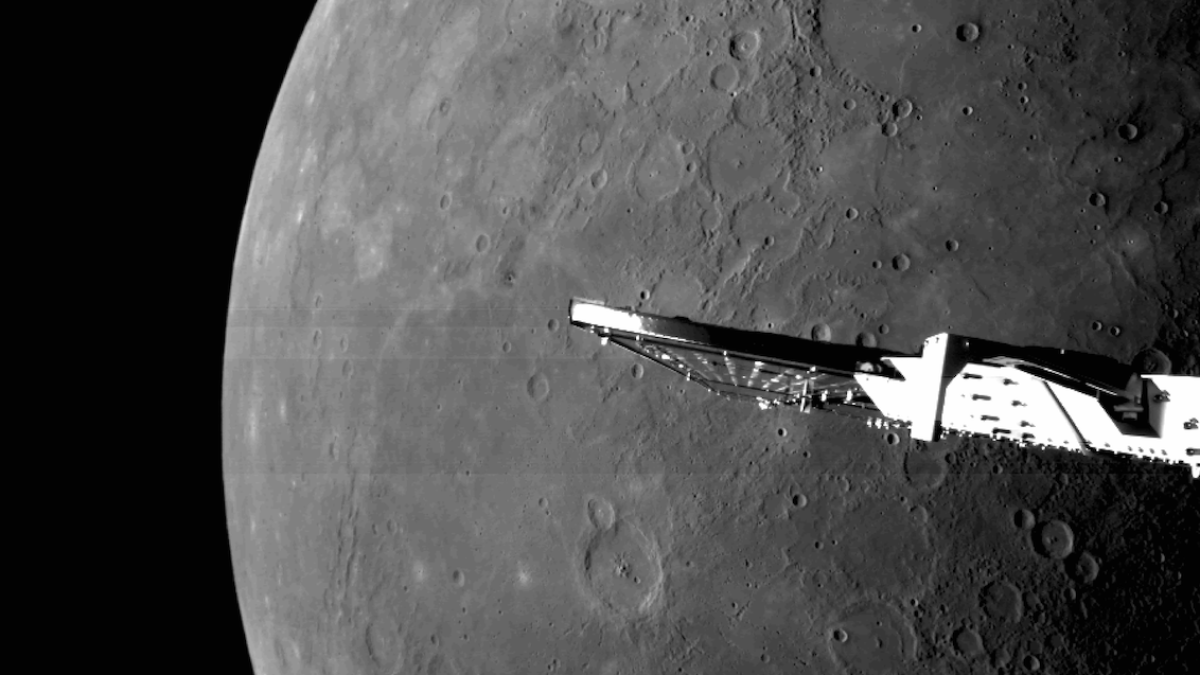
After eight years in space, the BepiColombo mission has reached Mercury: however, a software anomaly shortened the entry maneuver and the possible effects on the rest of the journey are now being evaluated.
Listen to the audio summary of the article
Listen on Spreaker.
After an eight-year journey, the European-Japanese probe BepiColombo began orbiting Mercury, the smallest planet closest to the Sun. However, ESA (European Space Agency) announced on Sunday that a problem with the thrusters occurred during arrival, the causes and consequences of which are being assessed. Mercury, just larger than our Moon, is the least explored of the four rocky planets of the inner solar system: BepiColombo is only the third probe to visit it and the second to put it into orbit, after NASA’s MESSENGER which studied it from March 2011 to April 2015. The mission is the result of collaboration between ESA and JAXA (Japan Aerospace Exploration Agency, the Japanese space agency).
A confirmation that arrived hours later
The orbit insertion took place on Saturday 21 November, at the end of a 37-minute maneuver that began at 7.24pm Italian time. The success, however, was confirmed only several hours later. On Saturday evening, the team announced that they had re-established contact with the probe and that the flight dynamics specialists of the ESOC (European Space Operations Centre, the European space operations center in Darmstadt) had verified the orbital capture. However, a clarification arrived on Sunday: in a post on social media, ESA explained that entry into orbit was successful, but that during the maneuver the firing of the thrusters was shorter than expected due to a software problem. The agency has assured that the probe is safe and that ESOC teams are working to understand what happened, with new updates expected today Monday 23 November. At the moment it is not clear how much the anomaly will affect the maneuvers that remain to be carried out.
Two probes in one
The mission is a composite of two vehicles with different scientific objectives: the MPO (Mercury Planetary Orbiter, ESA’s planetary orbiter) and the MMO (Mercury Magnetospheric Orbiter, JAXA’s magnetospheric orbiter), also known as Mio. They launched together in October 2018 on board an Ariane 5 rocket from French Guiana, with a propulsion and energy module, the MTM (Mercury Transfer Module, the transfer module).
Reaching Mercury is complicated precisely because of its proximity to the Sun: the enormous gravitational attraction of the star accelerates the approaching probes, which then have to expend a large amount of energy to be captured by the much weaker gravity of the planet.
For this reason the trajectory included one flyby of the Earth, two of Venus and six of Mercury in about seven years. A problem with the MTM’s electric engines, which emerged in 2024, then forced the plan to be revised and the arrival postponed by about a year.
The next steps
Insertion into orbit closes the approach phase, which lasts approximately six months in total. On September 3, MTM released MPO and Mio, who remained attached to each other and will separate on December 9 and 10. Soon after, Mio will reach its final, polar and highly elliptical orbit. MPO is also destined for a polar orbit, but much less elliptical: it will reach it on March 10, 2027, after a series of engine firings. These maneuvers could be affected by the anomaly. Routine science operations are scheduled to begin on April 6, 2027. The mission is named after the Italian scientist and mathematician Giuseppe “Bepi” Colombo.
The questions he seeks answers to
The two probes will collect complementary data from different observation points to study the planet in the round: the magnetosphere and its interaction with the solar wind, the interior with the large iron core, the origin of the magnetic field. Scientists also want to understand why ice exists in the polar craters of a planet scorched by the Sun and what is the nature of the mysterious depressions called “hollows”, visible on the surface.
An extreme world
Mercury’s surface resembles that of the Moon, with numerous impact craters, flat expanses and escarpments that in some places reach 1.6 kilometers in height. The planet is about 60% closer to the Sun than the Earth: seen from its surface, the star appears more than three times larger and seven times brighter. With a diameter of 4,880 kilometers, Mercury is less than 40% of the Earth, which measures 12,753 kilometers.