
For decades, the landscape of the Great Karoo, in South Africa, lost much of the fauna that had been part of its ecosystems. Hunting, the expansion of livestock farming and other human activities caused animals such as elephants, black rhinos and large predators to disappear from the area. But a project started in 1997 has managed to progressively change this situation.
That year, Sarah and Mark Tompkins began collecting old livestock farms to recover a territory that had lost much of its biodiversity. Over time, they came to group 11 farms totaling some 27,000 hectares, giving shape to the Samara Karoo Reserve, one of the most notable private ecological restoration initiatives in this region of South Africa.
What happened next was not just about creating a protected space. The project began by recovering the land itself and, once the ecosystem began to respond, some of the species that had disappeared from the Great Karoo returned.
First they had to recover a very degraded landscape
When the project began, some of the old farms that now form Samara were very degraded. Livestock activity had exerted strong pressure on the land, so one of the first steps was to remove the sheep and goats and let the land rest.
Invasive plants were also removed and fences dividing the old properties were dismantled. The land remained dormant for almost a decade before beginning a more ambitious program of rehabilitation and recovery of the fauna.
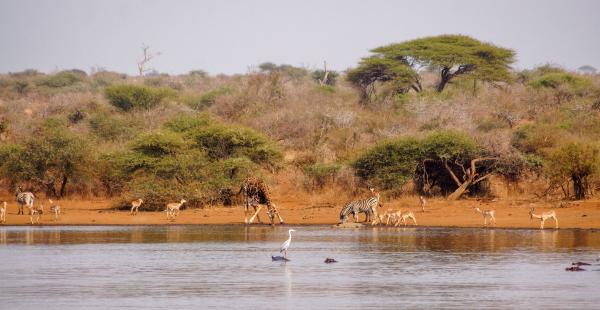
The strategy followed a specific order. Before introducing large predators, it was necessary to rebuild the base of the ecosystem. That is why herbivore populations recovered first, including elands, gazelles, mountain zebras, giraffes, buffaloes and white rhinos.
The idea was to gradually recover the different pieces of an ecosystem that had been fragmented.
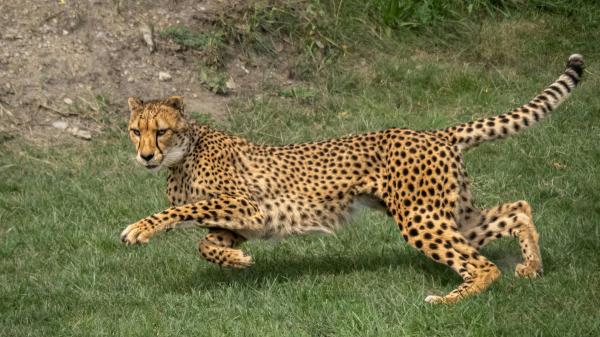
The cheetah returned after 130 years and the black rhinos also returned
One of the first major milestones came in the early 2000s. In 2003, the first cheetah was reintroduced, after about 130 years of absence from the region. The reserve itself indicates that the current population of these felines has a good part of its origin in those first specimens.
Among the best-known animals from this stage was Sibella, a female cheetah that arrived in Samara and whose offspring later contributed to the expansion of the species in other conservation areas in South Africa.
In 2013 came another important step: Samara became one of the few South African private reserves that had reintroduced the black rhinoceros adapted to desert environments, a subspecies considered critically endangered. The reserve indicates that at that time there were less than 5,000 specimens left worldwide.
Thus, the recovery was not limited to increasing the number of animals. The objective was to reestablish the ecological relationships that had existed in the territory.
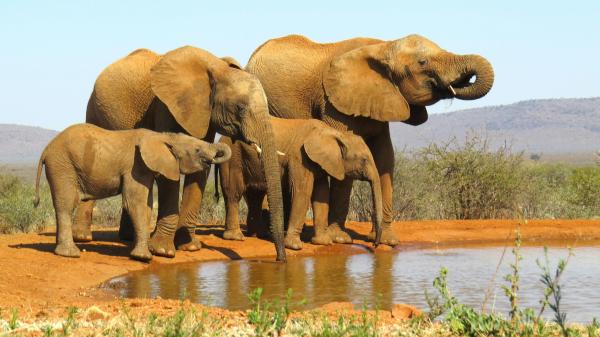
Elephants returned in 2017 after about 150 years of absence
One of the most striking moments of this transformation occurred in 2017, when a small family group of elephants was transported to Samara.
According to the reserve, these large herbivores had been absent from the landscape for approximately 150 years. Their arrival also had an ecological significance: elephants are not only a species that occupies a territory, but they can physically modify the environment and act as true engineers of the ecosystem.
That first group was later expanded with the arrival of two adult males in 2018. The operation was carried out in collaboration with conservation organizations and the movements of the animals were followed to control their adaptation to the new territory.
The presence of elephants allowed us to recover ecological processes that had disappeared along with them. Their feeding and movements modify the vegetation and generate new opportunities for other species.
Then the lions returned and a large predator returned on its own
The next big step came with the lions. In 2019, the reserve incorporated these large predators to also recover the ecological function they had played in the past. According to Samara, lions had disappeared from the region approximately 180 years earlier.
Their return completed the presence of several of the continent’s most emblematic species and allowed Samara to become a space where the so-called Big Five are present: elephant, rhinoceros, buffalo, lion and leopard.
But the case of the leopard is especially interesting because it was not necessary to reintroduce it. The reserve documented their presence for the first time in 2021 and monitoring through camera traps and tracking subsequently confirmed that these cats had returned under their own power.
It is one of the most significant signs that habitat restoration is not limited to the animals that those responsible for the project move there.
More than 60 species of mammals now live in the reserve
Almost three decades after the project began, Samara’s landscape is very different from what the Tompkins found in 1997. Currently, the reserve records more than 60 species of mammals and 225 species of birds, with large herds of antelope and the presence of elephants, rhinos, cheetahs, lions and leopards.
Furthermore, the project is not proposed as an isolated action. Those responsible have a broader vision: connecting Samara with other protected areas through ecological corridors to create a continuous territory that allows the movement of fauna and contributes to conserving the Great Karoo on a much larger scale.
The history of these 27,000 hectares thus shows one of the keys to the so-called rewilding: recovering a species can be important, but restoring the terrain and the relationships between animals, vegetation and landscape can allow, over time, other species to reoccupy a territory that they had abandoned decades or even centuries ago.
If you want to read more articles similar to From 11 livestock farms to a 27,000 hectare reserve: the project that managed to return elephants, rhinos and large predators to South Africa, we recommend that you enter our Ecosystems category.
