
In 1864, Tasmania made a decision that at the time seemed to offer only benefits: introducing brown trout from England (Salmo trutta) to develop recreational fishing. The species adapted extraordinarily well and ended up turning the Australian island into an international destination for hobbyists. More than a century and a half later, however, that introduction has a much less friendly face.
One of the fish that has suffered the most from the trout expansion is the Swan galaxies (Fontanus galaxies), a species that lives nowhere else on the planet. The estimates released by those responsible for its conservation place its current population at around 6,000 individuals, distributed in small water courses. The situation has led to the development of a striking strategy: creating authentic trout-free refuges where the native fish can reproduce without facing one of its main predators.
The small Tasmanian fish that does not exist anywhere else in the world
He Fontanus galaxies It is a small freshwater fish that reaches approximately 13 centimeters in length. Its natural distribution is limited to eastern Tasmania, mainly to the headwaters of the Swan River and some tributaries of the Macquarie. The Australian Department of Climate Change, Energy, Environment and Water classifies it as a threatened species and points out predation and competition by exotic fish among its main problems.
The common trout occupies a prominent place among them. Introduced from England in 1864, it later spread throughout much of the rivers and lakes of Tasmania. Currently it also constitutes the basis of an important recreational fishing activity, which adds complexity to its management.
The problem is that small galaxids evolved for millions of years without coexisting with these predatory salmonids. A research published in Inland Waters found that the presence of non-native predatory fish can significantly modify the ecology of Tasmanian galaxids and reduce their trophic niche.
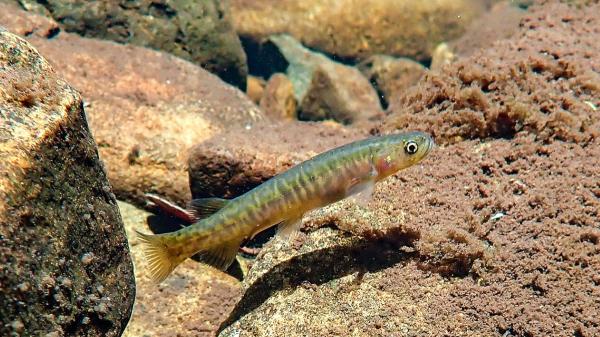
The last refuges of the fish are where the trout cannot reach
The current distribution of the Swan galaxies reveals the extent to which both species are difficult to make compatible. Their natural populations essentially survive in trout-free headwater stretches, often protected by waterfalls and other barriers that prevent introduced fish from continuing up river courses.
Precisely these barriers have become a conservation tool. The Australian program combines monitoring of existing populations with translocations of specimens to safe streams, creation or improvement of obstacles to the advance of trout and search for new suitable places.
In 2023, for example, Swan galaxies were released into two selected waterways after initially analyzing about 1,200 possible sites, according to the report from the Inland Fisheries Service of Tasmania. These populations function as a kind of insurance: if a natural nucleus disappears, there are other separate groups capable of contributing to the survival of the species.
Science is also helping to locate these sanctuaries. A study published in Marine and Freshwater Research used digital models obtained through LiDAR technology to identify possible natural barriers against trout. The researchers verified that galaxids appeared only where they were absent and located three new populations of native fish.
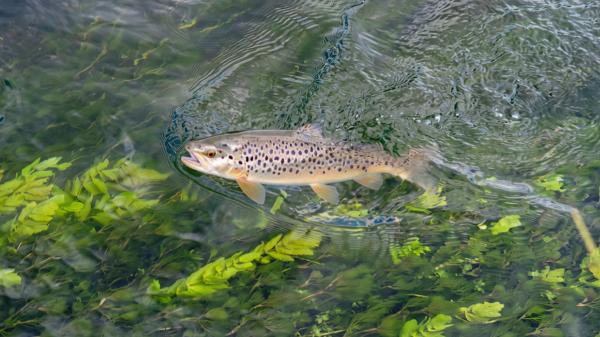
Trout arrived from England 162 years ago to create a fishery
The case shows that the consequences of introducing a species can last for generations. Brown trout did not arrive in Tasmania accidentally: they were deliberately moved to create a recreational fishery. The experiment worked from that point of view. Today the authorities themselves promote trout fishing as one of the great attractions of the island’s inland waters.
However, the success of one introduced species can become the problem of another. The official file of the Swan galaxies explains that its distribution area was reduced by predation by common trout and European perch, although habitat loss may also have intervened.
Added to these pressures are droughts, high temperatures, extreme flooding and isolation between populations, factors that are especially worrying for a species with so few specimens and a fragmented distribution.
The common trout is native to Spain, but not to Tasmania
In Spain, the situation for common trout is completely different. Salmo trutta It has native populations in the Iberian Peninsula, whose genetic diversity has been studied for decades. A work published in Hereditary He even identified different Spanish historical lineages. Therefore, it is not the species itself that is the problem, but rather its introduction outside its natural area and, in other contexts, repopulation with specimens from different origins.
Tasmania thus offers a particularly clear example of a basic rule of conservation: a valuable species in its original ecosystem can cause profound alterations in another when humans move it. And correcting these consequences may require decades, barriers, translocations and small refuges where native species once again have their own space.
If you want to read more articles similar to In 1864 Tasmania introduced the common trout for sport fishing: 162 years later it created trout-free refuges to save a native fish of which 6,000 specimens remain, we recommend that you enter our Ecosystems category.
