
Every summer, when heat waves raise thermometers above 40ºC in much of Spain, all kinds of tricks resurface to try to keep the house cool without increasing electricity consumption. One of the most talked about in recent weeks proposes placing a towel or a damp cotton sheet in front of a window to refresh the air that enters the home. Although the idea may seem novel, it is actually part of a much older tradition linked to North African architecture.
Far from being a miracle remedy, this method has a physical basis known as evaporative cooling, a phenomenon that was used for centuries in Morocco to make homes more comfortable before the arrival of air conditioning. Today, architects and engineers are once again focusing on these traditional solutions to design more sustainable buildings and better prepared for climate change.
The growing interest in these strategies also responds to an energy issue. According to the Institute for Energy Diversification and Saving (IDAE), air conditioning is one of the main electrical consumptions of Spanish homes, especially during the summer, when heat waves trigger the use of air conditioning.
Architects and researchers are turning their gaze towards passive solutions capable of reducing indoor temperature with hardly any energy consumption, recovering principles that traditional Mediterranean and North African architecture has been applying for centuries.
Why placing a damp cloth next to the window can help cool the house
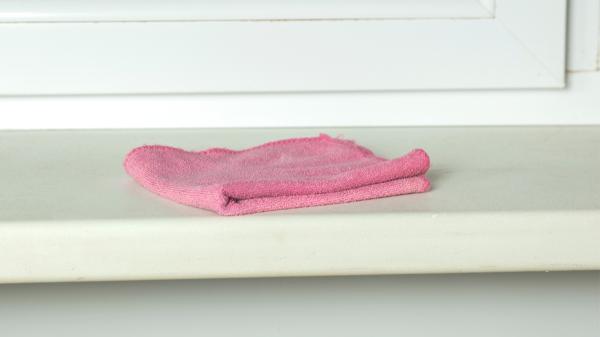
The technique consists of moistening a cotton cloth and placing it near a draft, usually next to an open window. When the water begins to evaporate, it absorbs some of the heat from the environment, so the air passing through the fabric can enter the home slightly cooler.
This process, known as evaporative cooling, is widely studied in climate engineering and has been used for decades in low-consumption air conditioning systems. Its effectiveness, however, depends on several factors. It works especially well in dry environments, where evaporation is rapid, while it loses much of its capacity when the relative humidity is high.
This resource can provide a slight sensation of freshness in certain circumstances, but it never replaces an air conditioning unit. It is also advisable to use it during the early morning hours or at night, when the outside air is cooler and favors thermal exchange.
In reality, the value of this trick lies in the fact that it summarizes in a very simplified way a principle that traditional Moroccan architecture has been applying for centuries through much more complex and effective solutions.
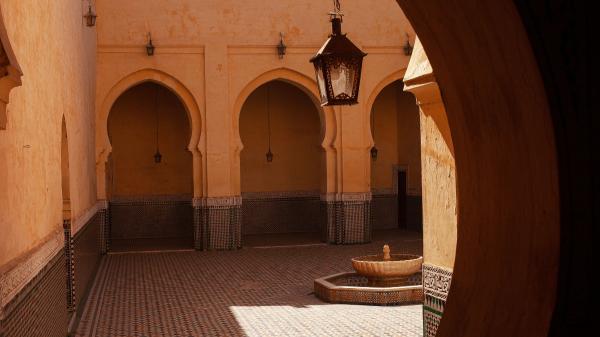
Traditional Moroccan architecture that once again inspires solutions against extreme heat
Traditional Moroccan homes, known as riads, were designed to maintain a comfortable temperature even during the hottest months of the year. Instead of opening large windows to the outside, they organize the entire home around a central patio with vegetation and, often, a fountain or a small pond.
Architect Mavi Vera, specialized in bioclimatic architecture, explains that these buildings “turn their backs on the street and pour all life into an interior patio.” According to him, this arrangement prevents extremely hot air from outside from penetrating directly into the home and allows for the generation of a much more comfortable microclimate thanks to the combination of shade, water and vegetation.
Vera also remembers that these patios are not a decorative element, but an authentic climate strategy developed over generations. The plants provide humidity to the environment through evapotranspiration, while the fountains promote evaporative cooling and the high walls protect the interior spaces from direct solar radiation. The result is a temperature several degrees lower than that recorded on the streets during the central hours of the day.
Added to this are other characteristic elements of traditional Moroccan architecture, such as the thick adobe or stone walls, capable of storing the coolness at night and delaying the entry of heat, the narrow streets that remain in shadow for much of the day and the small exterior windows, which reduce thermal gain.
These solutions, developed long before the advent of electricity, demonstrate that climate adaptation can be achieved through the building’s own design. It is no coincidence that many of them are once again awakening the interest of architects and researchers in a context marked by rising temperatures and the need to reduce energy consumption.
The Andalusian patios that already fought the heat centuries before air conditioning
Although we usually associate this type of architecture with Moroccan medinas, many of its strategies are also part of Spanish heritage. For centuries, Andalusian architecture adapted similar solutions to combat the heat in cities such as Córdoba, Seville or Granada, where summers could be as extreme as in much of North Africa.
The interior patios, porticoed galleries, whitewashed walls, narrow streets and fountains were not only ornamental elements. They all responded to the same logic: reducing direct solar radiation, promoting natural air circulation and creating small microclimates capable of lowering the temperature by several degrees compared to the outside.
One of the best examples is the Alhambra in Granada, whose patios, pools and gardens were designed to enhance water evaporation and generate cooler spaces even during the hottest months of the year. Likewise, the famous patios of Córdoba, recognized as Intangible Cultural Heritage by UNESCO, continue to demonstrate how vegetation, shade and water can improve thermal comfort without the need to consume energy.
For Mavi Vera, this type of construction shows that traditional architecture understood the local climate much better than many contemporary buildings. The architect maintains that these solutions “were not born as an aesthetic resource, but as a direct response to environmental conditions,” taking advantage of the natural resources available before modern air conditioning systems existed.
The lesson of the “Moroccan method” that architects and scientists recover today to cool cities
Many of these strategies are being recovered by architects and researchers who seek to reduce the energy consumption of buildings and adapt them to an increasingly warm climate. One of the most ambitious projects developed in Spain is Cartuja Qanat, in Seville. Inspired by the ancient cooling systems of the Islamic world, this experimental space combines shade, water, vegetation, high thermal inertia materials and evaporative cooling to create an urban microclimate capable of relieving extreme heat.
The results published in the scientific journal Building and Environment show that the system managed to significantly reduce the perceived temperature in the public space during episodes of intense heat, maintaining comfort conditions even when the outside thermometer greatly exceeded 40 ºC. The project demonstrates that recovering traditional knowledge can be an effective tool to confront heat waves without depending exclusively on air conditioning.
Also added to this line of research is the Lab Patio 2.12 study, promoted by the University of Malaga, which studies how Mediterranean patios and traditional ceramic materials can help cool homes passively. The objective is to combine the knowledge inherited from vernacular architecture with current technologies to design more efficient and resilient buildings in the face of climate change.
The so-called “Moroccan method” is actually a reflection of a way of building that for centuries knew how to coexist with heat using only the resources that nature offered. Rather than literally copying the trick of the wet towel on a window, the real lesson is to understand that the best air conditioning often depends on the design of the home itself.
If you want to read more articles similar to Morocco teaches Spain a lesson: this is how it manages to cool houses without air conditioning for centuries, we recommend that you enter our Energy Savings category.
