
On August 22, 2026, the average daily ocean surface temperature between 60 degrees north and 60 degrees south reached 21,104°C, the highest value recorded since reliable instrumental observations have been available. The figure slightly exceeded the 21.09 ºC on March 1, 2024, according to data collected by the Copernicus Climate Change Service.
The difference seems minimal, but the moment it occurs changes its meaning. The global average ocean temperature usually reaches its maximum around March and drops to its minimum around August, mainly because the largest ocean surface is in the southern hemisphere. Reaching a record at precisely this time on the calendar indicates the extent to which the ocean is accumulating heat.
Copernicus had already warned at the beginning of summer of an exceptional situation. On June 21, 2026, ocean surface temperatures had reached record levels for that time of year. The European organization linked the anomaly to warming caused by human emissions and to the development of a new El Niño episode.
Are we facing the highest sea temperature in the last 125,000 years?
Ryan Katz-Rosene, a professor at the University of Ottawa who specializes in environmental policy, has suggested that we are probably facing the highest ocean surface temperatures of the Holocene — the last approximately 11,700 years — and possibly since the previous interglacial period, about 125,000 years ago.
The comparison requires significant precision. There are no ocean thermometers from that time. Old temperatures are reconstructed using indirect indicators or proxiessuch as marine sediments, microfossils or chemical signals preserved in different materials.
A study published in 2026 in Quaternary Science Reviews compiled sea surface temperature records for the last 1.5 million years. Its authors concluded that the last interglacial, known as MIS 5e or Eemian, stands out as the warmest interglacial of that period in much of the latitudes.
Another research published in Nature Communications on the Eemian estimated that the average annual surface temperature of the oceans during that period was approximately 0.5 ± 0.3 ºC above pre-industrial levels. Therefore, speaking of the greatest ocean heat in 125,000 years is scientifically plausible, although it cannot be established as an exact record comparable to current measurements.
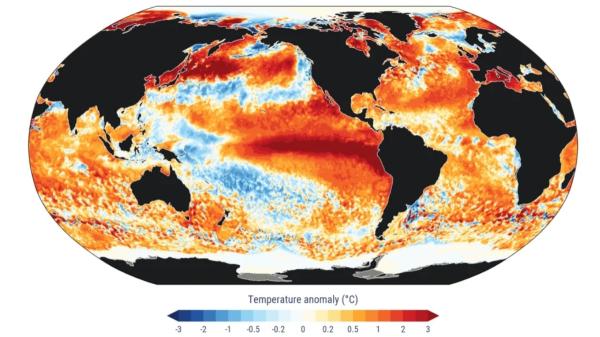
The ocean has been accumulating heat for decades and the 2026 record is only part of the problem
Surface temperature is only part of the problem. To assess global warming, scientists also use ocean heat content, which measures the energy stored at different depths.
The World Meteorological Organization (WMO) points out that the oceans absorb the vast majority of excess energy caused by the Earth’s climate imbalance. In 2025, its heat content again reached an all-time high and the warming rate observed between 2005 and 2025 was more than double that recorded between 1960 and 2005.
Previous records already showed the trend. Research published in Nature Reviews Earth & Environment calculated that by 2024 the ocean had accumulated an additional 452 ± 77 zettajoules of energy since 1960.
What happened between 2023 and 2024 is also revealing. A study published in Nature in 2025 determined that the jump in surface temperature in those years would have been practically impossible without the global warming trend. Under current climatic conditions, such an increase had a probability of approximately once every 512 years.
A warmer ocean can change much more than sea temperature
Marine warming doesn’t just mean warmer water for bathing. It promotes marine heat waves, alters the distribution of fish and other species, causes mortality of sensitive organisms, contributes to coral bleaching and modifies entire food chains.
The changes can also affect the amount of oxygen dissolved in the water, essential for many marine organisms. As temperatures rise, the ocean’s ability to retain oxygen decreases, a process that, combined with other factors, can expand areas where many species find it difficult to survive.
In addition, hot water occupies a greater volume, so thermal expansion contributes to sea level rise. An atmosphere located over exceptionally warm oceans also has a greater amount of water vapor and energy, ingredients capable of intensifying certain episodes of extreme precipitation and fueling tropical cyclones.
There is also another risk: that a warmer ocean will see its ability to act as a carbon sink altered. For decades, the sea has buffered a considerable part of the warming caused by human activities. Current records show that this gigantic climate regulator is also under increasing pressure.
If you want to read more articles similar to The oceans reach their highest temperature on record and scientists warn: “It could be the highest in 125,000 years”, we recommend that you enter our Climate Change category.
