
A group of researchers has managed to produce electricity by immersing special solar panels up to 10 meters deep in the South China Sea: the light filtered from the ocean can power robots, sensors and monitoring stations.
At first glance it would seem like a contradiction: putting a solar cell right where the light from the Sun becomes weaker and weaker as you go down. Yet a group of researchers from Yunnan University, China, has managed to produce electricity with photovoltaic modules immersed up to 10 meters deep in the South China Sea.
However, these are not the common silicon panels installed on the roofs of our homes, but rather cells made with lead halide perovskites, i.e. semiconductor materials whose characteristics can be modified to absorb certain portions of the light spectrum. The result, published in the magazine Joulehowever, does not prefigure endless solar power plants on the seabed: the objective is much more concrete and precise, and concerns the powering of sensors, cameras, communication systems and small robots which today depend on batteries or connections with the surface.
Filtered light
To understand why the system works, we must first consider that water does not “turn off” all the light in the same way. The longer wavelengths, especially on the red and infrared spectrum, are absorbed rapidly, while those between roughly 400 and 600 nanometers – ranging from blue to part of orange – are able to penetrate more deeply. The researchers then designed a perovskite with a band gap of about 1.96 electron volts: simply put, they tuned the material to be particularly suited to transforming the very photons that best survive the journey through water.
In the laboratory, under artificial light that simulated the spectrum present at 10 meters depth, the cells achieved a conversion efficiency of 34.71%. The data does not mean that underwater they produce more electricity than on land: the available light energy is in fact much lower, but a particularly high share of the little remaining light is converted into electricity.
Sea trial
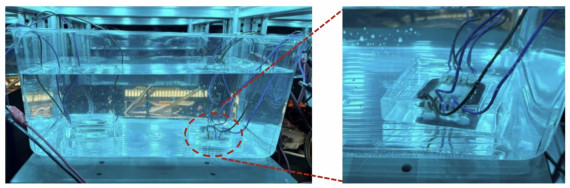
After experiments in the laboratory, the researchers mounted modules with an active surface area of 115 square centimeters on small underwater robots and submerged them near Weizhou Island in the South China Sea. In two hours of exposure to the Sun they collected 1,416 milliwatt hours of energy at a depth of 2 meters, 752 at 6 meters and 324 at 10 meters: modest quantities compared to those required by a household appliance, but sufficient to recharge small lithium ion batteries or to turn on LEDs.
Durability also looks promising, at least on paper. After 1,160 hours of continuous operation under artificial lighting equivalent to that present at 10 meters, the cells did not show significant degradation and from accelerated aging tests the authors estimated a useful life of approximately 5.5 years.
However, this is a prediction obtained in the laboratory, not the demonstration that a panel actually left at sea for five years would maintain the same performance.

Local energy
This is precisely where this technology could become interesting. A sensor that measures temperature and salinity, a camera that observes a fish farm, or an acoustic monitoring station can consume little energy but have to operate for months or years, often in hard-to-reach places. Producing electricity directly on site would allow the batteries to be continuously recharged, reducing the interventions necessary to replace them or the expensive wiring that connects them to the surface.
However, several problems remain to be solved: it will be necessary to understand up to what depth the system could work, ensure that the encapsulation prevents salt water from reaching the delicate materials and evaluate the effect of the biofoulingthat is, the accumulation of algae and other marine microorganisms on surfaces, which could progressively shield the light. But the principle has been demonstrated: at least in the first few meters of the ocean’s depth, the devices of the future could exploit the sunlight needed to power them directly underwater.
